Disclosure: dailypetpicks.com is a participant in the Amazon Services LLC Associates Program, an affiliate advertising program. As an Amazon Associate, we earn from qualifying purchases. Prices and availability can change.
Every dog drying towel on Amazon is sold on the same promise: it soaks up an impressive multiple of its own weight. Eight times. Ten times. Twenty times more water and mud than an ordinary towel. Those numbers are printed on the listing because they sound like specifications, and almost none of them tell you anything you can use.
Here is what actually decides whether drying your dog takes two minutes or fifteen: how much fabric you are holding, how much of the dog it covers, and whether you can keep hold of it while a soaking Labrador tries to leave. This guide works through those three things in order, then names the five dog drying towel picks worth buying, each solving a different part of the problem. Every one of them sits comfortably under thirty dollars.
Your dog does most of the work in about four seconds
Before you buy a dog drying towel, it helps to know what you are actually being asked to do. Researchers at Georgia Tech filmed dozens of animals shaking themselves off and found that furry mammals can shake themselves around seventy percent dry in a fraction of a second. A dog shakes roughly four to six times per second, and the loose skin whipping around the spine is what flings the water clear.
That single fact reframes the whole purchase. The first thing a towel does is not extract water — the dog has already dealt with the bulk of it. The first thing a towel does is contain the shake, which is why a big one that reaches over the back and down both sides beats a small, dense one at that moment. The second thing it does is get the remaining thirty percent out of the places the shake cannot reach, which is a completely different job needing a completely different kind of cloth.
Most people buy one dog drying towel and expect it to do both. That is the actual reason drying feels like a wrestling match.
“Absorbs 8x its weight” is not a specification
Every dog drying towel listing leads with a multiple, and a multiple is a ratio to a number that listing never gives you. A towel that weighs seven ounces and holds eight times its weight holds about fifty-six ounces of water. A towel that weighs three ounces and holds ten times its weight holds thirty. The bigger multiple loses badly, and nothing on either listing would tell you that.
The other number you will see is GSM, and it gets misused constantly in this category. GSM means grams per square metre. It is a measure of how much fabric there is in a given area — density, in other words — not a measure of how much water that fabric takes up. When a listing advertises a “GSM absorption rate,” it is quoting a fabric weight as though it were a performance figure. Worth knowing: the same shammy in our list below is described as 3000 GSM across a dozen retailer pages and as 1500 GSM on the brand’s own current product page. That is not a knock on the towel, which is excellent. It is a knock on the number, which clearly is not being measured by anybody.
So ignore the multiples. Two things on any dog drying towel listing are real and comparable: the dimensions and the shipping weight. Between them, you can work out roughly how much cloth you are getting, and that is the only absorbency figure that survives contact with a wet dog.
What to actually buy a dog drying towel on
Area: enough to reach both sides at once
The useful test is whether the towel drapes over your dog’s back and still reaches down past the ribs on both sides. For a medium dog, that means something around forty inches on the long edge and at least twenty across. Anything smaller becomes a cloth you dab with rather than a towel you wrap in, and dabbing is where the fifteen-minute version of this job comes from.
Mass: a thin, big towel runs out fast
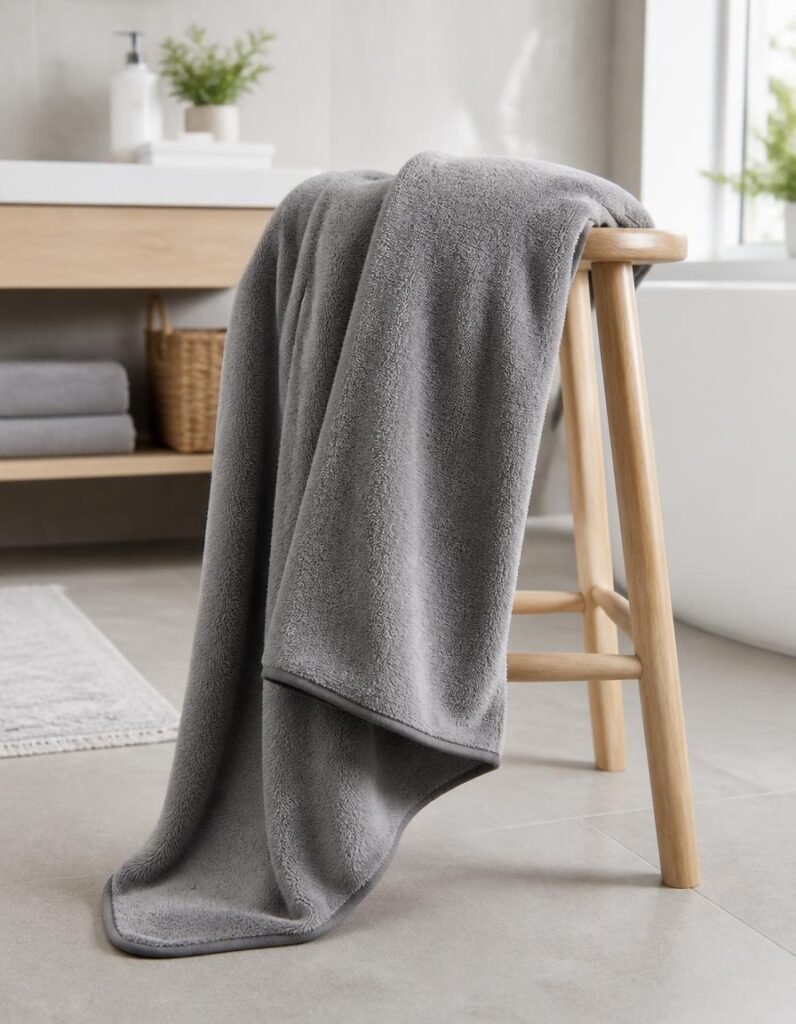
An area without weight gives you a bedsheet. Most inexpensive large pet towels land somewhere around 300 to 400 grams per square metre, which is fine for the first pass over a short-coated dog and completely saturated halfway down a wet Golden. A small, dense shammy can genuinely hold more total water than a large, thin dog drying towel three times its size. This is exactly why a two-towel approach beats hunting for one perfect product.
Grip: the feature nobody lists as a feature
Legs, belly, chest, and armpits need you to squeeze rather than wipe, and a flat rectangle slides out of your hands the moment the dog moves. Towels with elasticated hand pockets at each end fix this properly — you get a grip at both corners and can run the cloth down a leg like a sleeve. If your dog is the type that grabs the towel and runs, pockets also mean there are no loose ends to catch.
Wash behaviour: the spec that determines year two
Microfiber is a synthetic that works by capillary action, and it is easy to ruin in the laundry. Skip to the care section below before you wash anything — it is the single most common reason a good dog drying towel stops working.
The 5 best dog drying towels
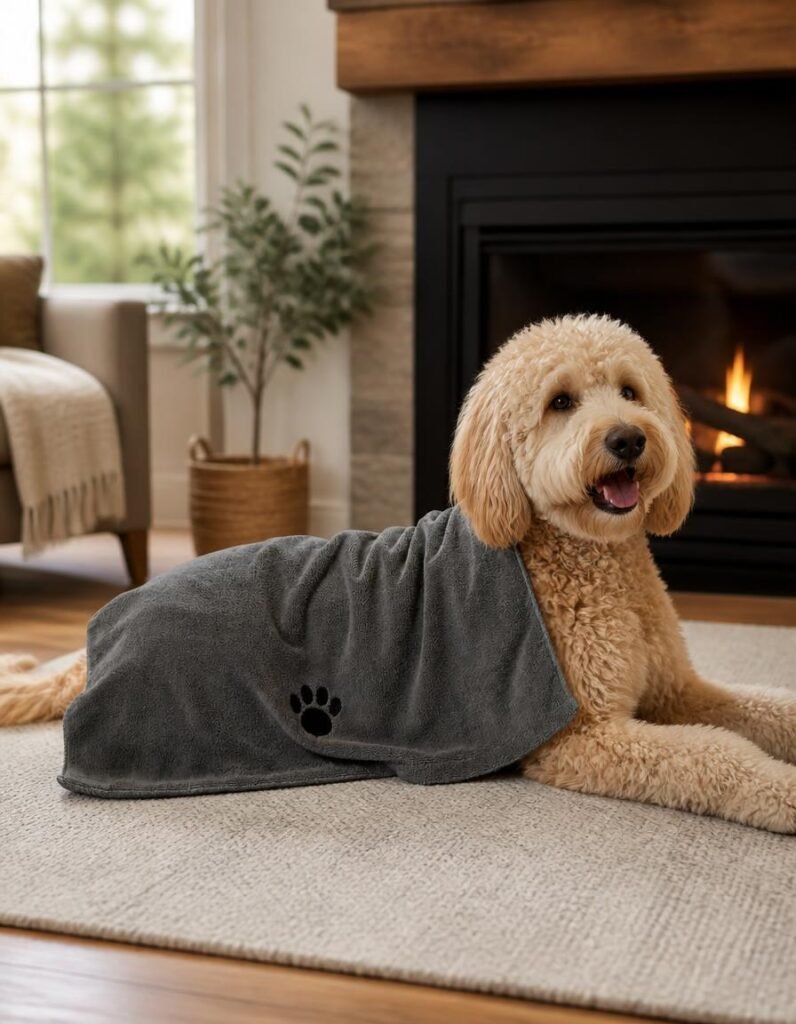
1. Bone Dry Pet Grooming Towel, X-Large 41″ x 23.5″ — best overall
Bone Dry is the DII pet line; it has been on Amazon for around a decade, and this size has accumulated thousands of ratings — which matters more than it sounds, because half this category is here-today brands with three months of history. At forty-one by twenty-three and a half inches, it clears the coverage test for anything up to a large dog, the terry microfiber has real weight to it, and it comes in enough colours that you can keep a dedicated dog drying towel by the bath instead of raiding the linen cupboard.
Two details worth flagging. The listing itself says, in its own care line, not to use fabric softener — a manufacturer telling you their product will stop working if you treat it like a bath towel is unusually honest, and it is the correct advice. And this is a single towel, not a set, so if you have a double-coated dog, read pick two before you decide.
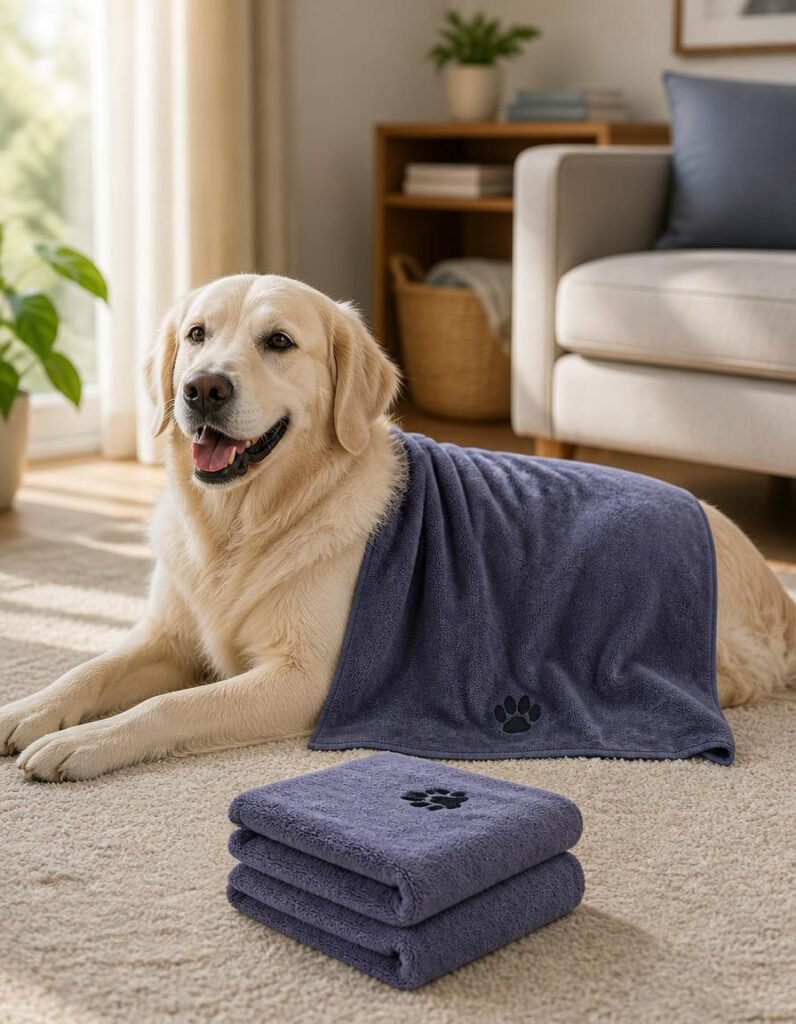
2. WOUSEDO Microfiber Dog Towels, 2-Pack 40″ x 23.6″ — best value, and the honest answer
This one is on the list because of the argument above rather than in spite of it. One dog drying towel does not dry a wet dog of any size — it gets loaded, then you are pushing water around with something already full. Two towels of the same size, used in sequence, beat any single towel at any price, and this pair currently sits inside the top ten of Amazon’s Dog Shower & Bath Supplies bestsellers.
Be clear-eyed about what you are buying: the pack weighs just under fifteen ounces for both towels, so each one is on the lighter side for its footprint. That is precisely why there are two. Use the first for the shake and the initial pass down the back and flanks; swap to the second for the second pass. For short and medium coats, this combination is all most households will ever need, and it costs less than one premium towel.
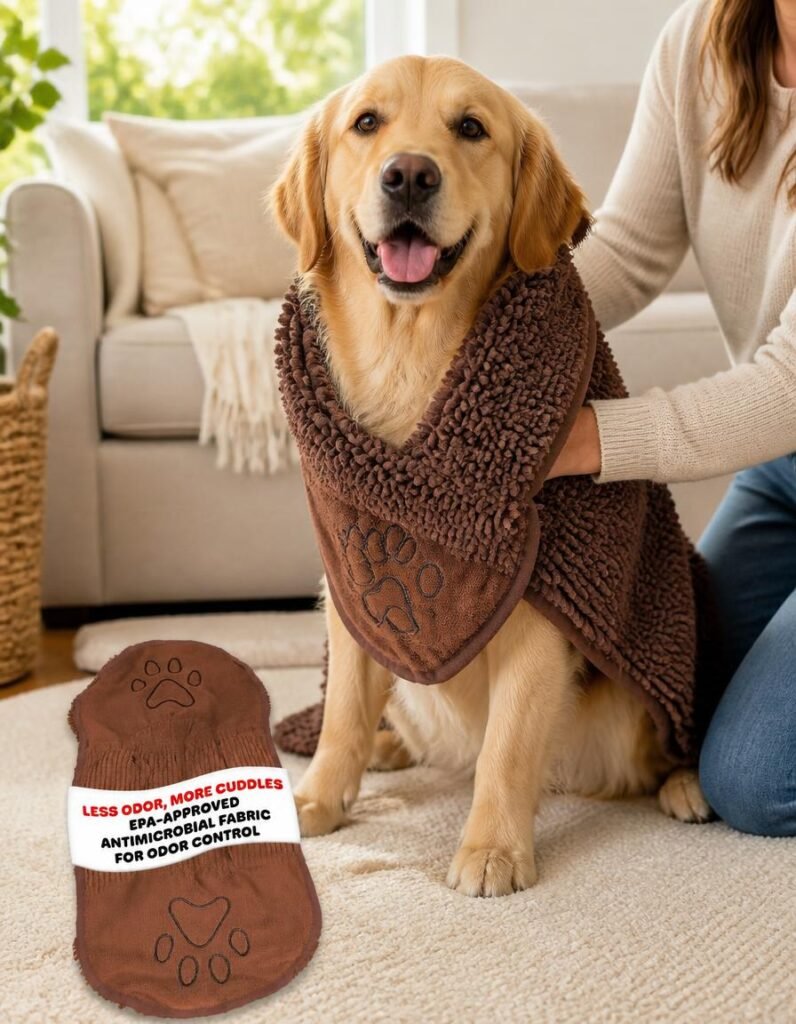
3. Dog Gone Smart The Dirty Dog Shammy, 31″ x 13″ — best for legs, belly, and paws
This is the grip pick. Elasticated pockets at both ends turn a rectangle into something you can actually work with: hands in, cloth pulled taut, and you can run it down a foreleg, under the chest, and around the belly with a squeeze instead of a wipe. Those are the awkward places, and a flat dog drying towel handles them badly. The pile is a plush chenille rather than flat microfiber, so it also gets down between the hairs rather than skating over the top of a thick coat.
It has been in production since 2016 and is stocked well beyond Amazon, which is a good availability signal. It is also the product whose GSM figure we picked apart earlier — buy it for the pockets and the pile, not for the number on the box.
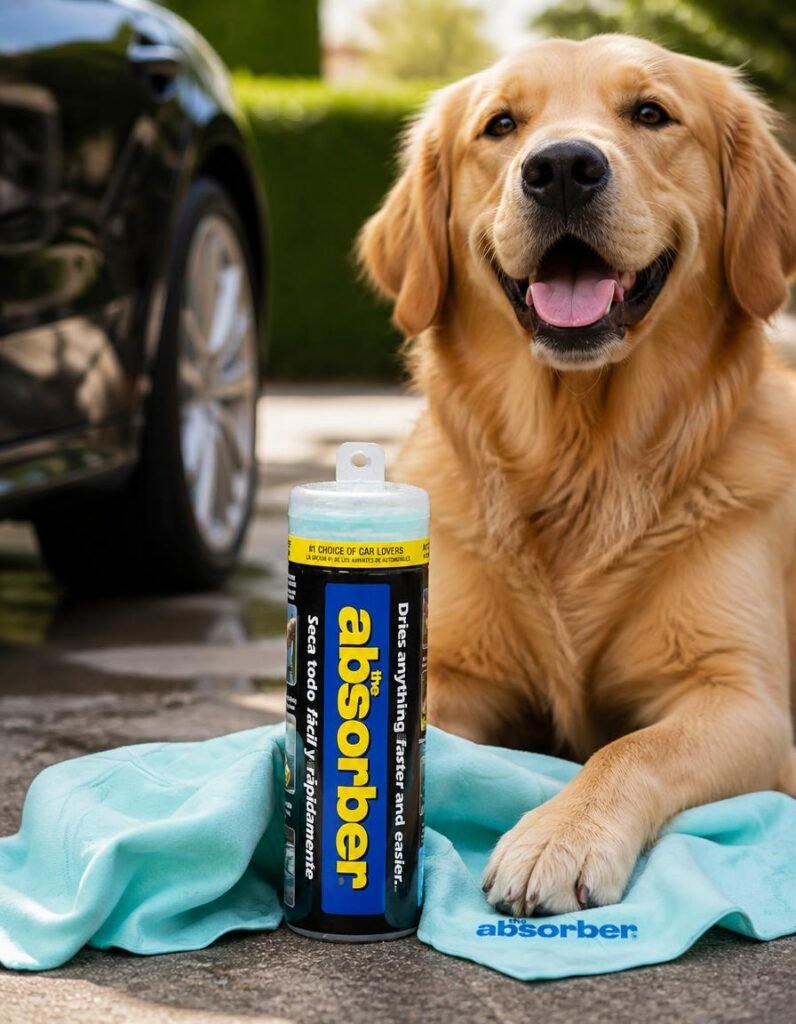
4. CleanTools The Absorber, 27″ x 17″ — best for double coats and big dogs
Fair warning before anything else: this is sold as a car product; it lives in the automotive aisle, and CleanTools’ own listing mentions drying your dog almost as an afterthought. Buy it anyway if you have a Husky, a Newfoundland, a Golden, or anything else with an undercoat.
It is not a towel in the fabric sense. It is PVA, a soft synthetic sponge with a uniform pore structure, and the point is that it does not fill up permanently — when it is saturated, you wring it out over the bath and carry on with what is effectively a fresh cloth. On a big double-coated dog, where a conventional dog drying towel is used for one flank, that changes the job completely. It stores damp in its own tube, resists mildew, and CleanTools has been making the same material in Japan since 1980, so the ASINs are not going anywhere.
The trade-off is that it is smaller than the towels above and has no pockets, so it is a second-stage tool rather than a first-pass one. Pair it with one or two.
5. Bone Dry Pet Grooming Towel Set, 3 x 15″ x 30″ — best for paws, ears, and the back door
Three small towels from the same line as pick one, and the cheapest thing on this page. These are not your main dog-drying towels. These are the ones that live where the wet actually happens on an ordinary week: one hanging by the back door for muddy paws after rain, one in the boot of the car, one in the wash. Fifteen by thirty is the right size for a leg or a face and small enough that you will actually pick it up rather than fetching the big towel.
Having three also solves the rotation problem. A damp towel left balled up develops a smell within a day, and the “wet dog” complaint people blame on the dog is very often the towel.
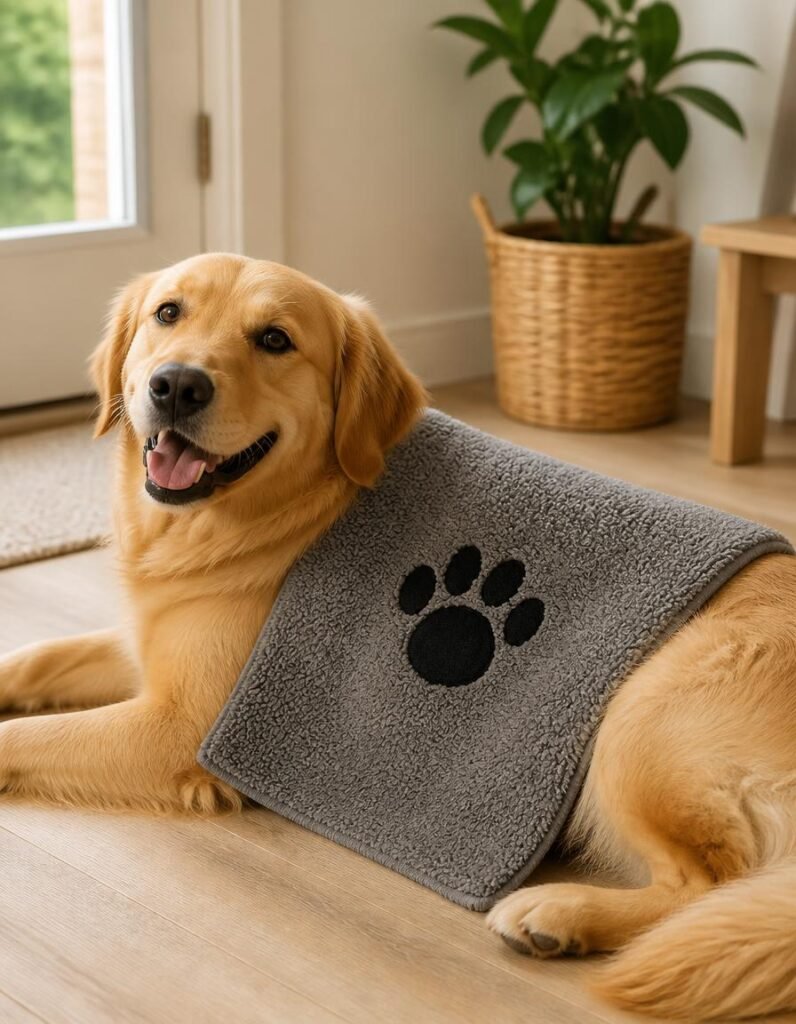
The places that stay wet — and why it matters
The thirty percent that the shake leaves behind is not spread evenly. It sits in the undercoat along the back and hips, in the armpits and groin, at the base of the tail, inside the ear flaps, and between the toes. Those are the same places dogs develop problems, and that is not a coincidence.
Cornell’s Riney Canine Health Center notes that a dog with a thick coat that does not dry fully after swimming or a warm summer rain is prone to developing hot spots, and that matted areas hold moisture against the skin. Hot spots — acute moist dermatitis — can go from a coin-sized patch to something the size of your hand in a matter of hours once the dog starts licking. Dogs with drop ears are flagged as particularly at risk because a damp ear is its own problem.
So the last two minutes with a dog drying towel are worth more than the first two. Work the ear flaps between the finger and thumb through the cloth, dry the outer ear opening only, and never push anything into the canal — our guide to cleaning your dog’s ears safely covers where the line is. Then do the armpits, the groin, the tail base, and each foot, spreading the toes gently. If your dog is double-coated and still feels cool and damp at the skin twenty minutes later, it is not dry yet, whatever the surface feels like.
How to dry a dog without wrecking the coat
Let the shake happen. Stand back, let it go, and you have removed most of the water for free. Fighting it just means you get the water instead.
Blot and squeeze; do not scrub. Vigorous rubbing on a long or curly coat drives loose hair into knots, and a fresh mat holds water against the skin — which is the exact condition you are trying to avoid. Press the dog drying towel in, hold it a second, lift, move on. Our roundup of common dog grooming mistakes covers the rubbing habit in more detail.
Work top to bottom. Back and sides first, then chest and belly, then legs, then feet, then head and ears last — most dogs tolerate having their head handled least well, so leave it until they have already settled.
Be careful with human hair dryers. A household dryer runs hotter than a dog’s skin can comfortably take and blows straight onto a small area. If you use one, keep it on the coolest setting, keep it moving, and keep it well back. A towel and time are safer for most coats.
Bathing less often also means drying less often, and most dogs are washed more than they need to be — see how often you should actually bathe a dog if this is a weekly event in your house.
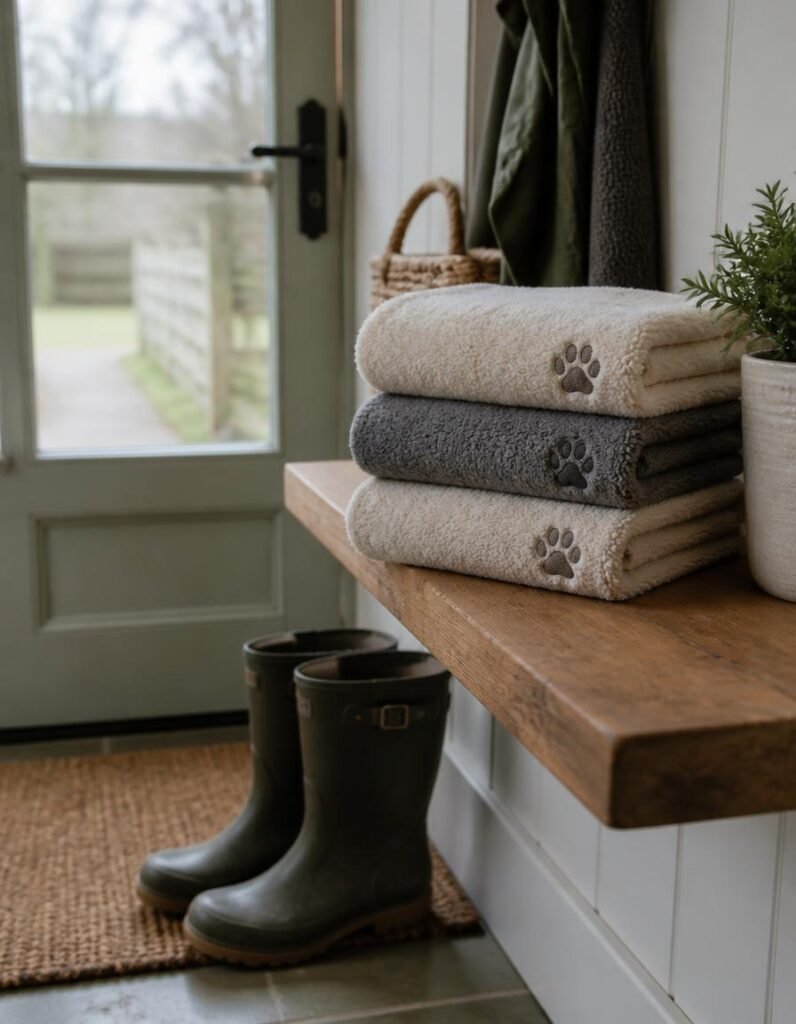
The laundry mistake that kills a dog: drying a towel
Fabric softener. That is the whole answer, and it explains most of the “it worked great for a month” reviews in this category.
Softener works by depositing a thin lubricating film on every fibre, which is what makes fabric feel silky. On anything whose job is absorbing water, that coating repels water instead, and dryer sheets do the same thing by transferring softener under heat. On microfiber, it is worse than on cotton, because the whole mechanism depends on millions of fine open fibres pulling water in by capillary action — coat them and there is nothing left to pull with. Bone Dry says so on its own product listing, which is why it appears twice on this page.
Wash a dog drying towel separately from lint-shedding cotton, in warm rather than hot water, with plain detergent and no softener. Skip the dryer sheets. Tumble on low or air dry — high heat can damage synthetic fibres. If a towel has already gone slick and started pushing water around instead of taking it up, a wash with white vinegar in the rinse and no detergent will strip a lot of the residue back out. It will not restore a towel that has been softened for two years, but it is worth one cycle before you replace it.
What to skip
Bulk packs of thirty thin towels. They look like extraordinary value per towel, and they are, in the sense that each one holds almost nothing. Fine as rags. Not a dog drying towel.
Drying robes, unless you know your dog’s measurements. They genuinely help double-coated dogs because sustained contact over twenty minutes beats a two-minute towel. But they are sized garments; sizing charts across brands do not agree, and returns are the most likely outcome. They also do nothing for legs, paws and ears, which is where the problems start. Buy one as an addition once you have the towels sorted, not instead of them.
Your old bath towels are the only plan. Cotton terry is not useless; it is just heavy when wet, slow to dry between uses, and it sheds lint into a damp coat. Keep one in rotation by all means.
Related reading: dog wipes that are safe to lick.
Frequently asked questions
How big should a dog drying towel be?
Big enough to lie over your dog’s back and hang past the ribs on both sides. For small dogs, that is roughly fifteen by thirty inches; for medium and large dogs, forty by twenty-four or larger. Sizing by your dog’s weight is the wrong approach — sizing by the span across the back is the right one.
Is microfiber actually better than cotton for drying a dog?
For this job, yes, mainly for two practical reasons rather than raw capacity: microfiber stays much lighter when loaded, so it is easier to handle around a moving dog, and it dries between uses in a fraction of the time, which keeps the smell down. Cotton terry of the same weight is not far behind in water retention. It is behind on everything else.
How often should I wash it?
After every bath, and every few uses for a door towel. Damp fabric plus dirt is how the wet-dog smell establishes itself, and a towel that smells will put that smell straight back onto a clean dog. Hang it to dry fully between washes rather than leaving it folded.
Do I really need a dedicated dog drying towel at all?
Need, no. You can dry a dog with anything absorbent. What a purpose-made one buys you is coverage in one piece, weight you can still hold when it is soaked, and in some cases pockets — plus you stop putting muddy paw water through the same wash as your bath towels. For a short-coated dog bathed a few times a year, two old towels are genuinely fine.
My dog hates being towelled. Any way around it?
Usually, it is the restraint rather than the towel. Let the shake happen first so there is less to do, work with the coat rather than against it, keep the head until last, and pay for cooperation with something good. If your dog is new to all of this, the handling groundwork in our new puppy checklist is worth doing before bath night rather than during it.
The bottom line
Stop shopping for absorbency multiples. Your dog removes most of the water himself in about four seconds; your job is to contain that and then get the last of it out of the ears, armpits, groin, and feet before damp skin turns into a problem. That takes coverage first and density second, and it is far easier with two cloths than one.
If you want a single answer, the Bone Dry X-Large is the best all-round dog drying towel here, and adding the Dirty Dog Shammy for legs and paws covers almost every household. Double-coated dog, or a big one? Make it the Absorber instead of the shammy and wring as you go. Then keep the fabric softener away from all of them, and whichever one you bought will still be working next year.