
DailyPetPicks is reader-supported. When you buy through links on our site, we may earn an affiliate commission at no extra cost to you.
You can smell it. You cannot find it. So you crawl the carpet on your hands and knees, sniffing like a bloodhound, and end up treating a patch you are only half sure about — which is exactly how a spot survives three cleanings and keeps drawing your dog back to it.
A dog urine detector is supposed to end that. Shine a black light, watch the invisible turn into a glowing map, clean what you can see. The American Kennel Club backs the method plainly: “Most use LED UV light to detect urine stains on different surfaces, allowing you to clean more efficiently,” it says in its guide to dog urine stains.
The method works. Most of the lights sold for it do not — and the reason is a number printed on the box that almost nobody reads. This guide explains that number, then gives you five picks that respect it.
The number on the box is the entire purchase
Urine glows because compounds in it absorb ultraviolet light and re-emit it as visible light. That handoff only happens efficiently at particular wavelengths, and those wavelengths have been measured. A 2023 fluorescence-spectroscopy study in Scientific Reports found that urine’s major excitation peak sits at roughly 335–350 nm, with the light it gives back coming out between about 420 and 445 nm.
Now hold that against what the shops actually sell. Run down Amazon’s best-selling pet urine detectors and the top ten are almost entirely 395 nm — a few are 400 nm — with a single 365 nm model breaking into the group. A 395 nm LED sits 45 to 60 nm past the wavelength urine actually responds to, so it excites the stain weakly. Worse, 395 nm is barely ultraviolet at all: it sits at the edge of human vision as deep violet, so the lamp floods the room with visible purple light that lands right underneath the faint 420–445 nm glow you are trying to see.
That is the difference people describe as “it kind of worked.” A 365 nm lamp sits close to urine’s excitation peak and emits almost nothing your eye can see, so a dried stain reads as a distinct dull yellow-green blotch on a dark floor. A 395 nm lamp gives you a purple-washed room in which several things look vaguely brighter than the rest. Same gesture, same darkness, completely different amount of information.

The sellers know. One of them says so in writing
You do not have to take my word for any of this, because the brands themselves put it in their own listings.
Vansky sells the single best-selling pet urine detector on Amazon — a 51-LED 395 nm torch. Vansky also sells a 365 nm model, and the sales copy for that one states that ordinary 395 nm flashlights “flood your view with purple visible light, masking weak fluorescence” and making stains hard to distinguish from the surface around them. That is a company explaining, on its own product page, why its own bestselling dog urine detector is the wrong tool for this job.
DARKBEAM fills in the other half of the puzzle — why the wrong one outsells the right one. Its listing warns buyers outright that “the 365nm light doesn’t look as bright as 395nm light,” because true 365 nm output is invisible to the eye. Think about what that does on a shop page. Two torches, one looks dramatically brighter in every photo and video, and the brighter-looking one is the one that fails on carpet. The feature that makes a dog urine detector work is the feature that makes it look worse than its rivals.
Treat the rest of their numbers with more caution. Vansky’s page claims “10x clearer contrast” and that 395 nm lights miss “up to 40%” of small stains, with no method published for either figure. The mechanism is well supported; the percentages are marketing. Buy on the wavelength, not on the multiplier.
Everything else in your house glows too
Here is the part the listings never mention. Urine is not the only thing in a living room that fluoresces. Optical brighteners — the additives that make laundry look “whiter than white” — glow hard. So does the residue of whatever carpet cleaner was used last time, along with lint, dust, dander, some paints, some adhesives, and a surprising amount of ordinary fabric.
Forensic labs hit this problem decades ago, and their solution is instructive because it is the opposite of what the pet aisle sells. Rather than reaching for more ultraviolet, they move up the spectrum and filter what reaches the eye: to rule out the glow of detergents, HORIBA’s guidance on detecting body fluids with an alternate light source is to use a source “tuned above 440 nm” and view it through a coloured filter — violet at 415 nm through a yellow filter, blue at 450 nm through orange, and so on.
No ten-dollar dog urine detector is a tunable forensic light source, and it does not need to be. But the principle carries: the cheap consumer version of “filter the light” is a lens over the LED, and the cheap version of “filter the view” is a pair of amber glasses. Do both if you can. Either way, you have to learn the two signatures by eye, because your dog urine detector will not sort them for you:
- Urine: dull yellow-green to pale amber, irregular shape, usually with a brighter ring at the edge where it wicked outward and dried. It looks stained, not clean.
- Brighteners and lint: bright blue-white, and either evenly spread (a washed rug, a shirt) or in flecks and fibres. It looks too tidy to be an accident.
Every listing has this backwards: old spots show up best
Read the marketing and you would think these lights are an accident alarm — catch it fresh, catch it fast. The measurements say the opposite. In that same Scientific Reports work, urine’s fluorescent intensity increased over time, and the peak shifted about 15 nm over the first fourteen days before settling.
Think about what that means in practice. The puddle you watched happen five minutes ago is the one you did not need help finding. The spot from three weeks ago, behind the armchair leg, under the edge of the rug — the one that has been quietly telling your dog this is a bathroom — is the one that lights up brightest. A dog urine detector is not a smoke alarm. It is a survey tool for damage already done.
That reframing changes how you use it. You do not keep it by the door for emergencies. You run one proper sweep of the house, mark everything, and then clean the whole map in one session with a proper enzyme cleaner. The AKC makes the reason this matters plain: “Lingering scent can draw your dog back to the same area, reinforcing accidents.” Every spot you miss is an invitation you left out.
How to choose a dog urine detector: five checks
- A stated wavelength, and it should be 365 nm. This is the whole purchase. A listing that says “UV” and never commits to a number is telling you something.
- A filter over the LED. The good ones name it — ZWB2, or “Wood’s lamp” glass — and it is what cuts the visible violet spill so you see a stain instead of a haze. An unfiltered 365 nm light still works; a filtered one works better in a room that is not perfectly dark.
- Beam shape you can live with. A dog urine detector is for surveying rooms, not inspecting coins. A wide flood covers a carpet in minutes; a tight spot beam makes you grid the floor square by square.
- Power you will actually have. Rechargeable is tidy but useless if it is flat at 11 pm; AAA cells are clunky but always available. Pick the failure mode you mind least.
- Ignore the LED count. “51 LEDs!” is the headline number on half the category and it is meaningless — fifty-one LEDs of the wrong wavelength are fifty-one wrong answers. One correct emitter beats a matrix of near-misses.

The 5 best dog urine detector picks
Every dog urine detector below is 365 nm. That is not a coincidence or a bias — it is the article’s argument turned into a shortlist, and it is also a fair description of how thin the field is once you apply the first rule. Prices shown are what they were at the time of writing.
1. DARKBEAM Filtered 365 nm Wood’s Lamp — best overall
Around ten dollars, and it is the highest-ranked 365 nm light in the whole category. That combination is the reason it leads this list: the correct wavelength has stopped being a premium feature, so there is no longer any excuse for buying the wrong one to save money.
It pairs a genuine 365 nm emitter with a toughened black filter that strips out the visible purple, in a USB-C rechargeable body small enough to live in a drawer. What the filter buys you is contrast: a dried stain on a mid-tone carpet stops being “a slightly brighter area” and becomes an outline you can trace with a finger — which matters, because the edge is where you stop scrubbing and start soaking. A dog urine detector that shows you the shape of a spot is doing a different job from one that shows you roughly where it is.
Watch out for: runtime is about an hour, so charge it before a whole-house sweep rather than during one. DARKBEAM also warns in its own instructions not to twist the head — the filter assembly is not a focus ring, and treating it like one can kill the light.

2. Vansky 365 nm UV Flashlight for Pets — best for a whole-house sweep
This is the one to buy if the job is “check every room before the inspection” rather than “confirm this one patch.” It throws a wide beam — Vansky quotes 40 cm across — so you walk the floor instead of gridding it, and it runs on six AAA cells for five hours or so, which means it is also the pick that never lets you down for being uncharged.
It names its filter, too: a ZWB2, the same Wood’s glass used in proper inspection lamps. Combined with the wide beam that makes it the most capable dog urine detector here for covering ground, and at around eighteen dollars it is still nowhere near an inspection-grade price.
Watch out for: six AAAs is a real running cost if you use it often, and it is the longest light here at just under seven inches. And as noted above, treat Vansky’s “10x contrast” and “40% of stains missed” claims as advertising — the wavelength argument stands on its own without them.

3. DARKBEAM 365 nm & 395 nm Two-Pack — best for seeing the difference yourself
Everything above is an argument. This is the experiment. One box, two otherwise identical torches, one variable changed — and it costs about what a single mid-range light costs.
Take both into a dark room and sweep the same patch of carpet twice. The 395 nm torch will look brighter and show you a washed purple field with some vague lighter areas in it. The 365 nm torch will look dimmer and show you outlines. Once you have seen that side by side you will never be talked into a 51-LED bargain again, and you end up with a spare dog urine detector for the garage into the bargain.
Watch out for: you are paying for one torch you will mostly stop using. If you are certain and just want the right tool, pick 1 is the same 365 nm light for less.
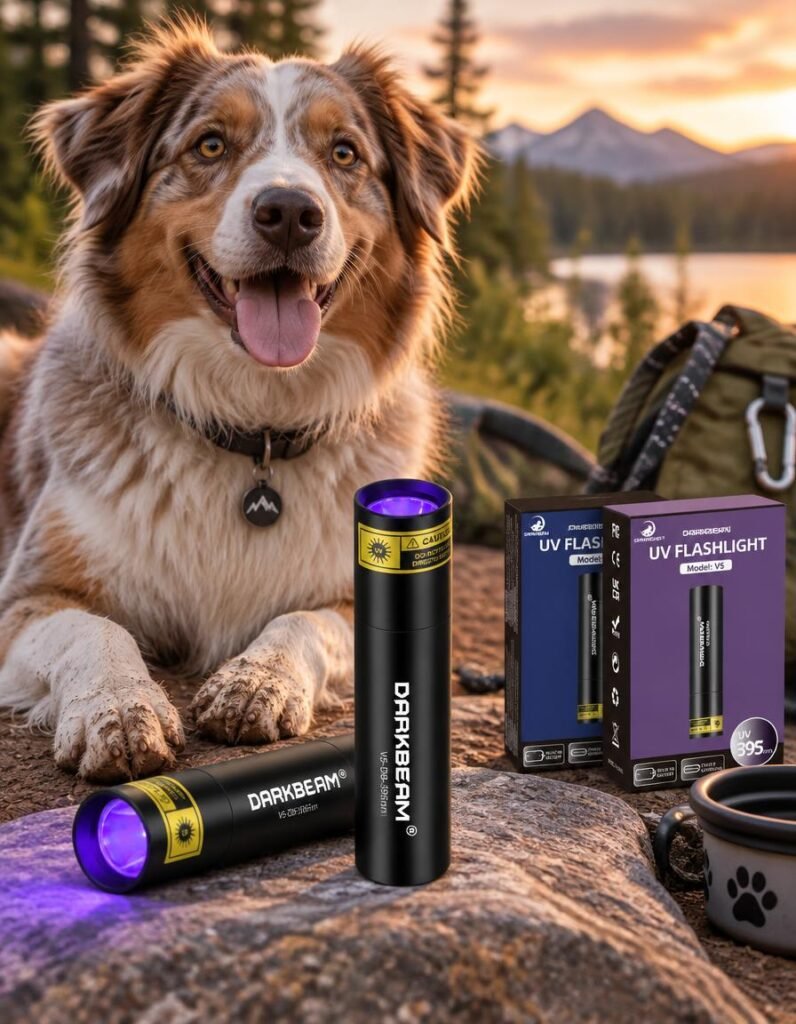
4. Dokhbem 365 nm 3-LED Rechargeable — best for long sessions
Three 365 nm emitters instead of one, rechargeable, with a small display showing charge state. That last detail sounds like a gimmick and is not: a UV light dimming gradually as its cell drains looks exactly like a floor with no stains on it, and a readout is how you tell “clean carpet” from “flat battery.”
It is the pick for someone doing a long, methodical survey — a whole flat, a rental changeover, a mattress you have doubts about — where the light needs to stay honest for an hour and you want to know it is doing so. It is also the sanest dog urine detector to own while you are deep in potty training and scanning the same rooms night after night.
Watch out for: its listing does not claim a filter, unlike picks 1, 2 and 5. Unfiltered 365 nm still works, but you will see more violet spill, so it rewards a properly dark room — or a pair of amber glasses.

5. DARKBEAM 365 nm Filtered Small — best pocket-sized
The same filtered 365 nm formula as pick 1 in a smaller body, for about eleven dollars. This is the one that goes in a bag rather than a drawer — for hotel rooms, holiday lets, a friend’s spare room, or checking a second-hand sofa before it comes through the front door.
Watch out for: small body, small cell, short session. It is a spot-checking dog urine detector, not a whole-house one — if you are surveying floors, pick 2 will do it in a fraction of the time.

Why one brand keeps appearing on this list
Three of the five above are DARKBEAM, and that deserves an explanation rather than a quiet pass.
Apply this guide’s first rule — a stated 365 nm wavelength, at a sensible price — to the best-selling dog urine detector listings and the field collapses almost immediately. The overwhelming majority are 395 nm. Of the handful that are not, one is a professional-grade torch at roughly four times the price of everything here, and the rest are DARKBEAM, plus Vansky’s newer 365 nm model. There is no long tail of 365 nm options to choose from, so a list that honestly applies the rule ends up looking like this one.
That is worth knowing as a buyer in its own right. If you find yourself comparing twenty near-identical lights, check their wavelengths first — you are probably comparing twenty versions of the wrong tool.
How to run the sweep so it actually works
- Wait for real darkness. Not dusk, not curtains drawn at 4 pm. Every listing in this category says “use in complete darkness” in its own bullets, and it is the instruction people skip before deciding their dog urine detector is faulty.
- Let your eyes adjust for two minutes. The glow you are hunting is faint. Walking in from a lit hallway and sweeping immediately misses spots you would see a hundred and twenty seconds later.
- Hold it low and angled, not overhead. Hold the dog urine detector twelve to eighteen inches above the surface and rake it across. A stain seen edge-on is far more obvious than one lit straight down.
- Mark as you go. Sticky notes, painter’s tape, poker chips — anything. The single most common failure is finding six spots, turning the lights on, and confidently relocating four of them.
- Check the vertical surfaces too. Male marking lands on chair legs, door frames, curtain hems and skirting boards, none of which get looked at when you are scanning the floor. If marking is the problem rather than accidents, the behaviour behind it matters more than any product.
- Clean the map, then re-scan when it is dry. Enzymes need volume and dwell time; a second pass with the dog urine detector tells you honestly whether you used enough.
What to skip
- The 51-LED 395 nm bestsellers. They are cheap, they are everywhere, they are the top of the category — and the brand that makes the biggest seller among them argues against the design on its own 365 nm product page. Let that settle it.
- Anything advertised by LED count instead of wavelength. A dog urine detector sold on how many diodes it has is doing marketing work the wavelength cannot.
- Phone-screen “blacklight” apps. A display cannot emit ultraviolet, so there is no such thing as a dog urine detector app. These do nothing at all.
- Treating the light as a cleaning product. It finds; it does not fix. And it cannot tell you how deep the damage goes — as the AKC notes, “urine may have soaked into padding, upholstery, or wood,” which no surface glow will reveal.
- Shining it at your dog, or at anyone’s eyes. 365 nm is real ultraviolet, and DARKBEAM’s own listing tells buyers not to look directly into it. Point it at floors, not faces, and do not let it become a toy.
- Buying the light instead of solving the cause. If accidents are frequent, a detector is a symptom manager — pee pads, a potty bell and a consistent schedule are the fix.
Frequently asked questions
Does a dog urine detector work on dark carpet?
Yes, and often better than on light carpet, because there are fewer competing brighteners and the contrast between a dark background and a pale glow is greater. Very dark fibres absorb some of the emitted light, so work closer to the surface and take your time.
Why can I smell urine but the light shows nothing?
Three usual reasons. The room is not dark enough. The stain has already been cleaned at the surface while the odour source sits in the underlay, out of sight. Or the light is the wrong wavelength — which is the failure this whole guide is about.
Is 365 nm or 395 nm better?
365 nm, clearly, for this job. It sits nearer urine’s measured excitation peak and emits far less visible light, so you see the stain rather than a violet room. 395 nm lamps look brighter to the eye and cost less, which is precisely why they dominate the dog urine detector aisle — and why so many reviews of them say “hard to tell what I’m looking at.”
Will it find cat urine as well?
Yes. The fluorescence comes from compounds common to mammalian urine, so the same tool works across pets, and on rodent urine too. Nothing about the physics is dog-specific.
Can I use it to check a used mattress or a rental before moving in?
That is one of the best uses for a dog urine detector, and the age effect works in your favour — old stains fluoresce more strongly than fresh ones, so the light does its most useful work on a history you were not there for.
Do I need amber goggles?
Not strictly, and none of the five picks above includes a pair, so this is a separate few-dollar purchase if you want it. They help twice over: they cut the violet haze that muddies what you see, and they keep stray ultraviolet out of your eyes during a long sweep. With a filtered light in a properly dark room you will manage without.
The bottom line
Buy on one number. A dog urine detector at 365 nm shows you stains; one at 395 nm shows you a purple room with some bright bits in it, and the gap between them is now a couple of dollars. The DARKBEAM Filtered 365 nm is the pick for most homes, the Vansky 365 nm is the one for covering a whole house, and the DARKBEAM two-pack is for anyone who would rather see the difference than be told about it.
Then remember what the tool is for. Run one thorough sweep after dark, mark everything, and clean the entire map properly — because the spots you never found are the ones still doing the damage. If you are working through accidents with a young dog, the new puppy checklist and our guide to crate training tackle the cause rather than the evidence.