This post contains affiliate links. As an Amazon Associate, we earn from qualifying purchases at no extra cost to you.
Your dog already tells you when they need to go out. They drift to the back door, they stare at you, they scratch the paint off the frame. The signal exists. The problem is that you are in the kitchen with the extractor fan running, or upstairs with a door shut, and the signal is completely silent.
That is the whole case for a dog doorbell, and it is a good one. It is also the reason so many of them disappoint. A bell your dog can ring, but you cannot hear from the next room, has not solved anything — it has just moved the silent signal from the door to the doorknob. So this guide is built around one question, and every pick below is judged against it: can you hear it from wherever you actually spend your time?
If you are still in the early weeks, read this alongside our guide to potty training a puppy — a dog doorbell speeds up communication, but it does not replace a schedule.
One brand sells all three shapes — and argues against the popular one
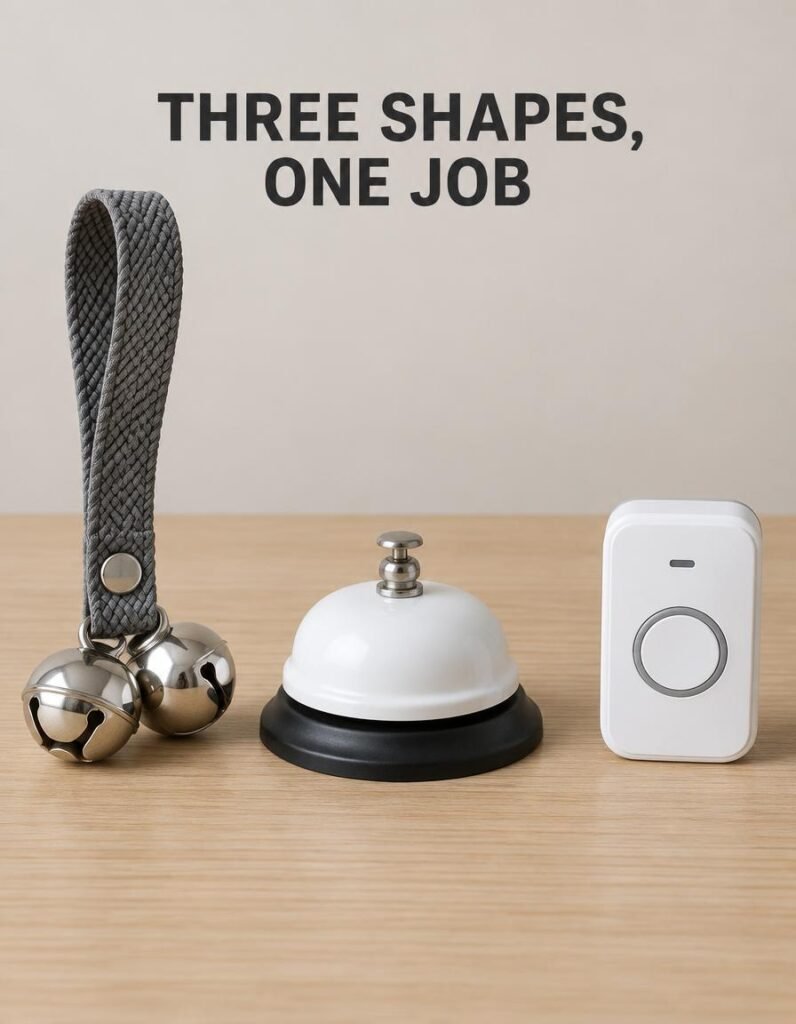
Mighty Paw sells three different kinds of dog doorbells: a hanging ribbon of jingle bells, a wall-mounted metal bell, and a wireless button with a plug-in chime. Because it sells all three, its listings end up arguing with each other, and that argument is more useful than any buying guide.
On the listing for its metal-mounted bell, the brand’s own bullet points make three claims: that fabric-based jingle bells are hard to hear from other rooms, that ribbon bells are awkward to fit to dogs of very different heights, and that ribbon and jingle bells wear over time in a way that lets claws catch. On the listing for its fabric ribbon — the shape that outsells everything — the same brand says the bells are thick-walled and made for sound, that the 24-inch length suits any size of dog, and that the ribbon survives tugging, scratching and biting.
Both pages are sales copy, so neither is neutral. But the three objections on the metal listing happen to be the three real failure modes of the ribbon shape, written by a company that has sold hundreds of thousands of them. That is your buyer’s guide: audibility, fit, and wear. Everything else on a dog doorbell listing — bell count, yarn colour, “premium quality” — is decoration.
The audibility complaint is the one worth taking seriously. A reviewer on Chewy who actually measured a set of ribbon bells found them a little over an inch across, made of steel rather than brass, with a dull rattle instead of a ring. That is the sound competing with your television.
The three shapes and who each one is for
Strip out the brand names, and every dog doorbell on Amazon is one of three things.
- A hanging ribbon of bells. Cheapest, easiest, no installation. Right for open-plan homes and small flats where you are never more than a room away.
- A freestanding floor bell. A metal service-desk bell with a rubber base that the dog taps with a paw or nose. Right for sliding glass doors, doors that swing outward, and dogs too short to reach a doorknob.
- A wireless button with a plug-in receiver. The dog presses a button by the door; a chime sounds wherever you have plugged the receiver in. Right for houses with stairs, for garages and home offices, and for anyone who has already missed a signal and paid for it with a carpet.
Notice that only the third dog doorbell shape actually solves the problem the category exists to solve. That does not make the first two wrong — it makes them right for a smaller house than the marketing implies.
What no dog doorbell can fix
Search any dog forum for bell training, and you will find the same complaint over and over: it worked, and now the dog rings it forty times a day because ringing it makes the door open. This is the failure mode of the category, and it is worth knowing before you buy that no dog doorbell feature prevents it.
The advice is also genuinely contradictory. The American Kennel Club’s bell training guide says that any time your dog rings, you praise them and take them straight outside. Mighty Paw’s own training instructions, published on its retail listings, say the opposite: do not reward a ring that is only a request to be let out. Followed literally, those two rules cannot both apply to the same dog.
The resolution is that they are describing different things. Answer the bell every single time — a signal you sometimes ignore is a signal your dog stops trusting, and the fallback behaviour is an accident on your floor. But make the trip boring. Lead on, straight to the toilet spot, stand still and say nothing. If they go, praise and treat and then play. If nothing happens in five minutes, go back inside calmly. The reward is attached to emptying, not to ringing, and within a week or two, most dogs stop calling you out for entertainment.
The one thing hardware can fix is a related and less obvious problem: signal contamination. A ribbon hung on the doorknob rings every time the door moves, including every time a human walks through it. During the exact fortnight your dog is working out what the sound means, the sound is firing constantly with no trip outside attached. Hanging the strap on a hook or a nail beside the door instead of on the handle removes that entirely and costs nothing.
The 5 best dog doorbell picks
Prices move constantly on Amazon, so check the current figure before you buy. Everything here sits at the affordable end of the category.
1. BLUETREE Dog Doorbells — the default, and the loudest ribbon
If you want the ordinary hanging dog doorbell, buy the one that has been the category’s number one seller for years. BLUETREE’s listing has been live since June 2021 and currently sits at the top of Amazon’s Dog Doorbells category, which, in a market this crowded, is the closest thing to a guarantee that it will still be purchasable next year.
Seven bells at 1.4 inches each are about as much noise as the ribbon shape can physically make, and three snap positions let you shorten the strap so a dachshund and a labrador can both reach comfortably. That adjustment matters more than it sounds — it is one of the three objections Mighty Paw raised, and this design answers it.
Watch out for: it is still a ribbon on a door. Hang it on a hook beside the frame rather than the handle, and check the ribbon monthly for fraying where the bells attach.
2. Caldwell’s Pet Supply Co. Dog Potty Bells — the one that has outlasted everything
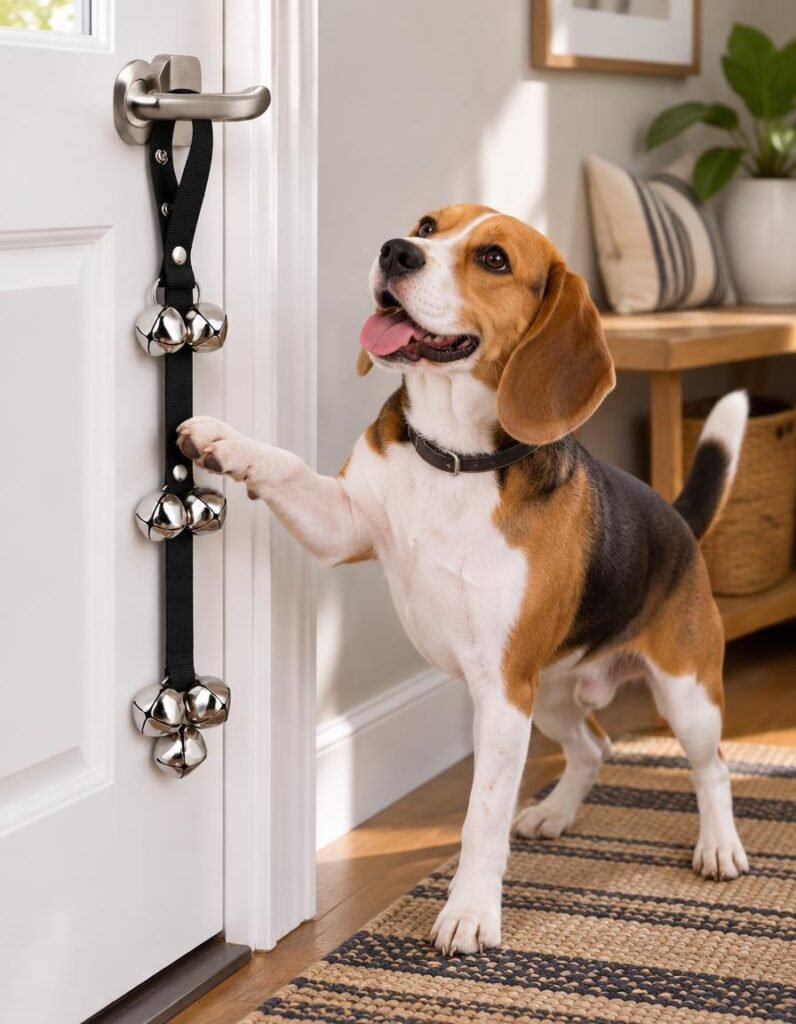
Ribbon bells are a churn category. Brands appear with a name that looks like a keyboard smash, sell for eighteen months, and vanish, which is a nuisance if you ever want to replace the exact thing your dog already understands. Caldwell’s listing has been tracked on Amazon since April 2015 — a decade of continuous availability from a small US supplier.
Mechanically, it is the same shape as pick one, so choose between them on price and looks rather than performance. Buy this one if you want the safer bet on still being able to buy a second set in two years.
Watch out for the same door-movement issue as with any hanging strap and the same monthly fraying check.
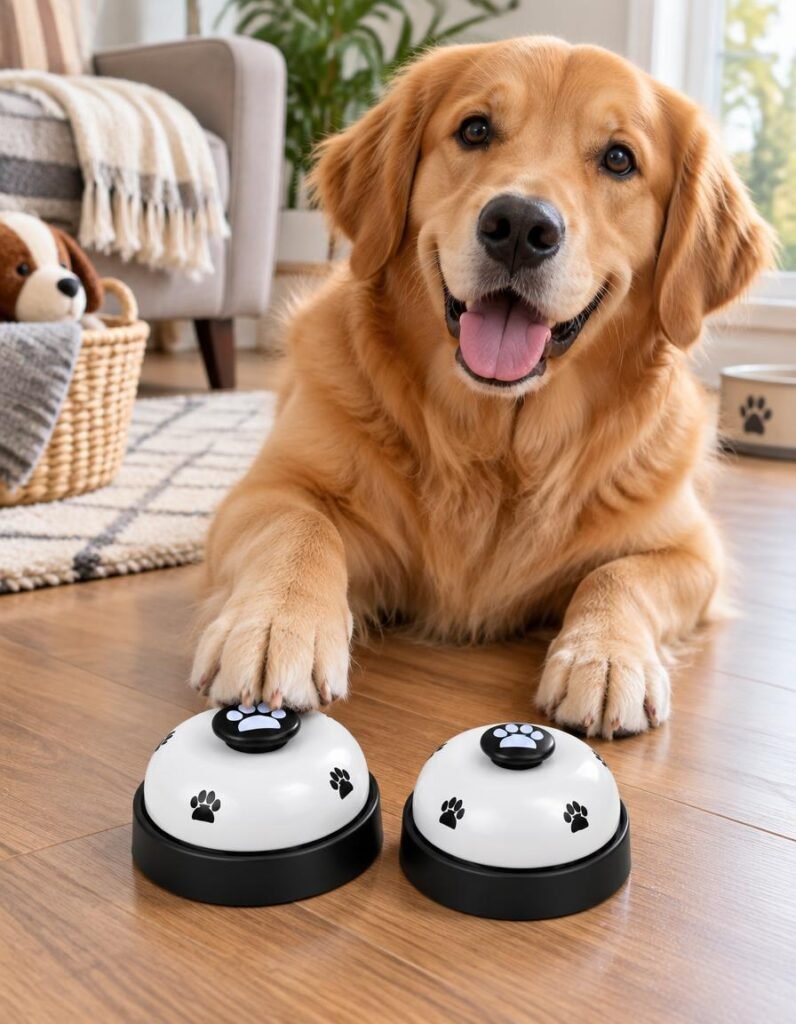
3. Comsmart Dog Training Bells, 2-pack — for doors you cannot hang anything on
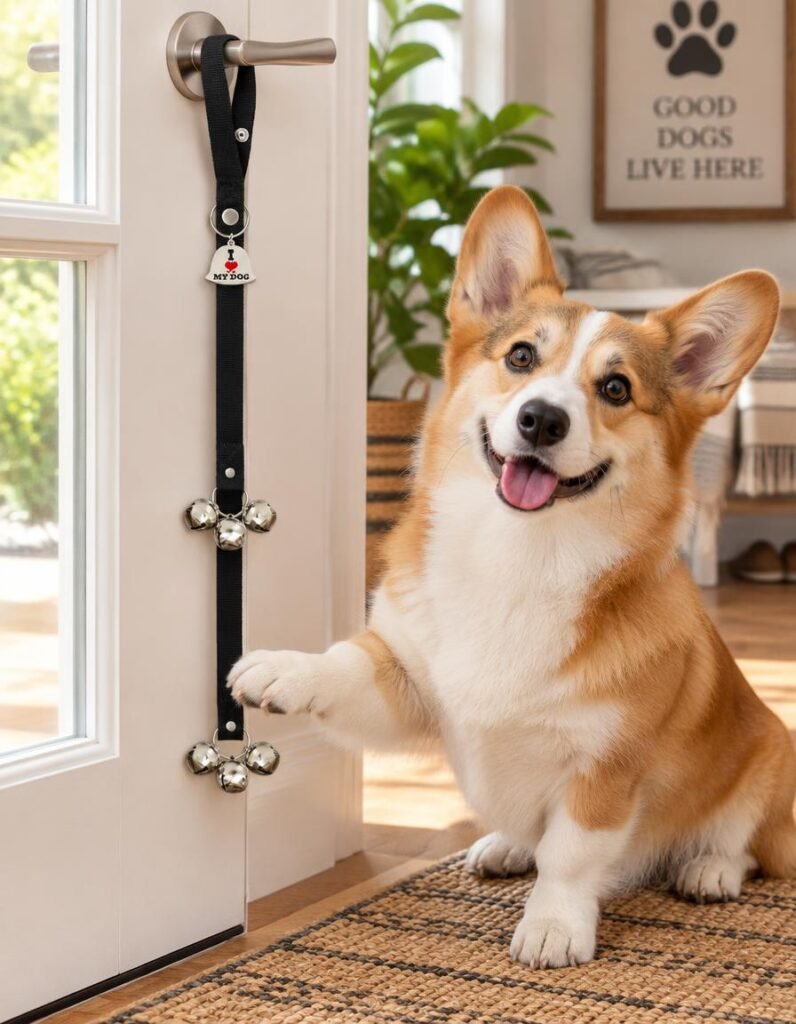
Two freestanding metal bells with non-skid rubber bases, tapped with a paw or a nose. This is the dog doorbell to buy for a sliding patio door, a door that opens outward, a rented flat where you would rather not put a nail in the frame, or a dog whose nose does not reach a doorknob.
Comsmart openly sells the same bells as reception desk bells for hotels and restaurants, which tells you exactly what they sound like: one sharp ding rather than a jingle. That is better at cutting through background noise and worse if your dog taps softly. Two in a pack cover a back door and a front door, or one by the door and one next to the crate while you are crate training.
Watch out for: anything freestanding gets treated as a toy. Expect it to be batted under the sofa at least once, and expect the cat to work it out too.
4. Mighty Paw Smart Bell 2.0, single button — the only one that solves the actual problem
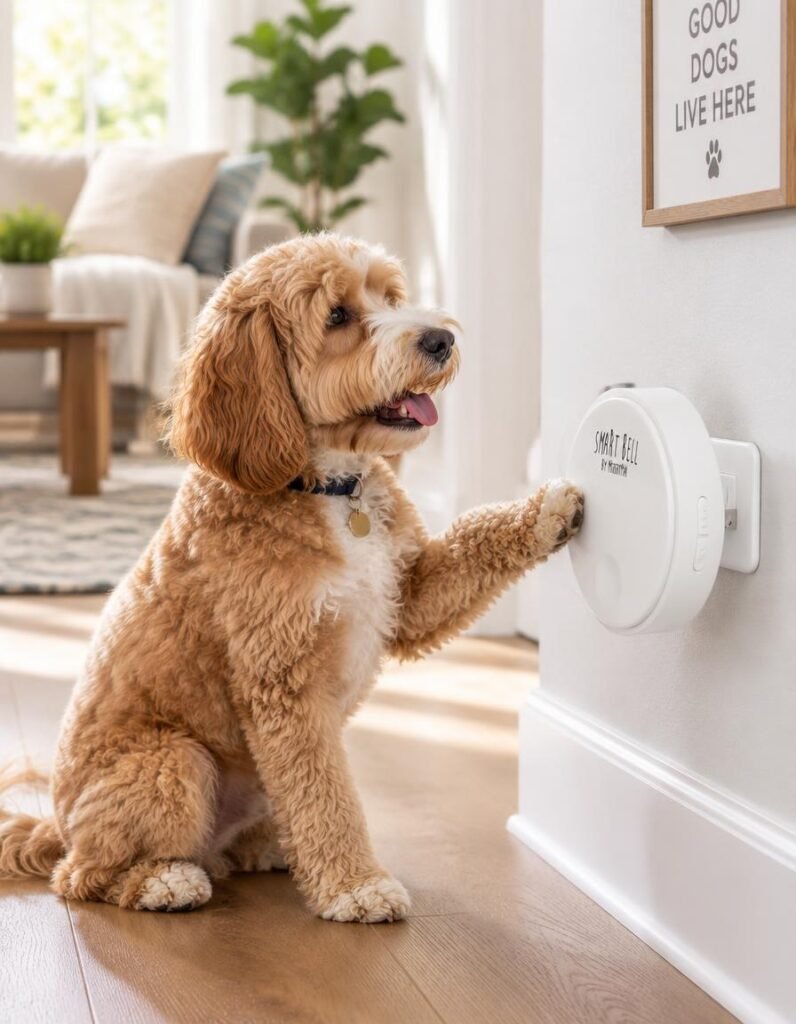
A touch-activated button by the door and a chime unit you plug into any socket, with a quoted range of 1,000 feet. You move the receiver to whichever room you are in. That is the entire point, and it is the only dog doorbell design here that reliably reaches you through a closed door, a floor of a house, or a running dishwasher.
The listing has been live since July 2017 and sits inside the top ten of the category, so this is a long-established product rather than a rebadge. Check the box contents for batteries before you set it up — the Amazon listing lists AA cells as required, and manufacturer descriptions vary between the button and the receiver.
Watch out for: a button is the easiest thing in this guide for a dog to learn and therefore the easiest to spam. Mighty Paw also puts a small-parts choking warning on the listing and asks that it be used under supervision, which is worth respecting with a puppy that chews.
5. Mighty Paw Smart Bell 2.0, two buttons — for two doors, or for asking to come back in
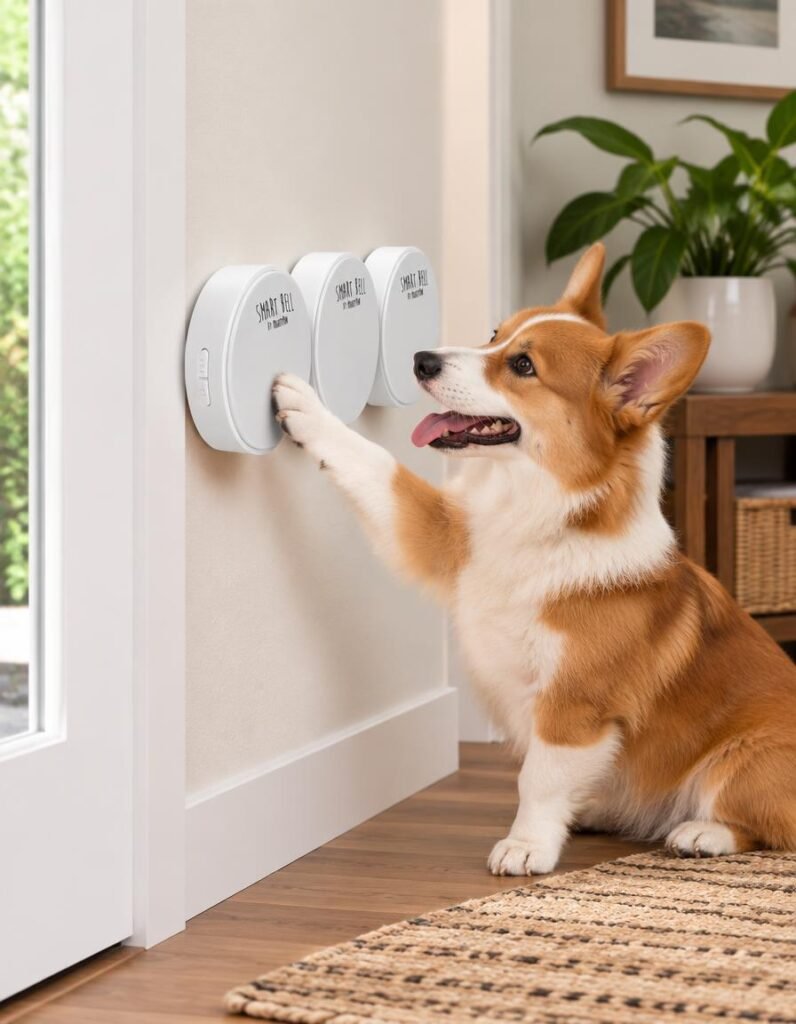
The same system with a second activator on one receiver. Most people buy it for a front and a back door. The better use is to put the second button outside, at dog height, so your dog can ask to come back in instead of scratching a glass door — a problem that turns up constantly in reviews of every other product in this category and that no hanging strap can answer.
If you have two dogs on different schedules, or a dog that spends stretches in a garden, this is the version to get. If you have one door, save the money and pick four.
Watch out for: an outdoor button needs to tolerate weather. Mount it under cover and check the seal.
Why are there only three shapes on this list
Scroll the dog doorbell category, and you will see dozens of brands. Look closely, and most of them are the same braided strap with seven bells, sold under names that read like passwords. There is no hidden gem among them — they come off the same production line, and the variables that actually differ are bell size, strap adjustment, and how long the listing has existed. That is why two of the five picks above are the same product line in different configurations rather than five different brands: pretending otherwise would be padding.
What to skip
- Anything sold on bell count. Seven small bells are not louder than four big ones. Bell diameter and metal decide the sound.
- Handwoven and macramé straps. Lovely, and exactly the material Mighty Paw says frays and catches claws over time. If you buy one, check it often.
- Recordable talking buttons for this job. They are a genuinely interesting project for building a dog’s vocabulary, but potty training needs one unambiguous signal, not a menu. Different tool, different goal.
- Wall-mounted metal bells, if you rent. The mounted designs install with screws and wall anchors only — there is no adhesive option — so budget for two holes and a repair when you move.
On that last point: Mighty Paw’s all-metal Tinkle Bell is the best-argued product in this whole category, and it is not on the list above because a brass bell on a sprung iron arm genuinely is louder than a ribbon and genuinely does mount at whatever height suits your dog. It is worth a look if you own your home and want the loudest passive option.
Where to put it, and how high
Three placement rules cover almost every problem people report with a dog doorbell.
- Set it at your dog’s nose height, not the doorknob’s. A standing adult dog should reach it without stretching, and a sitting one should not trigger it by accident. For a puppy, plan to move it up twice in the first year.
- Beside the door, not on it. A bell attached to a moving door rings for reasons that have nothing to do with your dog, and every one of those false rings makes the signal fuzzier.
- One door only, at first. Pick the door you use for toilet trips and use only that one for a fortnight. Adding a second entrance before the first is solid doubles the training time.
Then ring it yourself. Every single trip, before the door opens. The AKC’s approach is deliberately not to treat-lure the dog into touching the bell, because a dog trained to touch a bell on cue has learned a trick, while a dog that has watched you ring it two hundred times has learned what it means. WebMD’s guide to teaching a dog to ask to go out describes the alternative nose-target method if your dog is not picking it up by observation alone.
Frequently asked questions
How old does a puppy need to be to use a dog doorbell?
You can introduce one on the day they arrive. Trainers generally start at eight weeks, though a young puppy’s bladder is the limiting factor, not their understanding — at that age, you are still going out on a timer regardless. The AKC’s potty training timeline is a useful reality check on how often that needs to be.
My dog rings it just to go out and play. How do I stop that?
Keep answering it, but strip the fun out of the trip. Lead on, straight to the spot, stand quietly, no games. If they use the toilet, reward them and then play as a bonus. If they do not, go back inside within five minutes. You are teaching the difference between the bell and a door-opening button, and ignoring the ring teaches something worse.
Is a dog doorbell of any use for an already house-trained dog?
Often more use. An older dog whose needs are becoming less predictable, a dog left with a sitter who cannot read their subtle cues, or a household where someone is always in another room all benefit from an audible signal. It is a communication tool that happens to be sold as a training aid.
Are hanging bells safe for a puppy that chews everything?
Supervise and inspect the strap regularly — a manufacturer in this category says on its own listing that ribbon and jingle bells wear in a way that lets claws catch. If your puppy treats everything at head height as prey, the floor bell or the wireless button avoids the dangling-ribbon problem completely. Our guide to stopping destructive chewing covers the wider habit.
What if we still get accidents after the bell training works?
Normal, especially in the first months. Clean thoroughly with an enzyme cleaner rather than a household spray, because any residual scent invites a repeat in the same spot, and keep pee pads down overnight if your schedule cannot match your puppy’s bladder yet.
The short version
Pick the shape before you pick the brand. If you live somewhere small and open, a hanging strap is genuinely all you need, and BLUETREE’s is the safest buy. If your door cannot take one, the Comsmart floor bells do the same job with no installation. And if you have ever missed your dog at the door because you were upstairs, stop buying bells and buy the wireless button with a receiver you can carry to whatever room you are in — that is the only dog doorbell that answers the question the category is supposed to answer.
Whichever dog doorbell you choose, ring it yourself every time you open that door, answer it every time your dog rings it, and keep the trip outside boring. The hardware is the cheap part. New to all of this? Our new puppy checklist covers what else you will want in the first fortnight, and the right training treats make the whole process faster.