
As an Amazon Associate, DailyPetPicks earns from qualifying purchases. This costs you nothing extra and helps keep our guides free.
Here is the thing nobody tells you before you buy a pooper scooper: this is not one product. There are four different tools that happen to share a name, and which one works depends almost entirely on what your dog is standing on.
You do not have to take our word for it. The manufacturers say so themselves, in their own pooper scooper listings, and then sell you a single tool anyway.
The brands admit it in their own listings
Read the descriptions closely, and the category quietly falls apart into surfaces.
Four Paws spells it out in its own Amazon copy: its Spring Action Scooper is designed for grass; there is a separate Spring Action Scooper for hard surfaces like concrete; a Wire Rake Scooper for grassy and sandy areas; and a mini version for taking small dogs on walks. Four products, four surfaces, one product name.
Arm & Hammer describes the tooth spacing on its claw scoop as a feature that grabs waste but deliberately leaves grass and gravel behind. That is a design decision aimed squarely at loose ground — and it is the reason the same tool feels useless to somebody with a flat concrete run.
GoGo Stik goes furthest. Its Amazon bullets tell you that for indoor or challenging surfaces like gravel, you should use the scooper together with a second tool, its EZ Dootie Rake. Chewy’s listing for the set is blunter still: one hand holds the wedge, the other holds the stick. The brand is telling you, in its own marketing, that one tool is not enough.
So the question is not which pooper scooper is best. It is the surface you are cleaning and how much of it.
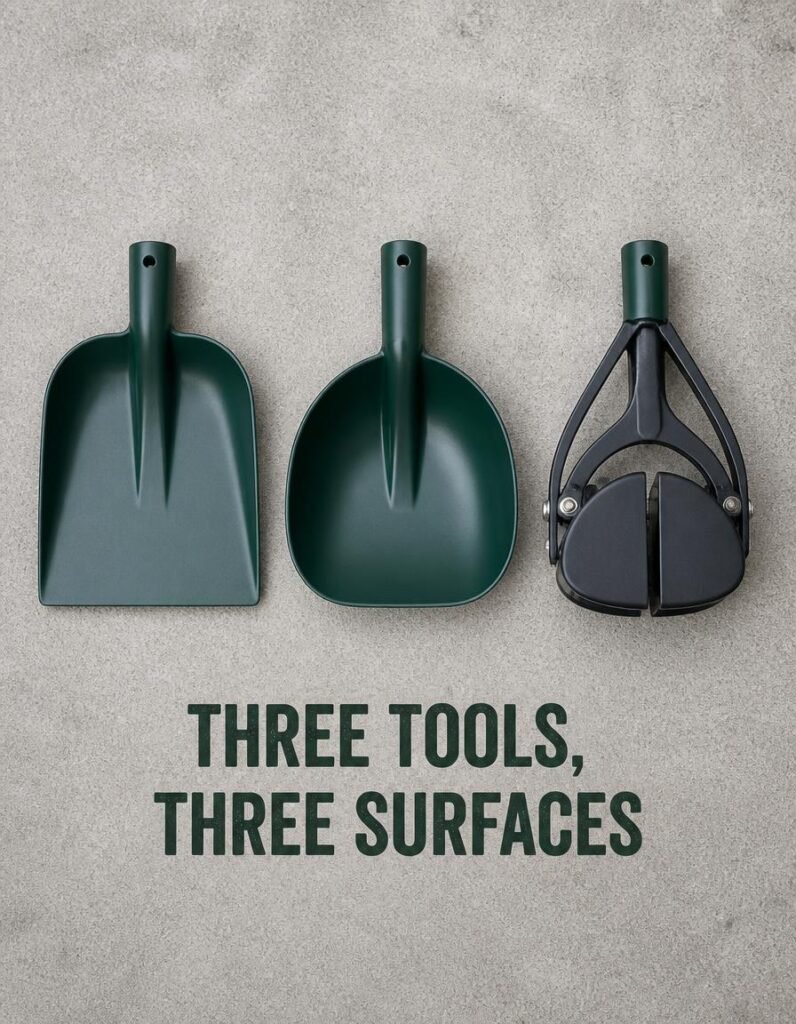
Match the tool to the ground
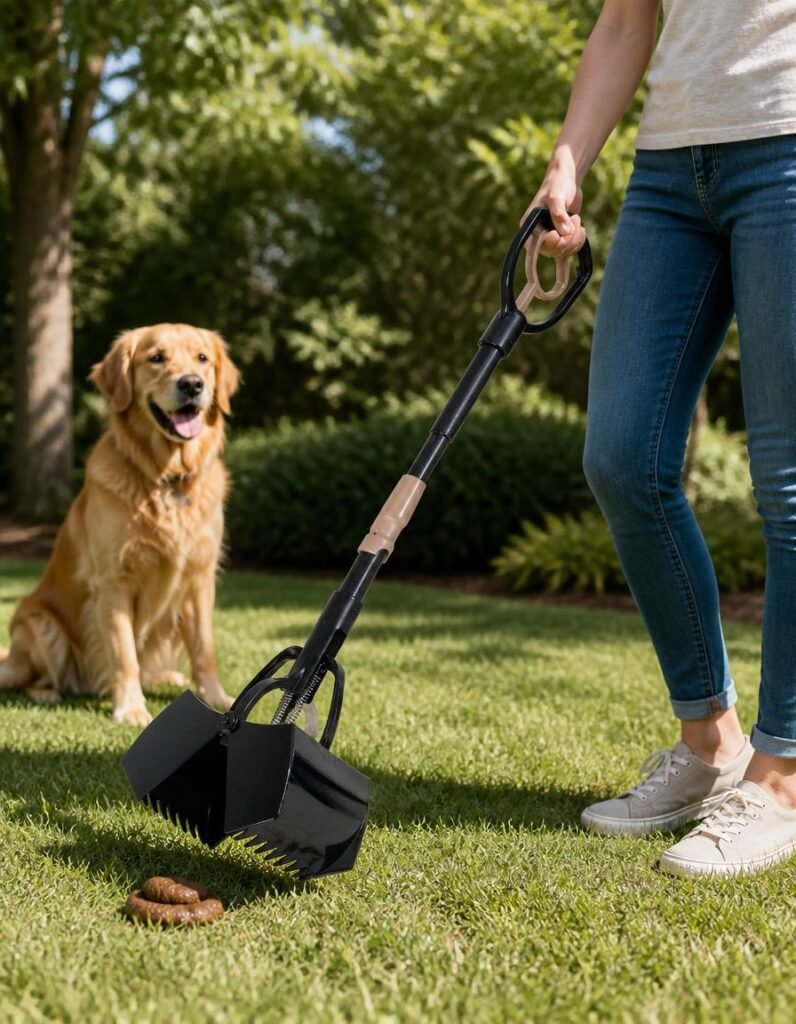
Lawn and grass. You need tines, not a flat edge. A rake combs down between the blades and lifts, where a scoop edge just mows across the top and smears. This is the single most common mismatch — someone buys a flat spade for a lawn and concludes all these tools are useless.
Concrete, patio, paving. Now you want the opposite: a flat spade or a hinged jaw that meets the ground cleanly. Tines on a hard surface skate and scatter. A pooper scooper with a rubber or soft-edged blade holds contact better on rough concrete than a rigid metal one.
Gravel, mulch, wood chips. The hardest surface of the lot, because anything that lifts waste also lifts the ground. This is where a claw-style pooper scooper with wide-spaced teeth genuinely earns its keep — the stones fall back through. Nothing works perfectly here, and you should not expect it to.
Walks and pavements. Honestly? A bag. Long-handled tools are yard equipment; carrying one on a walk is more hassle than it saves. If you want the tool anyway, look at the short bag-holder designs rather than a 37-inch pole.
If your yard has more than one of these — a lawn plus a paved side return, say — a bin-and-rake with a plastic rake is the most forgiving compromise, which is why it takes the top slot below.
How often you scoop matters more than what you scoop with
This is the part that changed how we ranked these, and it is genuinely useful to know.
Roundworm eggs in dog waste are not infectious at the moment they land. According to the CDC, the eggs have to embryonate in the environment over a period of one to four weeks before they contain infective larvae. The CDC’s guidance on toxocariasis notes that infection reaches people through contaminated soil and unwashed hands, and that the most severe cases tend to occur in young children who have been playing in or eating contaminated dirt.
Put those together, and you get a clear, practical rule. There is a window — days, not hours, but well under a month — in which removing waste breaks the cycle entirely. Miss it repeatedly, and the problem stops being about the pile and starts being about the soil, because those eggs are durable once they are established.
Which reframes the purchase. A pooper scooper you will use twice a week beats a better one you will use monthly. Weight, storage, and how annoying the pooper scooper is to clean matter more than scoop capacity, because those decide whether you actually go out and do it.
Where the waste ends up
Leaving it on the lawn to “break down naturally” is the most common yard mistake. The EPA describes pet waste as a leading source of nutrient and bacterial pollution in urban streams and waterways, carried there by stormwater running off lawns and into storm sewers. Dog waste is not fertiliser — the nutrient load is the problem, not the benefit.
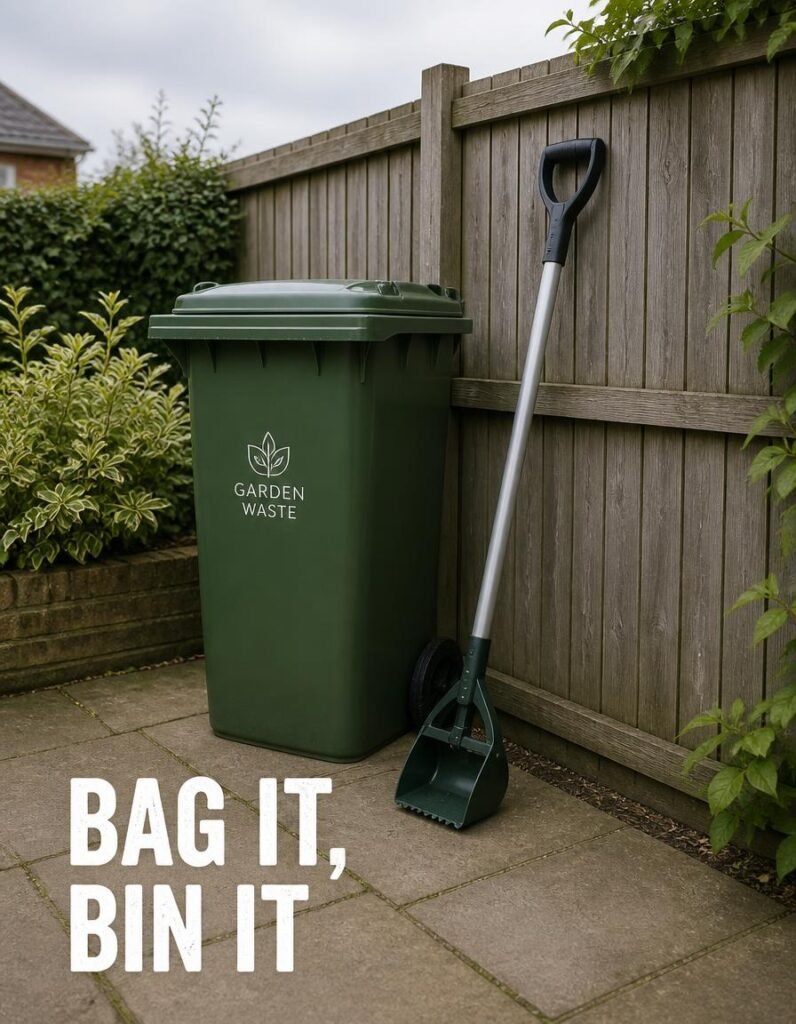
Bagged and binned is the standard answer, and it is why the bag mechanism on a pooper scooper matters as much as the scoop. A tool that holds an ordinary supermarket bag costs nothing to run. A tool that takes proprietary fitted bags has an ongoing cost, which is exactly the trap we covered in our guide to poop bags: the hardware is bought once, the consumable is bought forever.
The 5 best pooper scooper picks
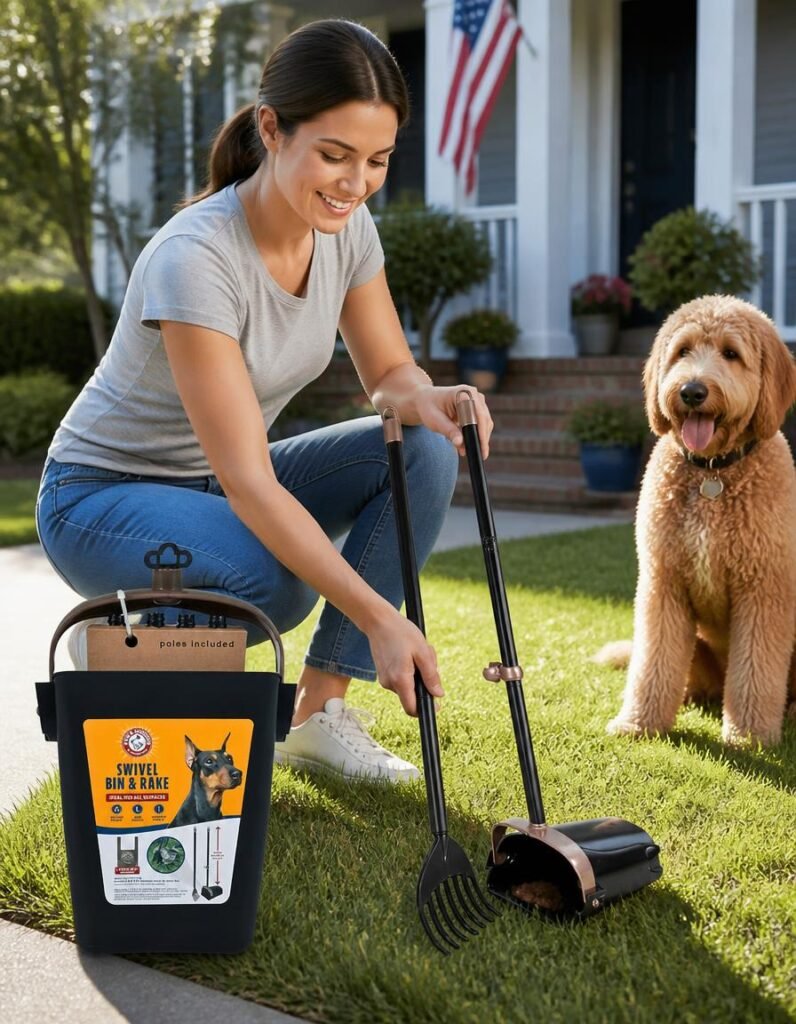
1. Arm & Hammer Swivel Bin & Rake — best overall
Two pieces: a rake in one hand, a swivel bin in the other. You rake the waste into the bin, rotate the bin, and it drops into a bag hooked over the sides. The handle adjusts up to 32 inches, and the two parts snap together for hanging storage.
It takes the top slot because it is the least surface-fussy thing here. The rake is plastic rather than rigid steel, so it flexes across concrete instead of skating, and it still has enough tines to work a lawn. For a mixed yard, that is the right compromise. The bag hooks also mean the waste never touches the tool, which is the single biggest predictor of whether a pooper scooper stays in use or ends up behind the shed.
Watch out for: it is two hands, always. There is no one-handed version of this design, so it is a yard tool and not a dog-walking tool.
2. Four Paws Wee-Wee Rake, Spade & Pan Set — best for lawns
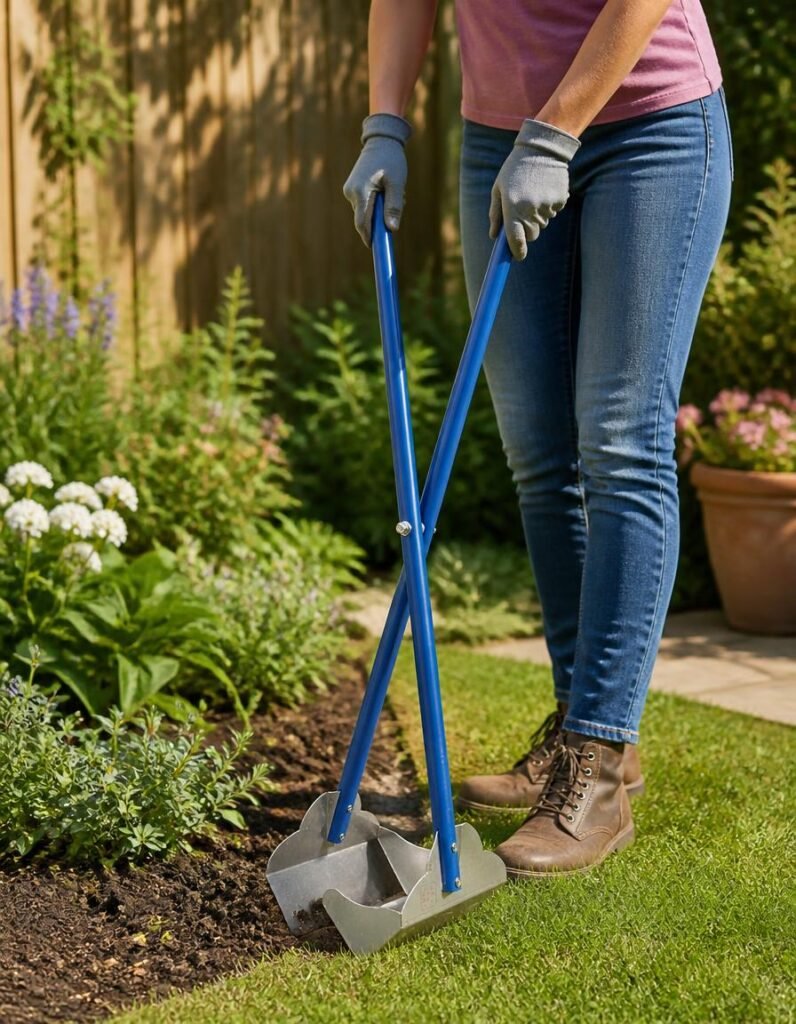
The traditional three-piece pooper scooper is still the correct answer for a proper lawn. You get a pan, a rake, and a spade on long handles: the rake for grass, the spade for anything flat, the pan to catch it.
The reason to buy a set rather than a single tool is the whole argument of this page. Four Paws builds separate scoopers for grass, for hard surfaces, and for sand, and buying the combined set is the cheapest way to stop guessing which one your yard needs. The pan holds considerably more than a claw or a jaw, so for a big lawn or two dogs, you make far fewer trips to the bin.
Watch out for: three separate pieces are three things to store and hose down. If your outdoor storage is a hook on a fence, this is the wrong shape.
3. Arm & Hammer Claw Scoop — best for gravel and mulch
A spring-loaded claw pooper scooper on an extending handle that reaches 27 inches. Squeeze the inner handle to open the jaws; release to close. On the one hand, no bag is needed to operate it, and it stands upright on its own, so it is not lying in the dirt between uses.
The reason it is here rather than in the “best overall” slot is that the tooth spacing we mentioned — the gaps — is wide enough to let stones and grass fall back out as you lift. On a gravel run or a bark-mulch bed, that is the difference between picking up waste and picking up half your landscaping. On smooth concrete, the same gaps are a liability, so buy this for what it is.
Watch out for: the claw itself gets dirty every time, by design. There is no bag between the tool and the waste. Budget for hosting it off.
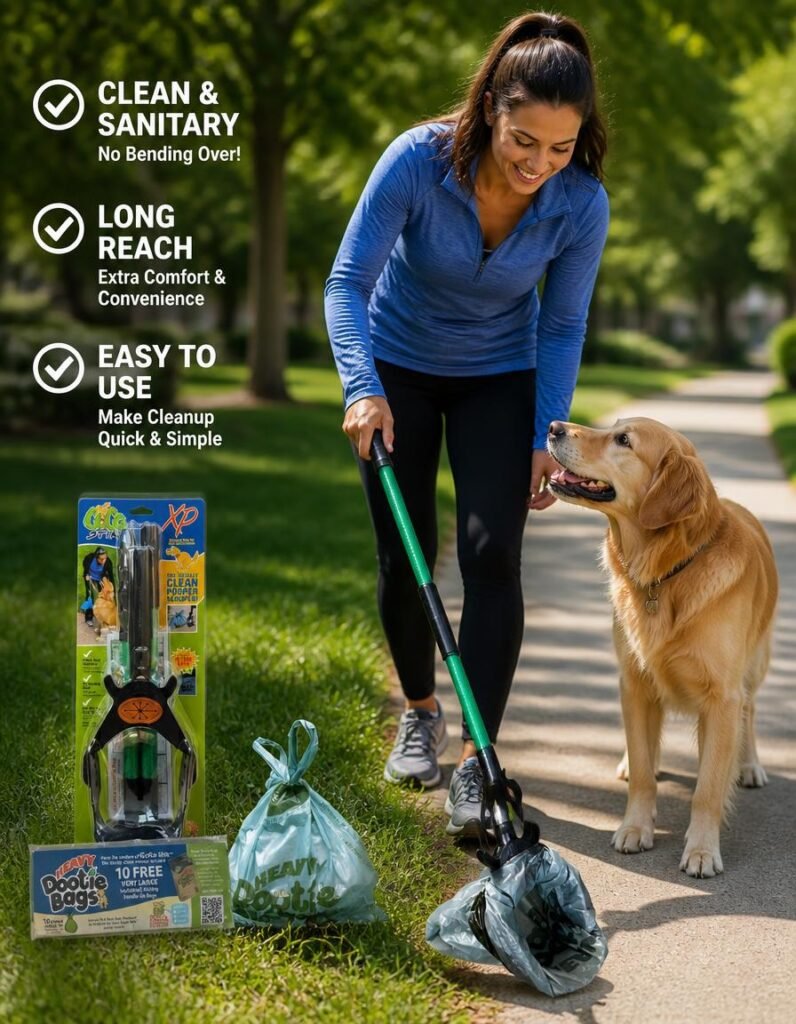
4. GoGo Stik XP — best if you hate cleaning the tool
A different idea entirely. On this pooper scooper, the bag goes on the scoop head, so the bag makes contact with the ground and the tool does not. When the bag is full, you tie it off, and the stick is still clean. It takes ordinary supermarket carrier bags as well as the brand’s own, so there is no locked-in consumable.
For anyone who has given up on a scooper because rinsing it was worse than the job itself, this is the design that solves that. It also keeps using the same bag until it is genuinely full, rather than one bag per pickup.
Watch out for — and this comes from the maker, not us: GoGo Stik’s own listing says that for gravel or indoor surfaces you should pair it with their separate rake, and their retail listings describe two-handed use with the wedge in one hand. Take that at face value. On short grass, it works alone; on anything loose, you are buying two tools.
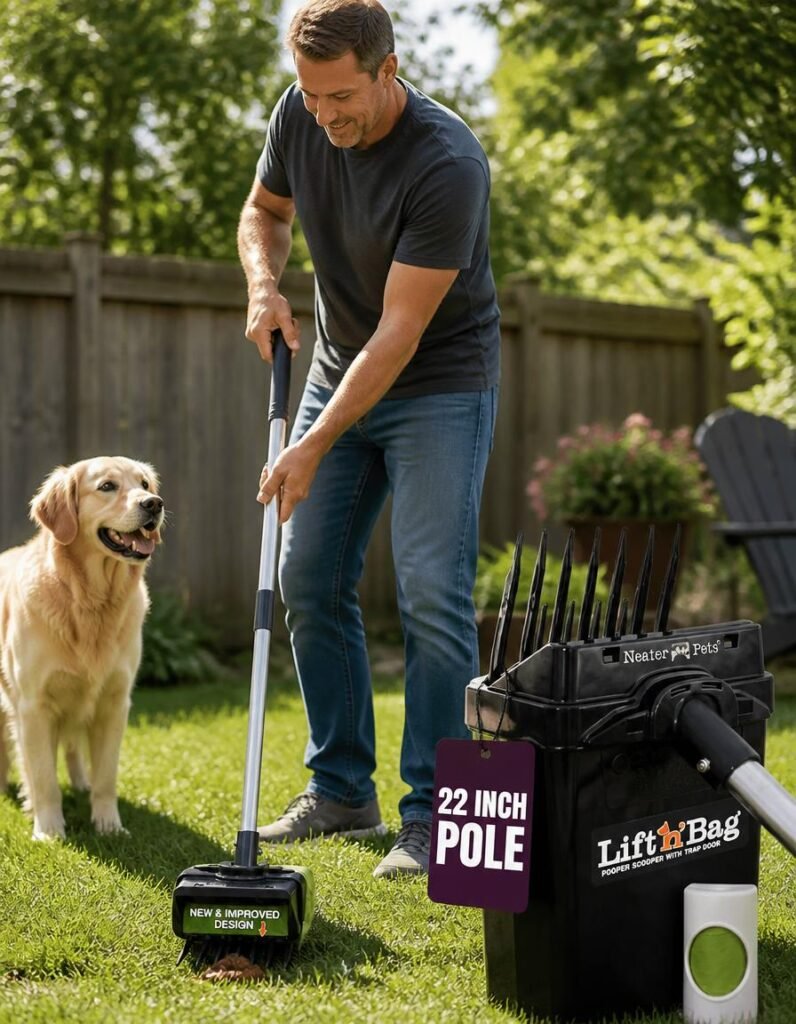
5. Neater Pet Brands Lift N’ Bag 2.0 — best one-handed
A short 22-inch pole with a bag clamped into the jaws worked with one hand. The compact size is the point: it hangs on a single hook, fits in a garage corner, and does not need two hands and a clear run at the target.
This is the right pooper scooper for a small paved yard, a balcony run, or anyone who needs a spare hand for a lead or a stick. It is also the easiest of the five to actually pick up and use on a wet Tuesday evening, which — per the timing argument above — counts for more than capacity does.
Watch out for: 22 inches is short. If you are tall, or if bending is the reason you are shopping in the first place, go back to pick one or pick four.
What to skip
Anything sold as “works on all surfaces”. After everything above, you know why. The brands that actually build these things publish separate models per surface. A listing that claims one tool does grass, concrete, and gravel equally well is describing marketing, not engineering.
Electric and automatic scoopers. A battery, a motor, and a charging port on a device whose entire job happens in mud and gets hosed down afterwards. More to break, more to clean, no faster.
Proprietary-bag-only designs. If a pooper scooper only accepts one brand’s fitted bags, you have signed up for a subscription. Check before buying whether a supermarket carrier bag will do the job.
In-ground waste digesters. Often recommended alongside these tools. They need reliable warmth and drainage to work at all, and in cold or clay-heavy ground, they become a hole full of waste. Bag it and bin it instead.
Storage and cleaning, which nobody mentions
Every review of these tools stops at the pickup. In practice, the reason a pooper scooper stops getting used is almost always one of two things, and both are solvable at purchase.
It has nowhere to live. These are awkward, unhygienic objects that cannot go in the house. Before you buy, decide where it hangs. Designs that snap together or stand upright are meaningfully better than a loose three-piece set if your only option is a corner of the garage — our roundup of time-saving dog care hacks has more on setting up a routine you will actually keep.
Cleaning it is worse than the job. Rinse it outdoors with a hose the same day, and let it dry in the sun rather than putting it away wet. Never bring it through the kitchen or wash it in a sink you use for anything else — the CDC’s whole point about transmission is contaminated hands and surfaces. Wash your hands afterwards, even though you never touched anything.
Frequently asked questions
How often should I clean up the yard?
At least weekly, and twice a week is better if you have more than one dog or small children using the lawn. That sits inside the one-to-four-week window before roundworm eggs become infective, which is the whole point of doing it on a schedule instead of when it looks bad.
Can I compost dog waste?
Not in an ordinary garden compost heap, and never anywhere near vegetables. Domestic compost does not reliably reach or hold the temperatures needed to destroy parasite eggs, and those eggs are durable. Bag it and bin it.
Is a metal pooper scooper better than a plastic one?
Not automatically. Metal lasts longer, and hoses clean more easily, but a rigid metal edge is worse on uneven concrete than a slightly flexible plastic one, because it cannot follow the surface. Choose by surface first and material second.
What about picking up in snow or heavy rain?
Both are genuinely difficult, and no tool fixes them. In snow, wait for a thaw and do a full sweep rather than chasing it daily. After heavy rain, softened waste is best handled with a pan-and-spade set rather than a claw, which will simply push it around.
My dog is scared of the scooper. Does that matter?
It is common with a long-handled pooper scooper and worth taking seriously if you are also housetraining, because a dog who associates the yard with a frightening object may become reluctant to go there. Scoop when the dog is indoors while they get used to it. Our guide to potty training a puppy covers keeping the toileting spot a low-pressure place.
The bottom line
Work out your surface before you look at a single product, because that decides more than price, brand, or capacity. Lawn wants tines, hard ground wants a flat edge or a jaw, and gravel wants wide-spaced teeth that let the stones drop out. For a mixed yard, the Arm & Hammer bin and rake is the safest single purchase and the best pooper scooper here for most people.
Then use it on a schedule rather than when the yard starts to look bad. The parasite timing means a mediocre tool used every few days beats an excellent one used once a month — so buy the one you will not resent getting out of the shed. If you are setting up a yard for a new dog, our new puppy checklist covers what else is worth having ready.