A dog treat pouch looks like the most skippable accessory in the pet aisle. It isn’t. It’s the difference between rewarding your dog while they’re still doing the thing you asked for, and rewarding them four seconds later once they’ve already wandered off to sniff a bin.
Timing is what makes reward-based training work, and a plastic bag in your coat pocket destroys it. Below are the five best dog treat pouch options under $20, plus the one habit that turns a pouch from a bag into an actual training tool.
Table of Contents
- Why a Pouch Beats Your Pocket
- The 5 Best Dog Treat Pouch Picks Under $20
- 1. PetSafe Treat Pouch Sport — Best Overall
- 2. Paw Lifestyles Treat Pouch — Best Budget
- 3. Mighty Paw Treat Pouch 2.0 — Best in Bad Weather
- 4. Kurgo Go Stuff It — Best for Hikes
- 5. OllyDog Goodie Treat Bag — Best Built
- What to Look For in a Dog Treat Pouch
- The Portioning Trick Most Owners Miss
- Frequently Asked Questions
Why a Pouch Beats Your Pocket
Reward-based training is the approach the veterinary behaviour field actually backs. The American Veterinary Society of Animal Behaviour states that based on current scientific evidence, only reward-based methods should be used for all dog training, including for behaviour problems.
But rewards only teach anything if they land at the right moment. Your dog connects the treat to whatever they were doing when it arrived — not to what you intended. Fumble with a zip-lock for four seconds and you’ve quietly rewarded sniffing the pavement instead of the sit you asked for.
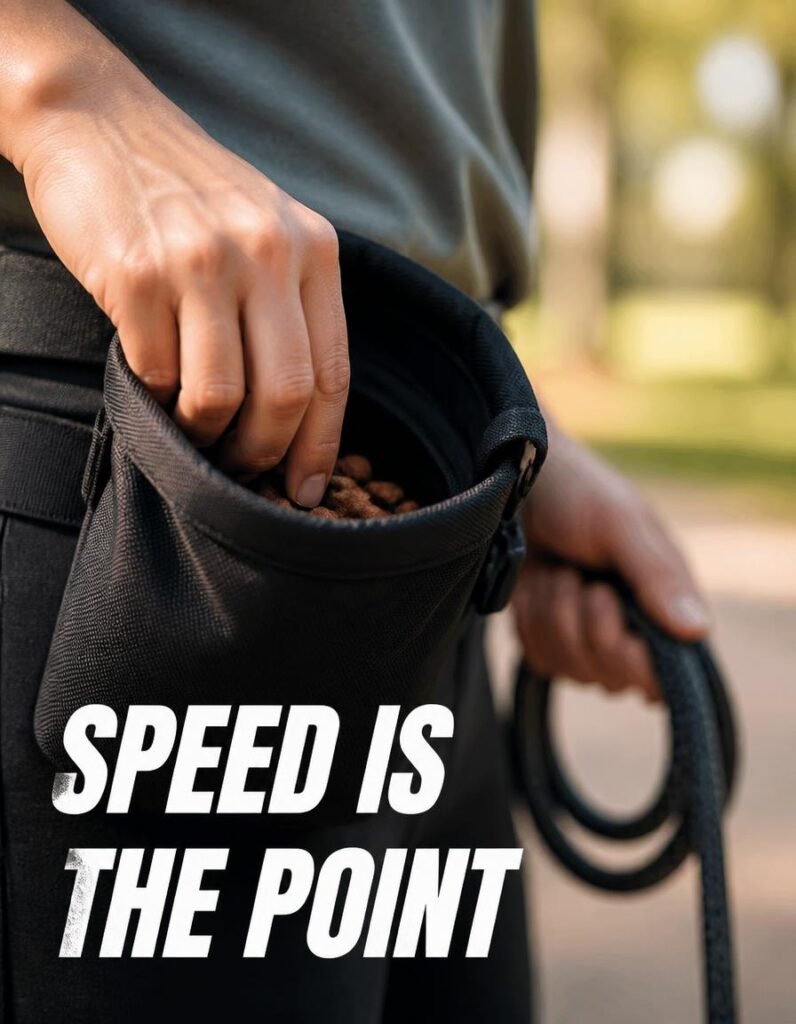
That’s the whole case for a dog treat pouch. It isn’t about carrying capacity. It’s about getting your hand in and out in under a second, one-handed, while the leash stays in the other hand.
There’s a second, less obvious benefit. A pouch sitting on your hip is a visual reminder to train at all. Most people don’t skip training because they’re lazy — they skip it because setting up feels like a task. A loaded pouch by the door removes the setup entirely.
The 5 Best Dog Treat Pouch Picks Under $20
- Best overall: PetSafe Treat Pouch Sport
- Best budget: Paw Lifestyles Dog Treat Pouch
- Best in bad weather: Mighty Paw Treat Pouch 2.0
- Best for hikes: Kurgo Go Stuff It Treat Bag
- Best no-spill design: Barkingly Treat Pouch
1. PetSafe Treat Pouch Sport — Best Overall
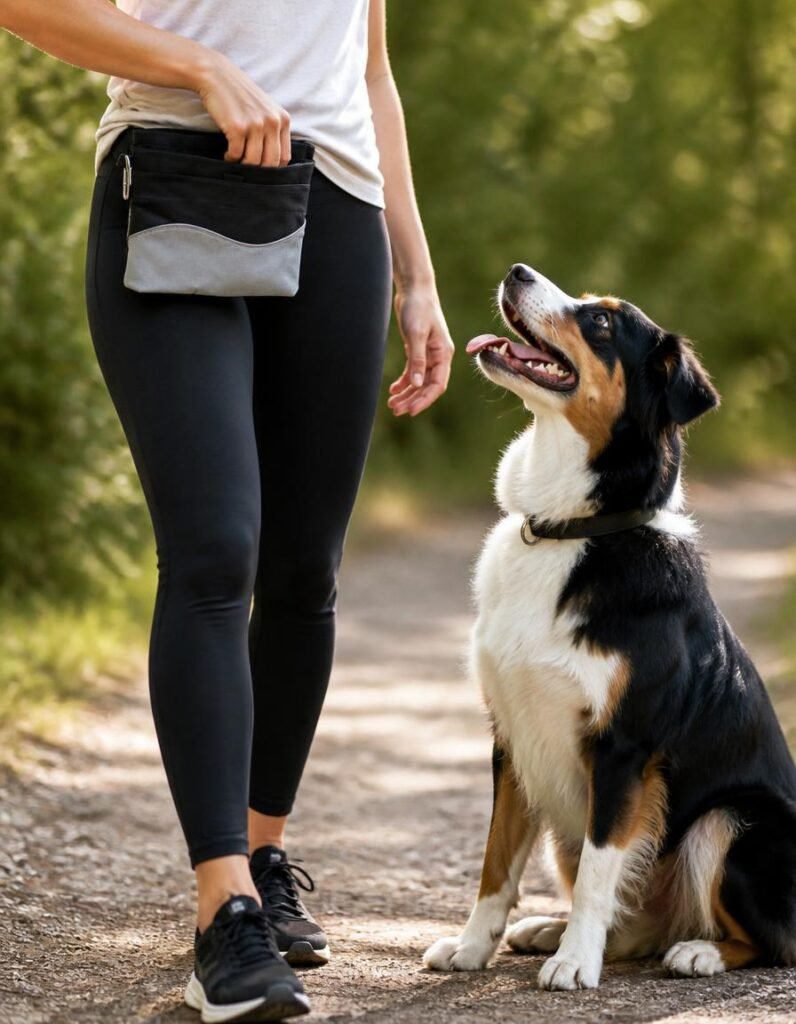
The hinge is why this one wins. Squeeze the sides, and the mouth springs open; let go, and it snaps shut. No zip, no magnets to line up, no drawstring to wrestle.
That matters more than any other feature on any dog treat pouch, because it’s the only mechanism here you can operate reliably without looking. In a class or on a busy street, you need your eyes on your dog, not on your hip.
It comes with a belt clip and a shoulder strap, has a small zipped pocket for keys, and the lining wipes clean. The closure isn’t fully sealed, so it won’t survive being tipped upside down in a bag, but that’s the trade you make for speed.
Best for: classes, daily walks, and anyone doing real repetition work.
Watch out for: the hinge stays slightly ajar, so it isn’t spill-proof in a rucksack.
2. Paw Lifestyles Dog Treat Pouch — Best Budget
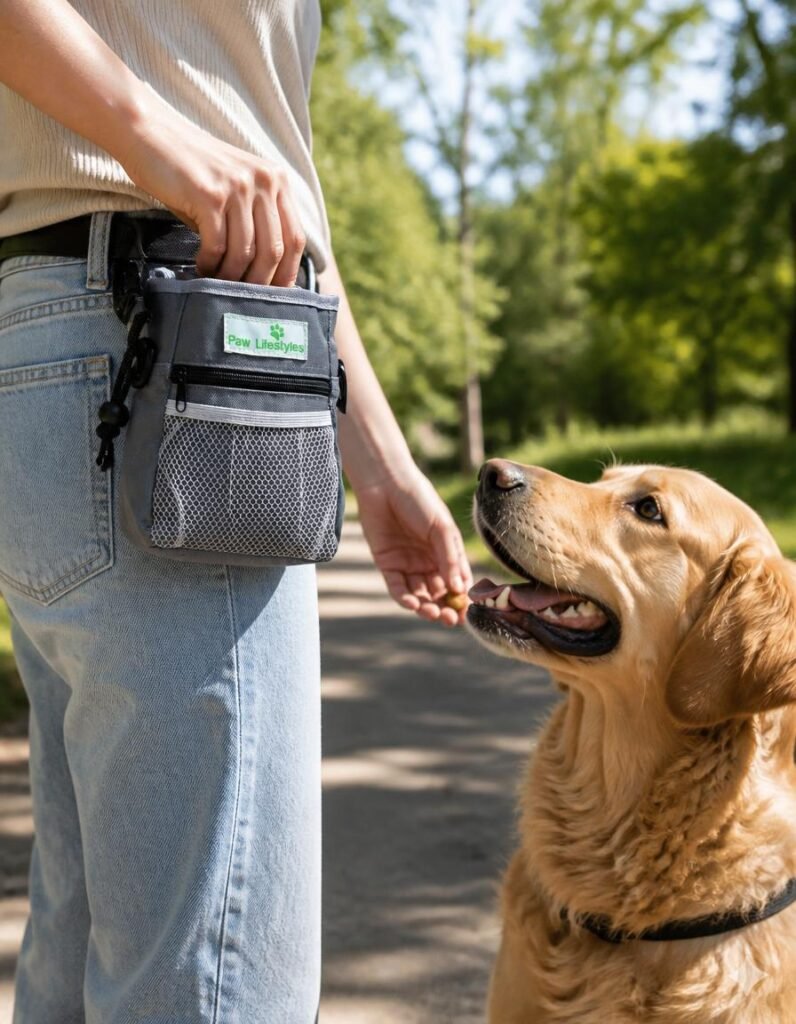
The cheapest option here that isn’t a false economy. Magnetic closure, a built-in poop bag dispenser, a front pocket for a phone, and a waist belt included rather than sold separately.
Magnets are a genuine step down from the hinge — you have to push the opening apart rather than squeeze it, which is a two-finger job instead of a one-motion one. For casual walk-and-reward use, you’ll never notice. For fast repetition drills, you will.
The poop bag dispenser is more useful than it sounds. If you’re already carrying rolls, our Earth Rated poop bags review covers which rolls actually fit these built-in dispensers, since not all of them do.
Best for: everyday walks and first-time buyers testing whether they’ll use one.
Watch out for: the magnets weaken over time, and the fabric holds odours from oily treats.
3. Mighty Paw Treat Pouch — Best in Bad Weather
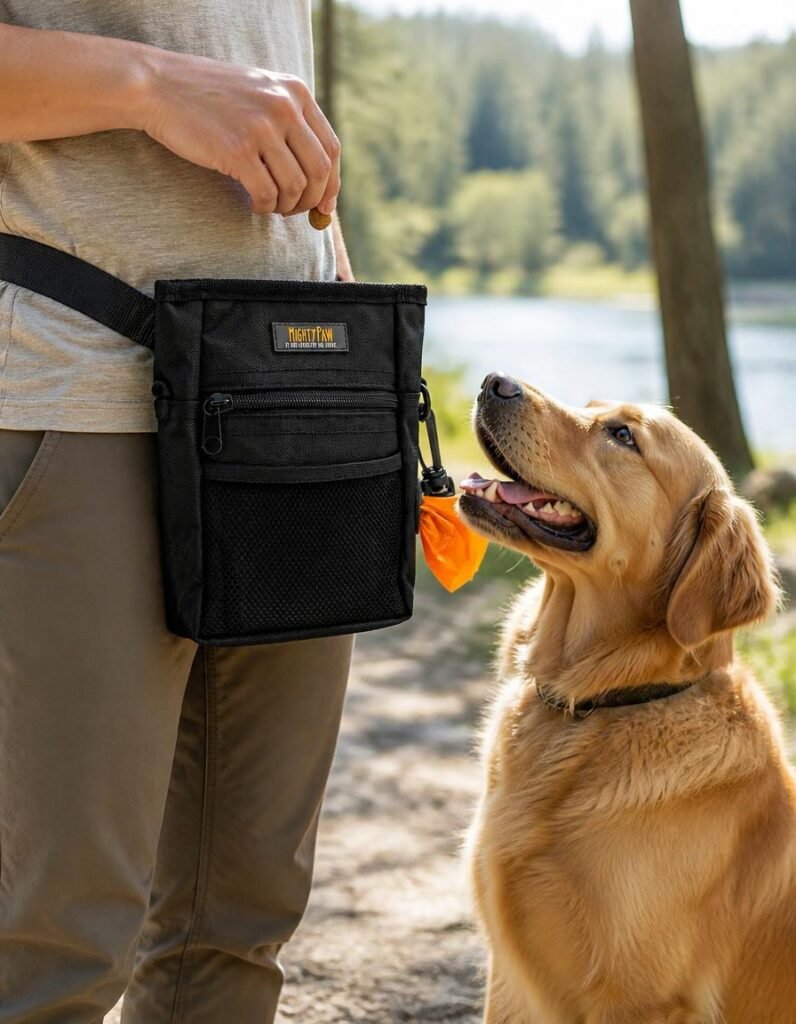
Two magnets sit inside the main compartment and pull it shut the moment you let go. That’s a meaningful difference from a pouch you have to remember to close — in rain, or when you’re juggling a leash and a phone, it stays sealed by default rather than by attention.
The body is weatherproof polyester with a water-resistant interior lining, so a wet walk doesn’t turn your treats into paste and the inside wipes clean afterwards. It holds about two cups, has a mesh pocket and a zipped pocket for a phone and keys, and comes with a roll of poop bags.
It’s also the most flexible to wear — over the shoulder, crossbody, around the waist, or clipped to a belt. If you share the dog with someone a different size, that matters more than it sounds.
Best for: wet weather, shared use between two people, and anyone who forgets to close things.
Watch out for: magnets are a step slower than a hinge, and water-resistant is not the same as washable — very greasy treats still leave a smell.
4. Kurgo Go Stuff It Treat Bag — Best for Hikes
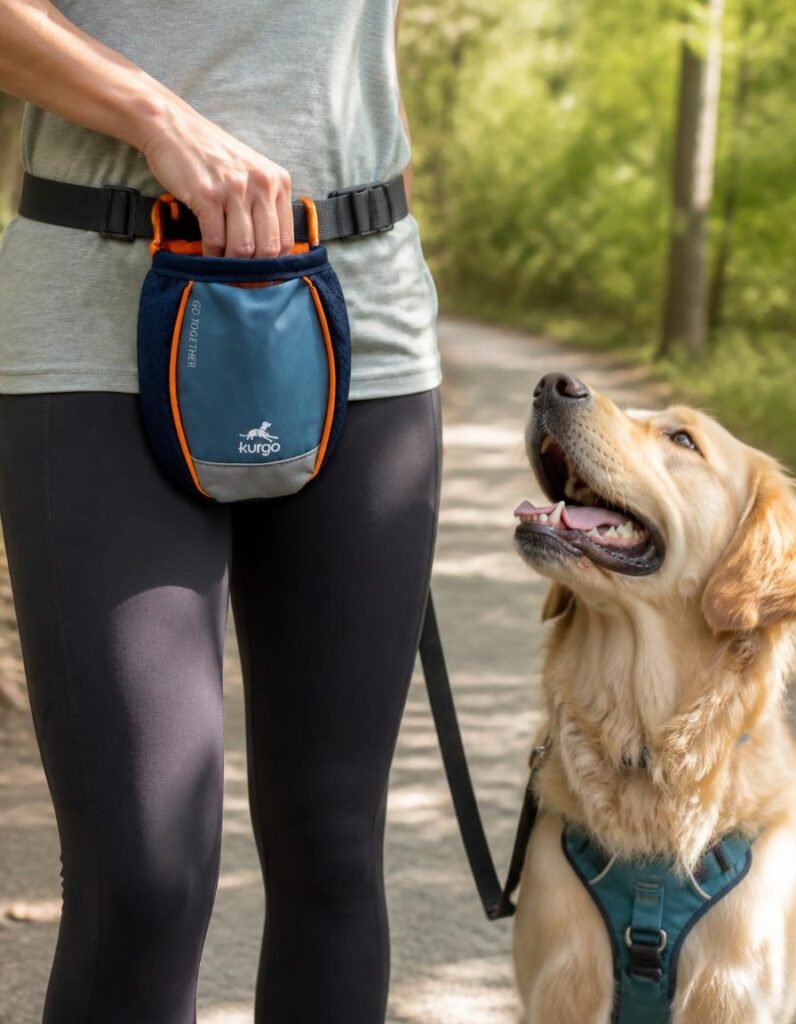
Kurgo builds outdoor gear rather than pet-aisle accessories, and it shows in the materials. Heavier fabric, a proper carabiner-style clip instead of a plastic hook, and a drawstring you can cinch fully shut when you’re scrambling over rocks.
The trade-off is honest: a drawstring is the slowest closure on this list. This isn’t the bag for a puppy class. It’s the bag for a five-hour trail day where the pouch needs to stay shut on a stile, and you’re rewarding recall every ten minutes rather than every ten seconds.
Best for: hiking, trail recall, and rough weather.
Watch out for: too slow for high-repetition training sessions.
5. OllyDog Goodie Treat Bag — Best Built
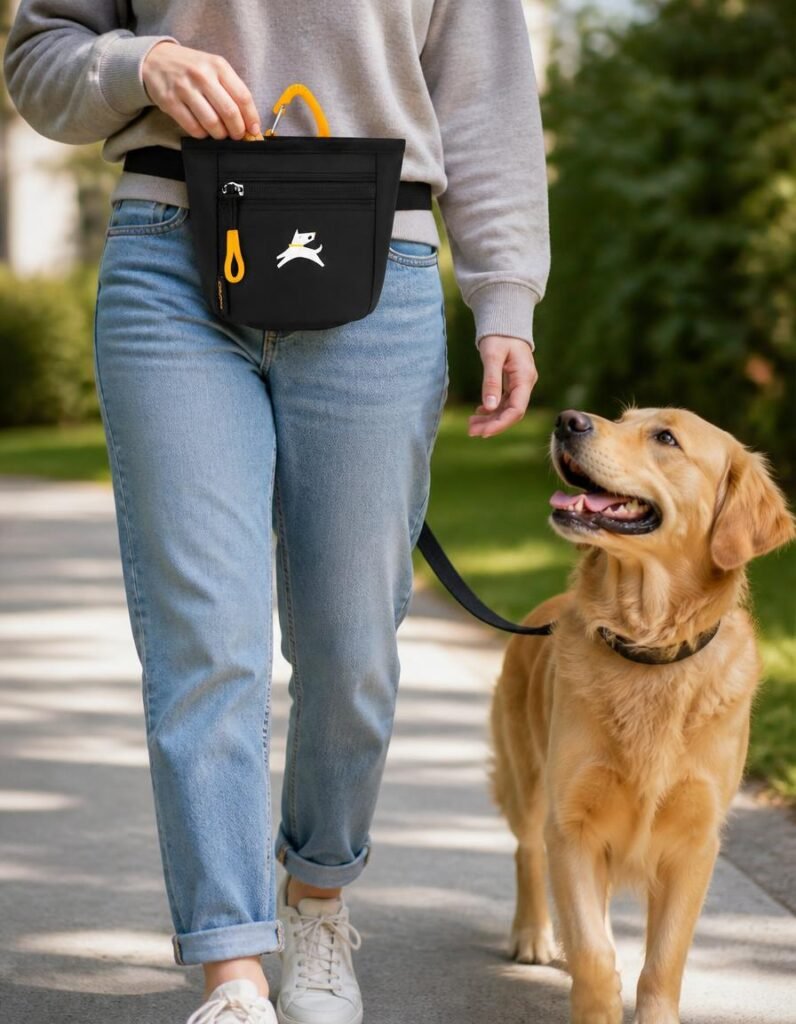
The magnet on this one opens and snaps shut in a single motion, which puts it second only to the PetSafe hinge for speed. No zip, no drawstring, no lining anything up.
What sets it apart is how it’s made. The fabric is water-resistant and comes from recycled plastic bottles, and OllyDog backs it with a lifetime warranty — unusual in a category where most bags are treated as disposable. If yours develops a fault years from now, that’s covered. Chewing isn’t, which is fair enough.
It wears three ways: on the included quick-release waist belt, clipped to a belt loop, or hooked straight onto a leash or pack. There’s a zipped front pocket for keys.
Be clear-eyed about the size, though. At roughly four inches by five, this is a deliberately minimal dog treat pouch — plenty for a training session, not a bag that swallows your phone, keys, and a water bottle. If you want that, look at the Mighty Paw instead.
Best for: people who’d rather buy once, and anyone who finds bigger pouches bulky.
Watch out for: hand wash and air dry only — it doesn’t go in the machine — and it sits right at the top of the under-$20 band.
What to Look For in a Dog Treat Pouch
The closure, before anything else. Hinge is fastest, magnets are middling, drawstrings and zips are slowest. Match it to how often you’ll actually be reaching in.
A wipeable lining. Fabric-only linings are fine for dry biscuits and miserable for anything else. If chicken, cheese or wet food is your main reward, look specifically for a food-grade silicone pouch — those rinse out completely, where even a water-resistant fabric lining eventually holds the smell.
Both a clip and a belt. A clip alone will bounce off a soft waistband. A belt alone is a faff for a two-minute garden session. Most good pouches include both.
Machine washable, ideally. Any dog treat pouch you use daily will smell within a month. If it can’t go in the machine, it needs to be rinseable.
Wide enough for your whole hand. Narrow openings force you to pinch at treats with two fingers, which is exactly the delay you bought the pouch to avoid.
The Portioning Trick Most Owners Miss
Here’s the habit that makes a pouch worth more than the sum of its parts: fill it once in the morning with the day’s entire treat allowance, and when it’s empty, you’re done.
The standard veterinary guidance is that treats should stay at or below roughly ten percent of a dog’s daily calories, with the rest coming from complete, balanced food. The American Kennel Club is clear that this counts everything — training rewards, chews, table scraps, food used to hide medication — and that it comes out of the daily allowance rather than being added on top of it.
UC Davis veterinary nutrition guidance puts the same number in plain arithmetic: at a hundred calories a day, no more than ten should come from treats.
The problem is that nobody tracks this across a day of scattered rewards. Pre-loading the pouch makes it self-enforcing — the budget becomes something you can see rather than something you’re supposed to remember. And if you’re training heavily, a portion of the day’s kibble in the pouch works perfectly well as the reward.
If you would rather buy something purpose-made, our training treats roundup covers what actually fits a pouch.
Frequently Asked Questions
Can I just use my pocket?
You can, and plenty of people do. The cost is speed and greasy pockets. If your training is occasional, a pocket is fine; if you’re teaching something new, the delay genuinely works against you.
Will wearing a pouch make my dog only obey when I have treats?
Only if you never fade the rewards. Once a behaviour is solid, move to rewarding intermittently and mix in praise and play. The pouch becomes a top-up tool rather than a permanent bribe.
How do I stop it smelling?
Empty it after every walk rather than leaving treats in overnight, and wash or rinse it weekly. Check whether yours is machine washable before you buy — several popular pouches are wipe-clean only, which is a slower job.
What size treats work best in a pouch?
Pea-sized or smaller. Small treats are swallowed fast, which keeps the session moving, and they let you reward many times without eating into the calorie budget.
Is a dog treat pouch worth it for an older, trained dog?
Yes, though for different reasons. Recall needs maintaining for life, and older dogs benefit from short mental sessions. A loaded pouch by the door is what makes those happen instead of getting skipped.
The Bottom Line
Buy the PetSafe Sport if you’re doing real training — the hinge closure is worth the small premium over the budget options. Take the Paw Lifestyles if you mainly want somewhere to put biscuits on a walk, the Mighty Paw if you walk in bad weather, the Kurgo if you’re on trails, and the Barkingly if you’re clicker training or forever spilling treats.
Whichever you pick, load it in the morning with the day’s allowance and let the empty pouch tell you when to stop. That single habit does more for your dog than the difference between any two bags on this list.
This article is general information, not veterinary advice. Ask your vet about the right calorie intake for your specific dog.
Prices and availability change frequently on Amazon. Check the current listing before buying.
Disclosure: As an Amazon Associate, DailyPetPicks earns from qualifying purchases. This costs you nothing extra and helps keep the site running.