Press the back of your hand to the pavement outside and hold it there for seven seconds. If you have to pull away, it is too hot for your dog to walk on. The Kennel Club recommends exactly this seven-second test, and it sends thousands of owners searching for a dog paw balm every summer. Most of them end up disappointed — not because they bought a bad product, but because of how they used it.
This guide covers the five balms worth your money, the application mistake that makes most of them seem useless, and one dangerous myth about what a dog paw balm can actually protect against.
What’s In This Guide
- Why Most Paw Balm Seems Not to Work
- The Hot Pavement Myth
- Our Top 5 Picks
- How to Apply It So It Actually Works
- Frequently Asked Questions
Why Most Paw Balm Seems Not to Work
Read the one-star reviews on any paw product, and you’ll see the same two complaints over and over: my dog licked it straight off, and it left greasy marks on the floor. Both of those are application problems, and the manufacturers themselves say so.
Pet MD states plainly that its balm contains nothing to stop a dog licking it off, and advises giving a treat as a distraction until the product absorbs. Natural Dog Company gives near-identical advice, suggesting you time application around mealtime or a treat so the balm gets a few uninterrupted minutes. Musher’s Secret goes at the second complaint directly: owners finding wax on their carpets are using too much, because a properly thin layer absorbs and stays put.
In other words, three separate companies are telling you the same thing in their own instructions, and almost nobody reads it. A dog paw balm needs perhaps two to five quiet minutes to soak in. Give it that, and it works. Apply it to a dog who immediately walks off licking, and you have wasted your money regardless of which tin you bought.
The Hot Pavement Myth
This is the part of the article we would rather you read than the product list.
Dog paw balm is sold heavily on summer protection, and it does offer some defence against rough, warm surfaces. What it does not do is make genuinely hot asphalt safe. A wax layer is thin, and it is not thermal insulation. Musher’s Secret carries an explicit warning on this point in its own retail material, asking owners not to assume that using their wax — or even dog boots — means a dog can be exercised for long periods in summer heat.
Treat a dog paw balm as conditioning and mild protection, never as permission. The threshold is lower than most owners assume: the AKC warns that once the thermometer reaches 85°F and stays there through the day, even a short outing can be risky, because you are wearing shoes and your dog is not. On a hot day, the answer is walking early or late, choosing grass over asphalt, and doing the seven-second hand test before you set off. Pad burns are painful, slow to heal, and entirely preventable by changing the walk rather than by buying a product.
The same logic applies in reverse in winter, where road salt and de-icing chemicals are the real hazard rather than the cold itself. A barrier wax genuinely helps there, but rinsing the paws when you get home matters just as much.
Our Top 5 Dog Paw Balm Picks
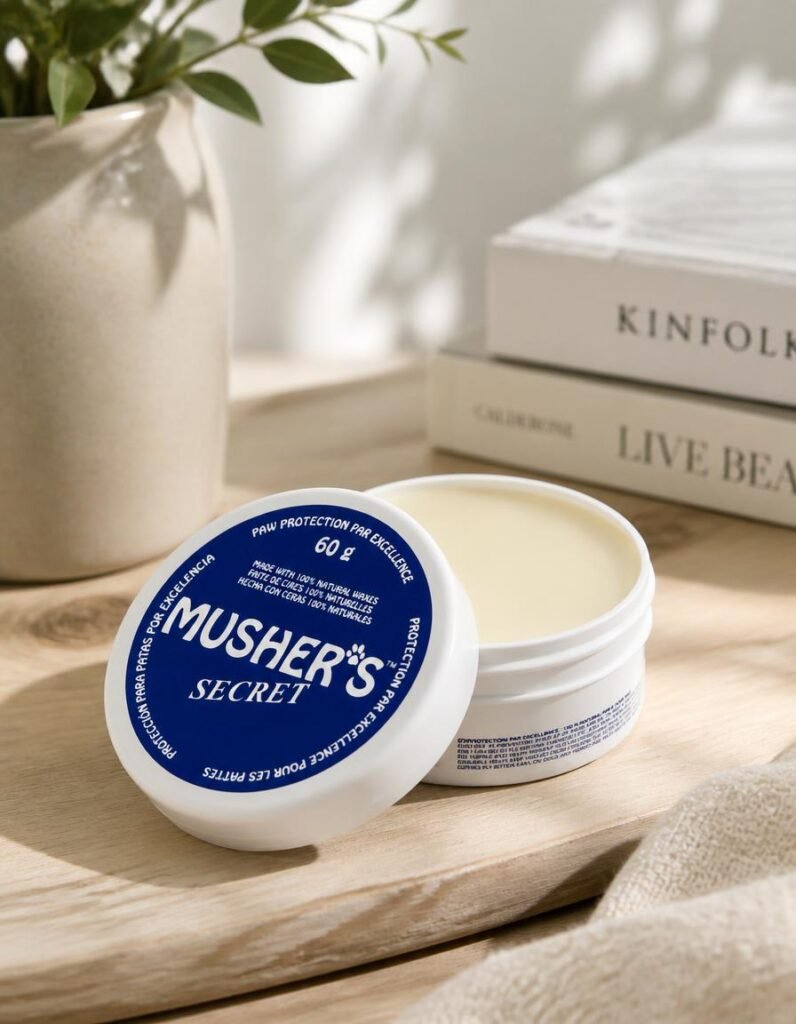
1. Musher’s Secret — Best Overall
Originally developed in Canada for sled dogs running long distances over ice and road salt, Musher’s Secret has become the default recommendation in this category for good reason. It is a dense barrier wax rather than a moisturiser, built from food-grade beeswax, carnauba wax and candelilla wax with vegetable oils and vitamin E.
The detail that matters is that the shield it forms is semi-permeable. It absorbs into the pad and still allows perspiration to escape through the toes, which is why it can be used year-round rather than only in winter. The manufacturer also confirms it contains no soy, flax, coconut, nut oils, lanolin or petroleum — useful if your dog has known sensitivities.
Guidance is applied as a thin layer two or three times a week. It is completely non-toxic, so a dog licking its paws afterwards is not a concern.
Best for: year-round protection, rough terrain, winter salt, and dogs who walk a lot.
2. Natural Dog Company Paw Soother — Best for Cracked Pads
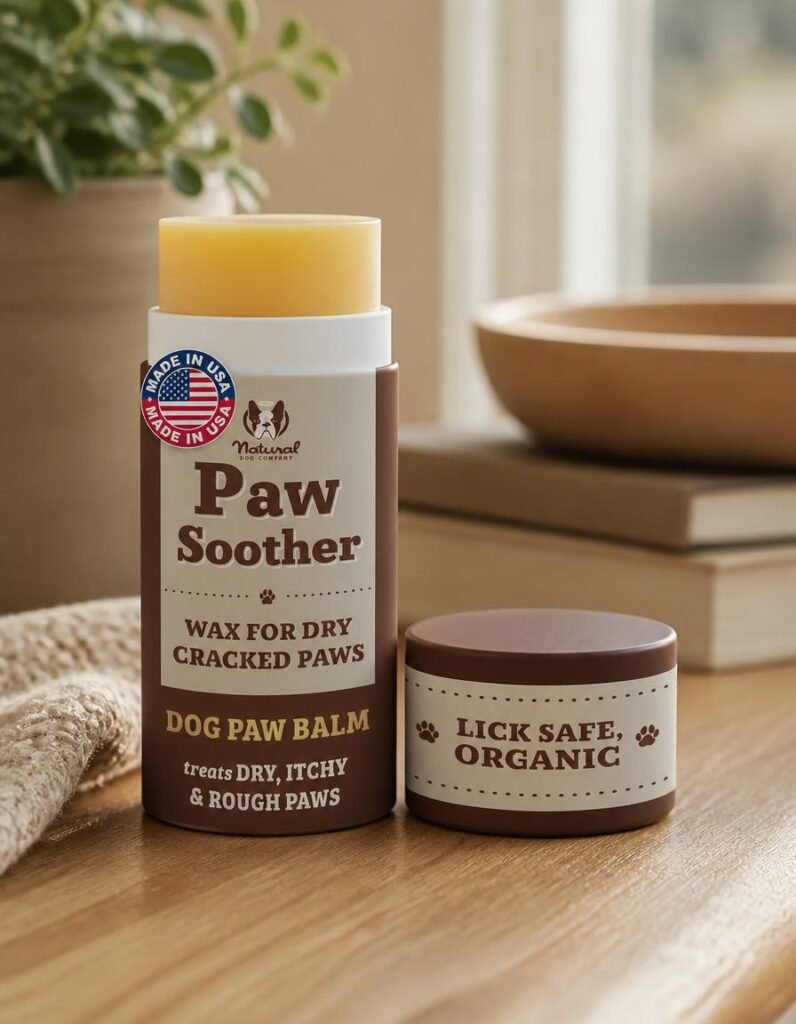
If your dog’s pads are already dry, peeling, or split, a barrier wax is the wrong tool — you need something that repairs rather than protects. Paw Soother is a butter blend rather than a wax, built around coconut oil, cupuaçu and cocoa butter, hempseed oil, jojoba, chamomile and calendula.
The company’s own framing is the clearest summary of how these two categories differ: protection before going outside, repair before bed. It is also the one product here with independent professional backing, appearing as a vet’s recommendation in a tested 2026 roundup rather than only in brand marketing.
For actively damaged pads, the guidance is two to three applications a day until they improve, then occasional maintenance. Bedtime is the ideal slot, since a sleeping dog is not licking its feet.
Best for: cracked, peeling or rough pads that need healing, not shielding.
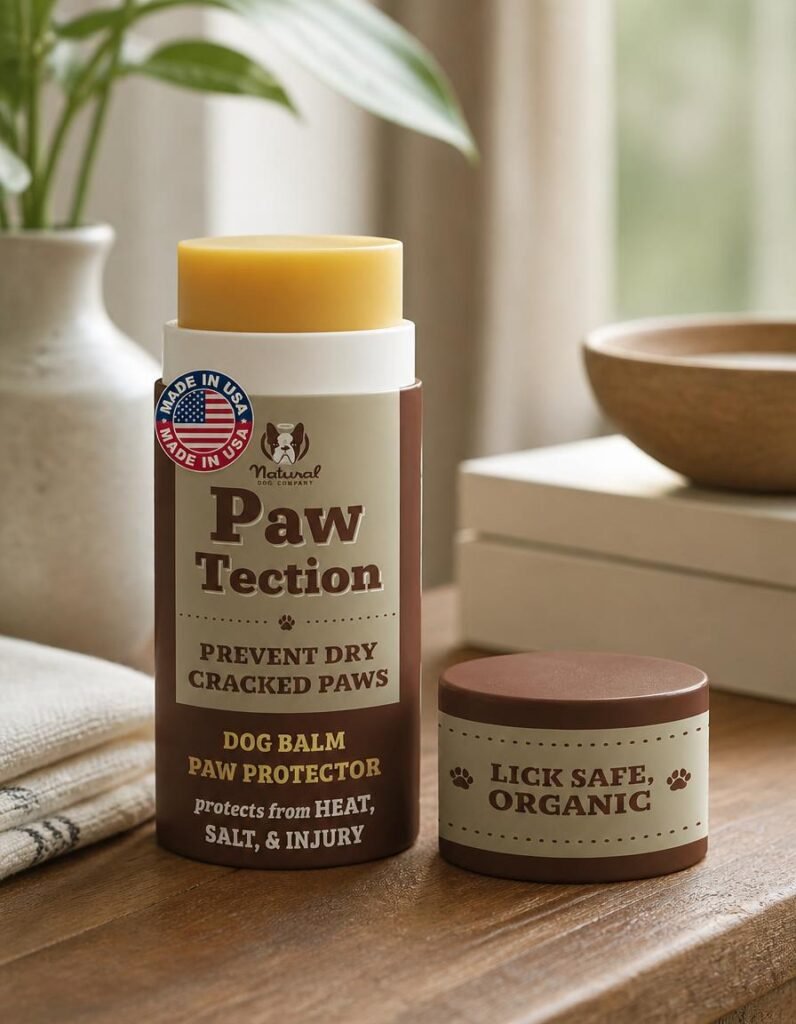
3. Natural Dog Company PawTection — Best Organic Barrier
PawTection is the companion product to Paw Soother, and the pairing is the reason both appear on this list. Where the Soother heals, this one shields: an organic wax blend of carnauba, sunflower, and candelilla waxes with mango butter, rice bran oil, lavender, and rosemary extract.
Functionally, it competes directly with Musher’s Secret. Choose it if organic certification and a plant-based formula matter to you, or if your dog reacts to something in the Musher’s blend. Choose Musher’s if you want the denser, longer-established barrier at a lower price per gram. Neither is a wrong answer.
If your dog needs both healing and protection, using Paw Soother overnight and PawTection before walks is the routine the manufacturer designed for.
Best for: owners who want an organic barrier, or a partner product to the Soother.
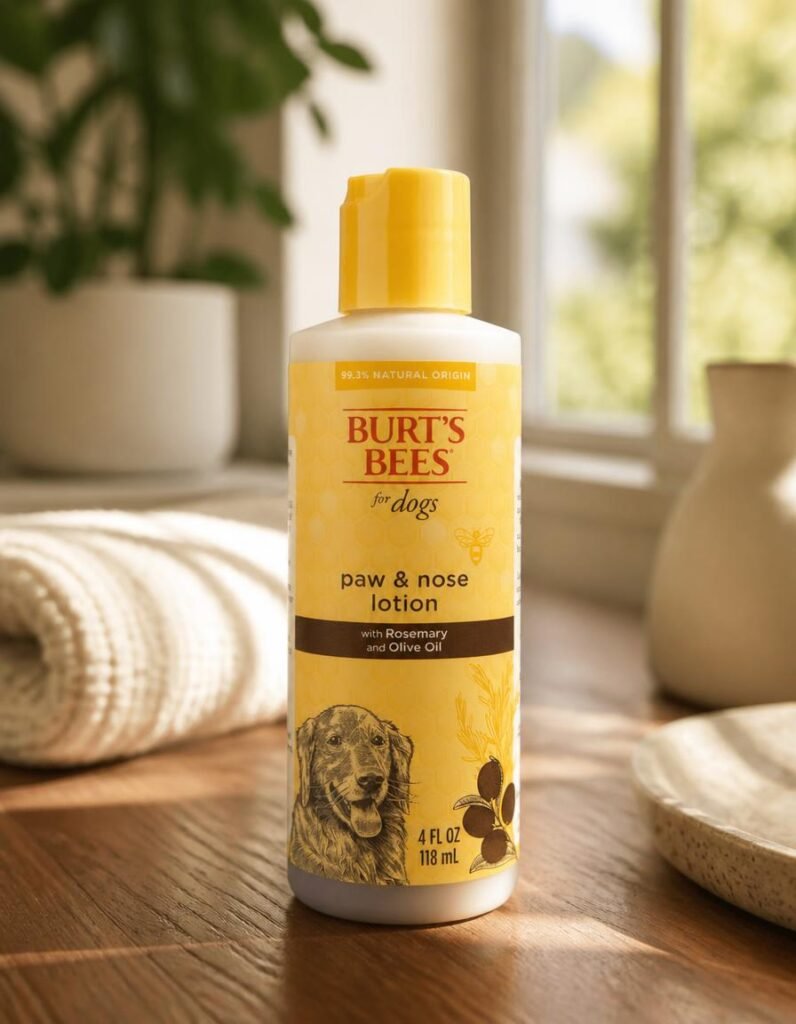
4. Burt’s Bees Paw & Nose Lotion — Best Budget Pick
The odd one out here, and deliberately so. This is a water-based lotion rather than a wax, which makes it lighter, faster to rub in, and considerably cheaper than the tins above.
The formula is 99.7% natural origin, built on rosemary, olive oil and honey, and made without parabens, sulfates, phthalates or artificial dyes. Being a lotion, it moisturises well but leaves far less of a protective barrier than a wax — so treat it as everyday conditioning rather than as armour for a long hike over gravel.
Its second use is the nose, which is where the four-ounce bottle earns its keep. Apply to the bridge and avoid the wet part. As with every product here, let it dry before your dog starts grooming.
Best for: everyday moisturising on a budget, and dry noses as well as paws.
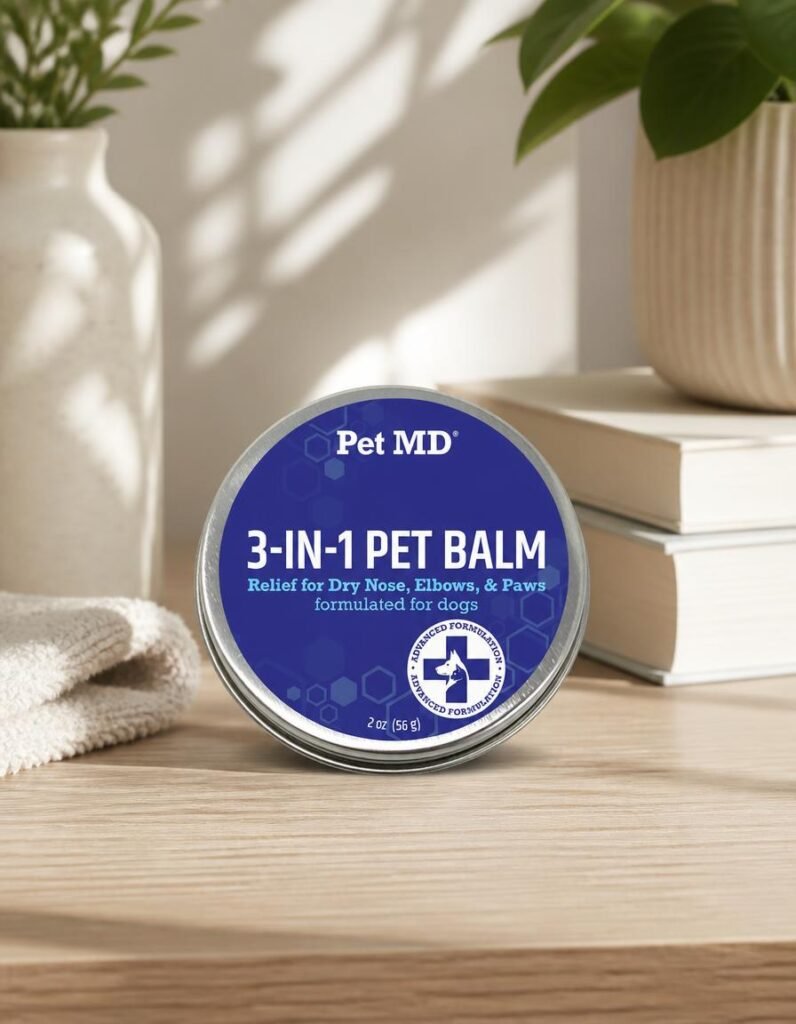
5. Pet MD Paw Balm 3-in-1 — Best Multi-Use
Dry pads rarely arrive alone. Dogs who crack their paws often have a crusty nose and callused elbows from lying on hard floors, and this balm is built to cover all three from one small tin.
It blends twelve oils and butters — shea, coconut, almond, avocado, cocoa and castor among them, with beeswax and herbal infusions of calendula, comfrey and chamomile. It is non-toxic and harmless if swallowed, and a useful trick from the maker is to warm it briefly in your palm first, which softens it and speeds absorption.
This is also the product whose instructions are most honest about the licking problem, telling you outright to hand over a treat while the balm sinks in. One caution worth knowing: it is a moisturiser, not a traction aid, so it won’t help an older dog slipping on laminate floors.
Best for: paws, nose and elbow calluses from a single tin.
How to Apply It So It Actually Works
- Clean and dry the paws first. Dog paw balm applied over grit just seals the grit in.
- Warm a small amount between your fingers or in your palm until it softens.
- Use less than you think. A thin, even film across the pad is the target — visible white residue means too much.
- Work it into the pads and the skin between the toes, which is where cracks usually start.
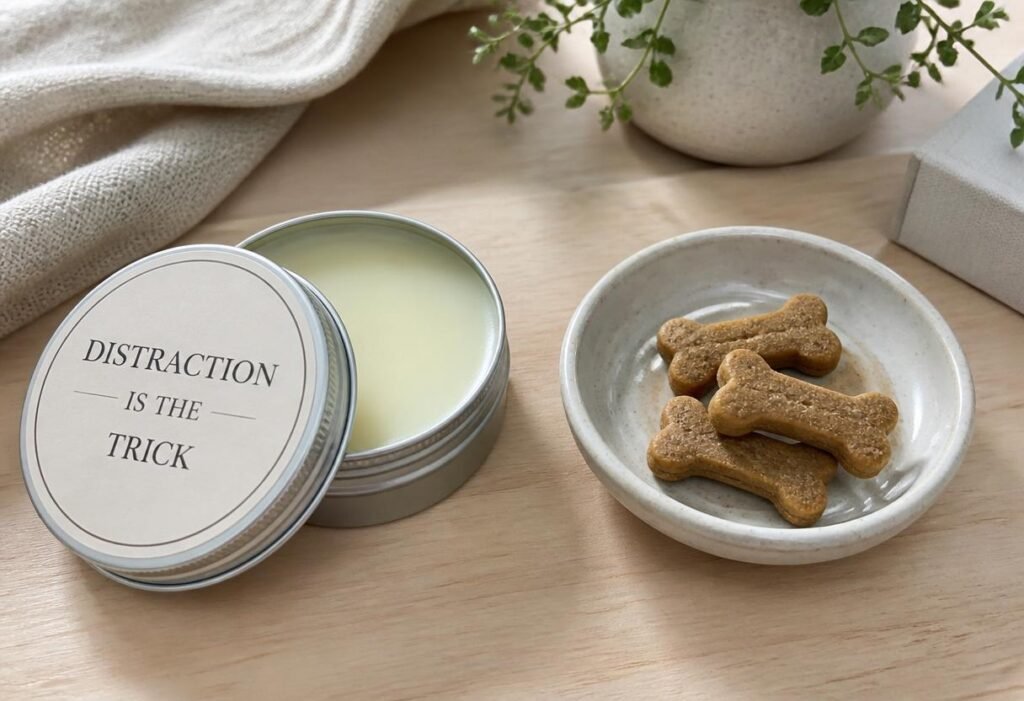
- Occupy your dog for the next few minutes. A chew, a stuffed toy, or mealtime all work.
- Better still, apply at bedtime. A sleeping dog gives the balm hours instead of minutes.
A lick mat is the single best distraction tool for this job, since it buys you several minutes of stationary dog. Our roundup of the grooming basics worth getting right covers where paw care fits alongside bathing, which is the other routine most owners either overdo or skip entirely.
When to Skip the Balm and Call Your Vet
A dog paw balm handles dryness and everyday wear. It does not handle injury or illness. AAHA has a useful guide to spotting and responding to paw burns, and one point it makes is worth repeating: dogs often keep walking on damaged pads rather than showing pain, so you have to check rather than wait to be told. Book an appointment rather than reaching for a tin if you see:
- Bleeding, deep splits, or a flap of loose pad
- Limping, or refusing to put weight on a foot
- Blistered or peeling pads after a walk on hot ground — that’s a burn
- Swelling, heat, discharge, or a smell coming from between the toes
- Constant licking or chewing at one paw, which usually signals allergies, pain or anxiety rather than dryness
- Thick, crusty overgrowth on the pads, which can indicate an underlying condition worth diagnosing
Frequently Asked Questions
Is it safe if my dog licks the balm off?
Every product on this list is non-toxic and safe if swallowed — several are food-grade. Licking doesn’t harm your dog, it just wastes the application. That’s why distraction matters more than any anti-lick claim.
Can I use coconut oil or human hand cream instead?
Coconut oil moisturises but stays greasy and offers no real barrier the way a proper dog paw balm does, so it tracks across floors and comes off quickly. Human hand creams are a firm no — many contain fragrances or actives that aren’t meant to be eaten, and your dog will eat them.
How often should I use a dog paw balm?
For healthy pads, twice or three times a week is plenty as maintenance. For damaged pads, daily or more until they recover. In salted-road winter conditions, apply before every walk and rinse the paws afterwards.
Will balm stop my dog slipping on wooden floors?
Generally no, and some manufacturers say so directly. A few dense waxes can improve grip slightly on pads worn smooth, but if slipping is your problem, look at nail length, paw hair trimming, and rugs instead.
Does my indoor dog need it?
Often not. Pads that only meet carpet stay soft on their own. Dry indoor heating in winter can still cause cracking, so check the pads occasionally rather than applying out of habit.
The Bottom Line
For most dogs, Musher’s Secret is the dog paw balm to buy first: it’s proven, versatile, and works in every season. If the pads are already cracked, start with Natural Dog Company Paw Soother instead and switch to protection once they’ve healed. Burt’s Bees covers light everyday moisturising cheaply, and Pet MD handles the dog whose nose and elbows need the same attention as their feet.
Whichever you choose, thin layers and a few minutes of distraction matter more than the brand on the tin. And on genuinely hot days, no dog paw balm replaces the back-of-the-hand test and a walk at a cooler hour.
This article is for general information only and is not veterinary advice. If your dog is limping, bleeding, or has blistered pads, please consult your veterinarian.
As an Amazon Associate, we earn from qualifying purchases. Prices and availability are accurate as of the date of publication and are subject to change.