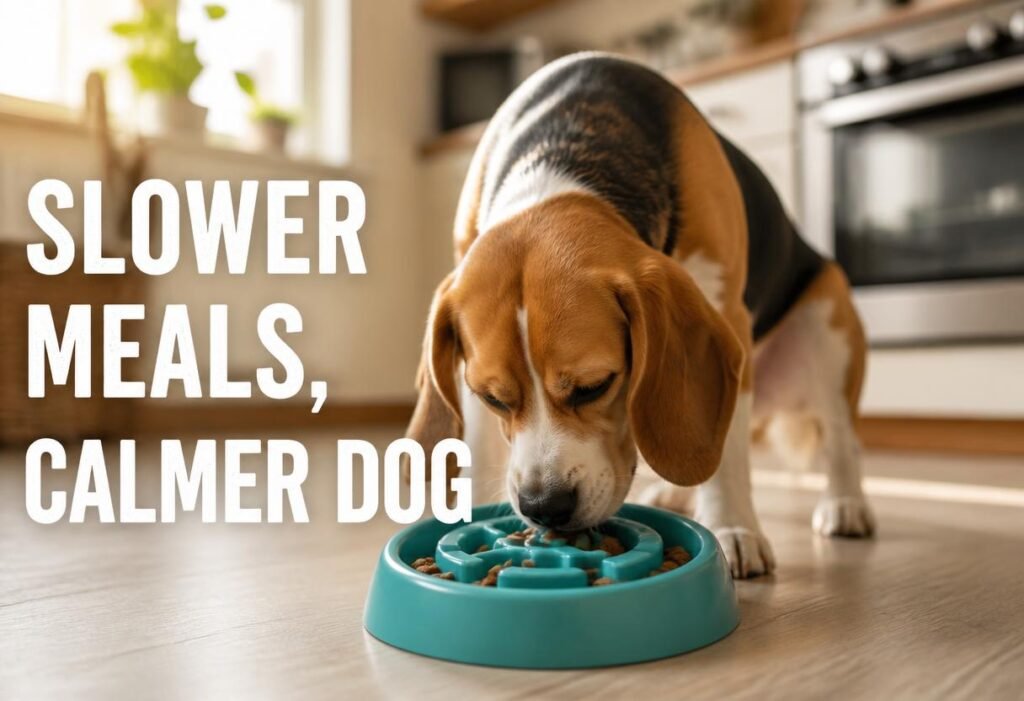
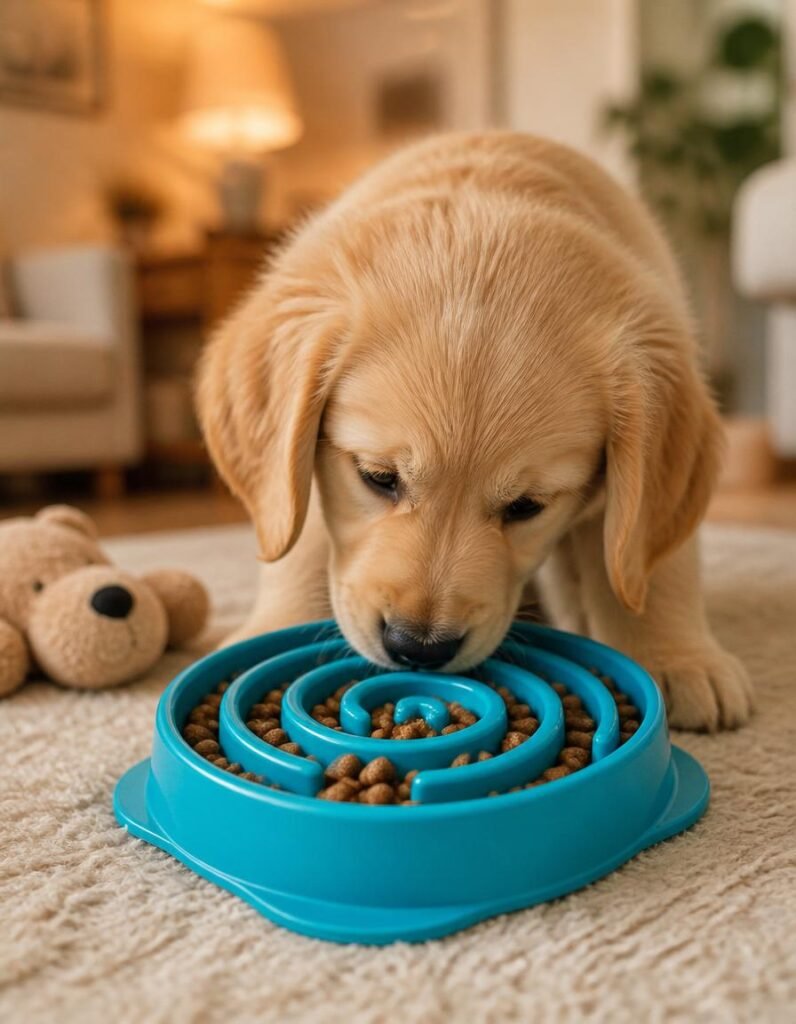
Time your dog’s next meal. If a full portion disappears in under ninety seconds, you have a speed eater — and a slow feeder dog bowl is the cheapest fix available for a habit that carries real risk. The trouble is that most buyers pick by size and colour, then discover their dog either cleared the maze in forty seconds or gave up and flipped the whole thing across the kitchen.
The decision that actually matters is difficulty, and almost nobody explains it. This guide covers what the research genuinely supports, how to match maze difficulty to your dog, and seven slow feeder dog bowls worth buying.
What’s In This Guide
- What the Evidence Actually Says
- Difficulty Is the Real Decision
- Plastic, Stainless or Ceramic?
- Our Top 7 Picks
- How to Introduce One
- Frequently Asked Questions
What the Evidence Actually Says
Every slow feeder dog bowl is marketed on bloat prevention, so it’s worth separating what the research supports from what the packaging claims.
Bloat — properly gastric dilatation-volvulus, or GDV — is when the stomach fills with gas and twists on itself. It is an emergency, and it is frequently fatal. According to the AKC, fast eaters carry roughly five times the risk of dogs that eat slowly, dogs fed a single daily meal are about twice as likely to bloat as those fed twice, and anxious or fearful dogs are around twice as likely as relaxed ones. The AKC explicitly names slow feeder dog bowls as one way to address the speed factor.
Do slow feeder dog bowls work? Peer-reviewed veterinary evidence says yes, with a caveat worth knowing: these bowls do reliably reduce eating speed, and although dogs get quicker at them as they gain practice, they still eat more slowly than they would from a standard dish. So expect your dog to improve at the maze over time. That’s normal, not a defective product.
Now the honest part. A slow feeder dog bowl does not make a dog bloat-proof. VCA notes that the exact cause of GDV remains unknown, and breed, chest shape, age, and genetics all contribute — none of which a bowl can touch. What a bowl does is address gulping and air swallowing, which happen to be one of the few risk factors an owner can actually control. That is a genuinely useful thing for around twelve dollars. It is not a medical guarantee, and anyone selling it as one is overreaching.
Worth adding: bloat is overwhelmingly a large, deep-chested dog problem. Great Danes carry the highest lifetime risk of any breed by a wide margin, with German Shepherds, Standard Poodles, Weimaraners, Boxers, and Irish Setters also over-represented. If you have a Chihuahua who inhales dinner, a slow feeder is about mess, weight, and regurgitation rather than about GDV.
Difficulty Is the Real Decision
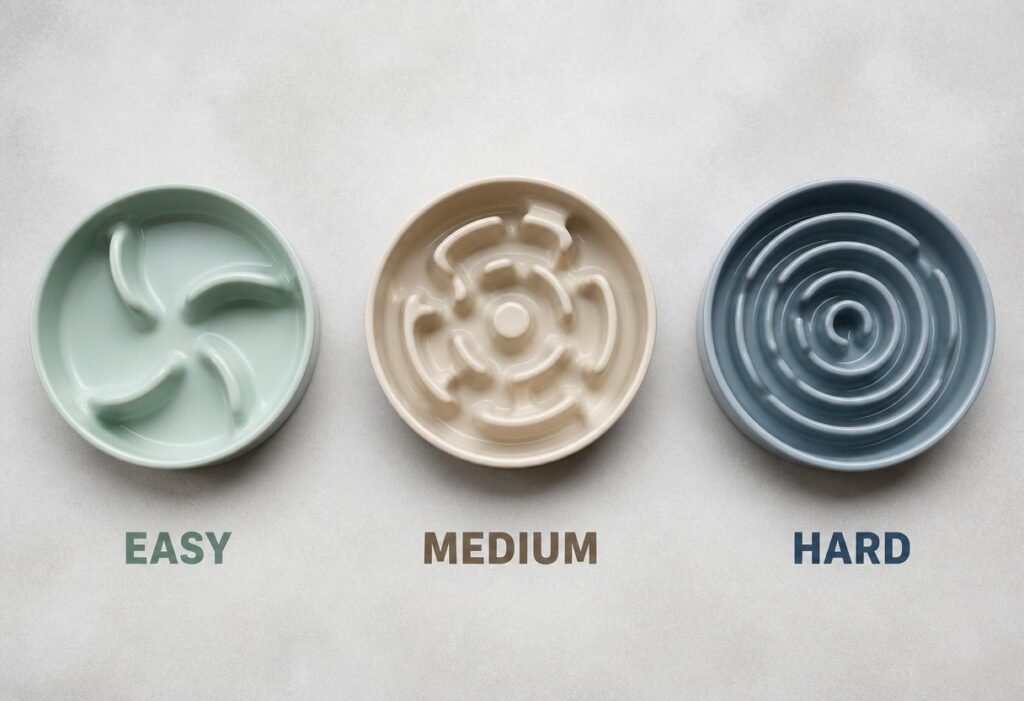
Here is the part the product listings bury. On a slow feeder dog bowl, maze patterns are not decorative — they are difficulty settings, and the gap between them is enormous.
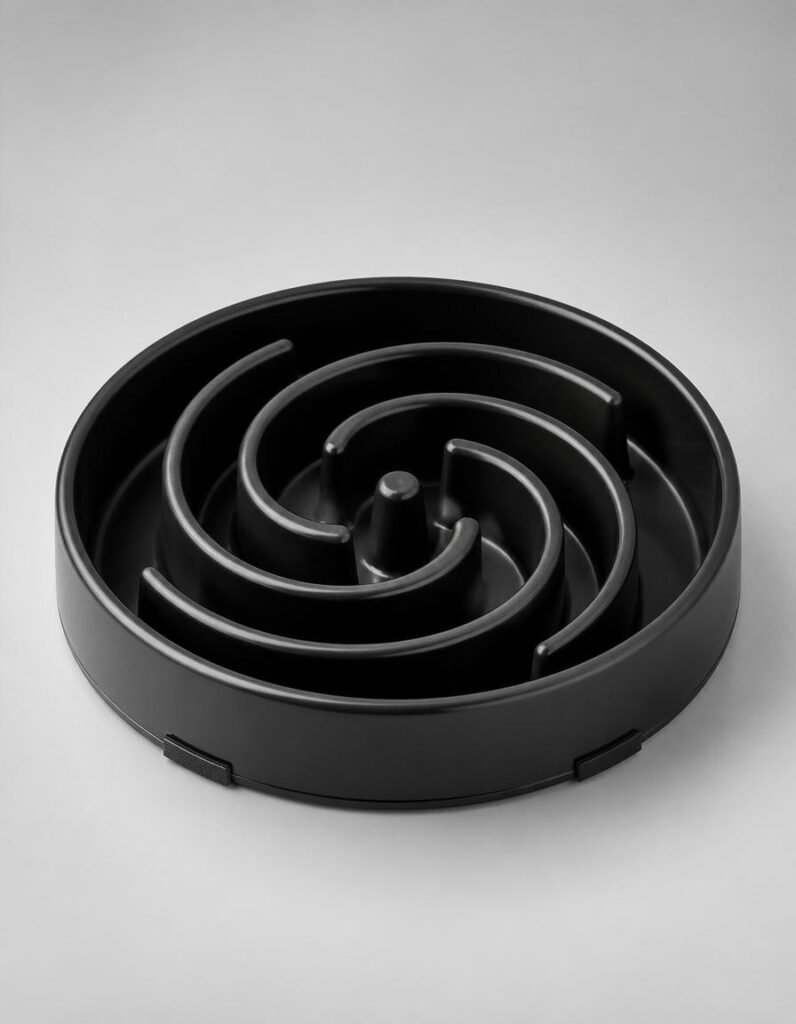
Outward Hound, which dominates this category, sorts its own bowls into three tiers it calls Slow, Slower, and Slowest. Shallow bowls with simple wide channels sit at the gentle end. Deep grooves and tight spiral mazes sit at the hard end and can stretch a meal roughly ten times longer. Same brand, same price bracket, wildly different experience for your dog.
Pick too hard, and you get the failure nobody warns you about: frustration. A dog that can’t extract its dinner doesn’t patiently persevere — it gives up, walks away, or picks the bowl up and dumps it. Neater Pets puts this well in its own product copy, describing the design goal as slowing a pet down without driving them crazy. That’s the balance you’re buying.
Three things decide where your dog lands:
- Snout shape. Flat-faced breeds — pugs, French bulldogs, Boston terriers — physically cannot reach into deep, narrow grooves. They need shallow, wide, rounded channels or a tilted bowl. This is the single most common mismatch.
- Temperament. A food-anxious or easily frustrated dog should start easy and work up. Given that anxiety is itself a bloat risk factor, a bowl that stresses your dog out is working against you.
- Current speed. A dog clearing a bowl in thirty seconds needs more resistance than one taking two minutes.
If you’re unsure, start easier than you think. You can always buy a harder bowl. Undoing a dog’s decision that mealtimes are stressful takes far longer.
Plastic, Stainless or Ceramic?
Plastic is the cheapest slow feeder dog bowl material and offers by far the widest range of maze patterns, which is why most people start there. The downsides are that determined chewers can damage it, and scratched plastic holds bacteria more readily.
Stainless steel is the hygiene and durability choice — non-porous, hard to destroy, and sensible if you feed raw or wet food. Maze designs are simpler by necessity, usually a raised centre dome rather than a complex pattern.
Ceramic splits the difference: heavy enough that flipping is difficult, non-porous, and usually the best-looking option in a kitchen. It’s also the only material here that will shatter if dropped on tile.
Our Top 7 Slow Feeder Dog Bowl Picks
1. Outward Hound Fun Feeder Slo Bowl — Best Overall
The default recommendation earns it through range rather than any single feature. This is the one line that lets you actually choose a difficulty rather than accept whatever arrives.
Three sizes cover most dogs — small at three-quarters of a cup, medium at two cups, large at three to four. Across those sizes, you get multiple maze patterns spanning all three slow levels, including shallow, simple designs for gentle slowing and deep, challenging mazes that can extend a meal up to ten times. The base is non-slip, it’s top-rack dishwasher safe, and it’s made without BPA, PVC, lead, or phthalates.
Buying advice: match the pattern to your dog, not the colour to your kitchen. The manufacturer labels the slow level on each listing — read it before adding to cart. One safety note from Outward Hound worth heeding: this is a feeder, not a chew toy, and a damaged bowl should be replaced rather than kept in service.
Best for: almost everyone, because you can pick your difficulty.
2. Leashboss Slow Feeder for Flat-Faced Breeds — Best for Pugs and Frenchies
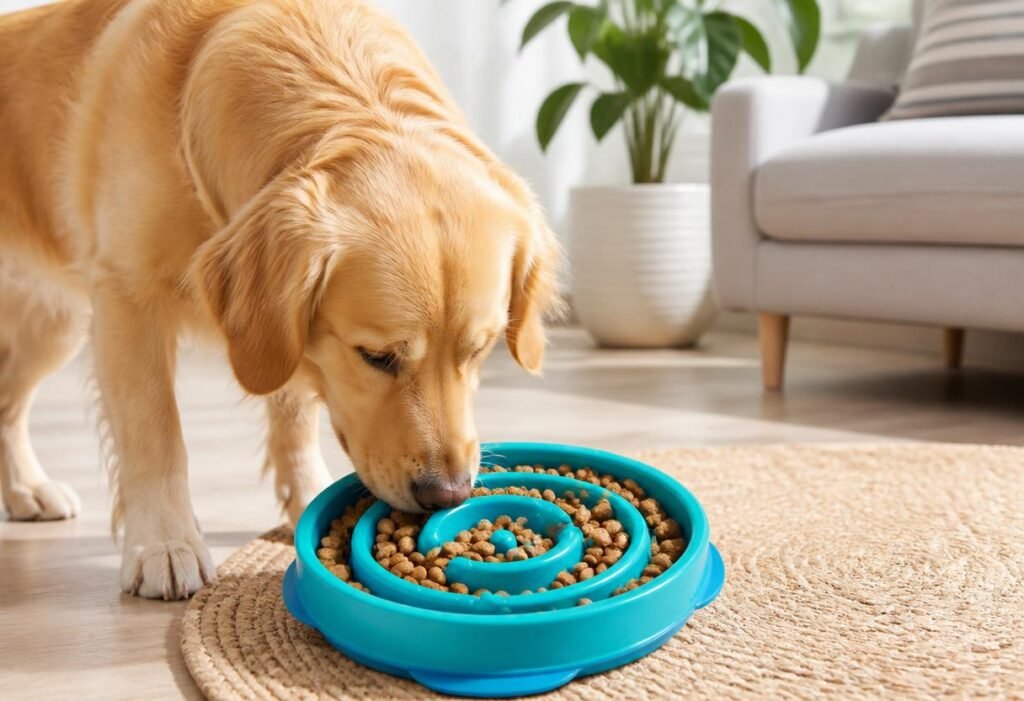
If you own a brachycephalic dog, this solves a problem that standard bowls create. Deep vertical grooves force a short-snouted dog to press its face into the plastic, which is uncomfortable and frequently ends with the dog refusing the bowl entirely.
The Leashboss design is tilted rather than flat, with a gentle incline and wide, shallow, rounded channels that let a squashed-nose dog eat without mashing its face. It holds 1.5 cups of dry, wet, or raw food, and a non-slip rubber grip keeps it from sliding while your dog works at it.
Suits pugs, French and English bulldogs, Boston terriers, Shih Tzus, and cats. It’s also a reasonable choice for any dog that has already rejected a conventional maze bowl.
Best for: flat-faced breeds and dogs that have refused a standard maze.
3. Feedoo Double-Wall Stainless Steel Slow Feeder — Gentlest Option
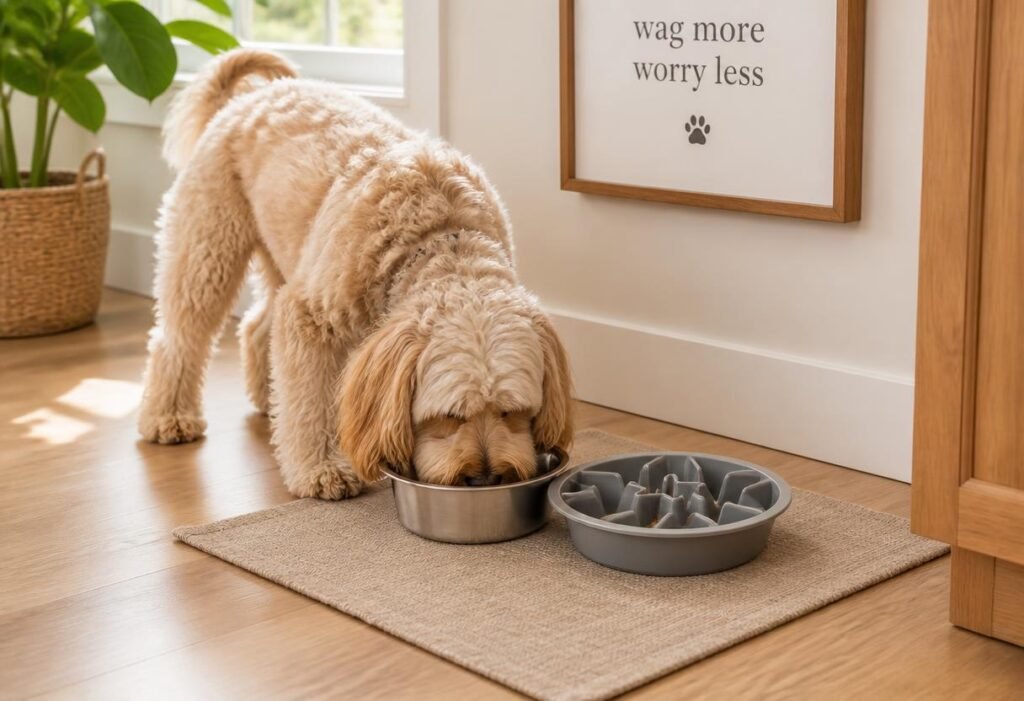
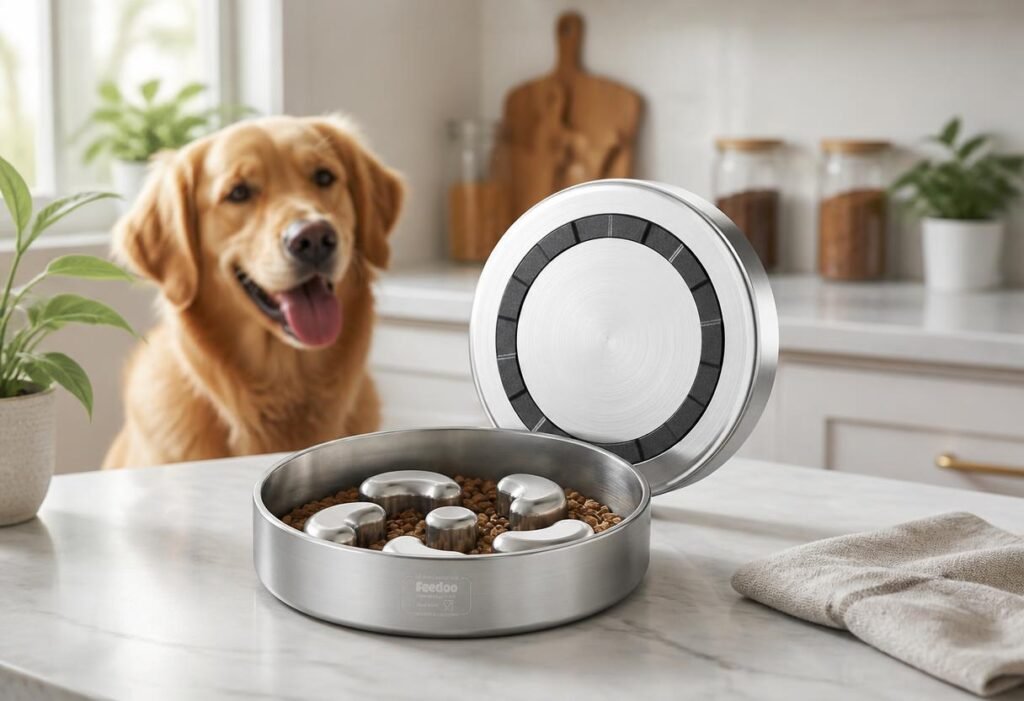
The gentlest slow feeder dog bowl here, and the pick for dogs that need slowing down but not a puzzle. The maker rates it at slowing a meal by more than three times, against the ten-times claims elsewhere — moderate resistance by design rather than by accident.
It’s built from double-layer 304 food-grade stainless steel with smooth, rounded edges, and the 2-cup version weighs just over a pound, which is enough heft to stop a dog from shoving it around. If you’ve ever looked at a deep spiral maze and wondered how any dog is meant to get food out of it, this is the answer to that instinct.
One detail worth more than it sounds: the non-slip silicone ring is bonded to the base rather than being a removable sleeve. Detachable bases trap water underneath every wash, which is a persistent annoyance with cheaper stainless bowls. It’s dishwasher safe, handles dry, wet, and raw food, and comes in capacities from one cup up to three and a half.
Best for: easily frustrated dogs, seniors, chewers, and raw feeders.
4. LE TAUCI Ceramic Slow Feeder Bowl — Best Ceramic
For the dog that treats plastic as a chew toy, or the owner who’d rather not have a bright turquoise maze on the kitchen floor.
This is a genuine ridged maze pattern in ceramic. The 8-inch version holds 1.5 cups and weighs around 2.6 pounds, and that weight is the feature — a dog can shove it, but flipping it takes real effort. It’s dishwasher safe, microwave safe if you warm food, and the glazed surface doesn’t trap residue the way scratched plastic does. A 9.5-inch, 3-cup version covers larger dogs.
The obvious trade-off is that ceramic breaks. On a tiled kitchen floor, a dropped bowl is a dead bowl, so it suits careful households more than chaotic ones.
Best for: plastic chewers, bowl-flippers, and anyone who wants it to look decent.
5. Outward Hound Stainless Steel Fun Feeder — Best for Hardcore Speed Eaters
The one to reach for when a standard bowl hasn’t worked. This pairs a stainless outer bowl with a removable maze insert carrying Outward Hound’s most challenging pattern, so you get their hardest difficulty in a material that survives abuse.
The removable insert is the underrated part. You can lift it out to clean properly, which is where deep-maze plastic bowls tend to disappoint, and you can serve a meal without it if your dog is unwell or you’re travelling. The two-cup version suits medium dogs, the base is non-slip, and it’s dishwasher safe on the top rack at low heat.
Given the difficulty level, this is the wrong first bowl for a nervous or flat-faced dog. It’s the right one for a determined gulper that has already defeated something easier.
Best for: dogs that have beaten an easier maze.
6. JASGOOD Slow Feeder Bowl — Best Budget Pick
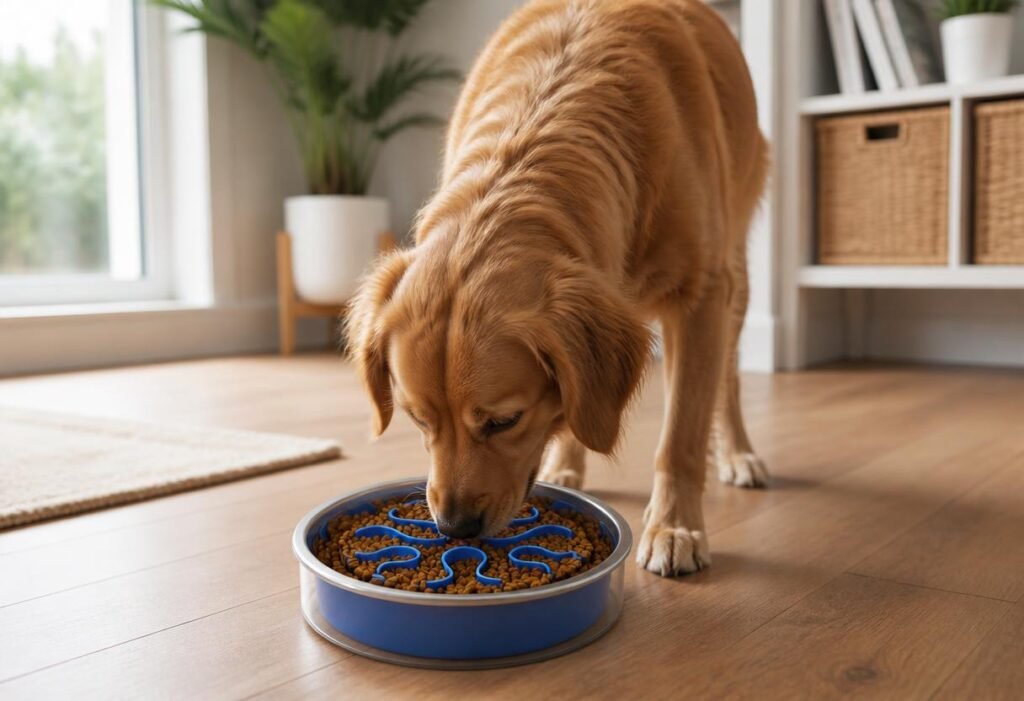
The one to buy when you are not yet sure a slow feeder will work on your dog. It runs the same spiral-maze idea as the Fun Feeder for a good deal less, which makes it a cheap way to find out whether the format suits your dog before you commit to a size and a difficulty level.
The maze sits in the middle of the difficulty range — deeper than the gentle patterns, nowhere near the hardest. Most versions ship with a non-slip ring on the base, the plastic is food-safe and dishwasher-friendly, and it holds a full portion rather than a token one.
It will not survive a determined chewer the way the stainless picks will, and the moulding is less precise, so check the base sits flat before you fill it. For a first slow feeder, that is a fair trade.
Best for: trying a slow feeder for the first time without spending much.
7. Outward Hound Fun Feeder Mini — Best for Small Dogs and Puppies
Standard slow feeders are the wrong shape for a toy breed. The channels are too deep and too wide, and a small dog either cannot reach the food or gives up trying — which is how a slow feeder ends up in a cupboard after a week.
The Mini scales the same proven maze down: shallower channels, a smaller footprint, around three-quarters of a cup. That is enough for Chihuahuas, Yorkies, Pomeranians and puppies under roughly 20 pounds to slow down without being beaten by the bowl.
If you have a puppy who will grow past that weight, treat it as a stage rather than a purchase for life — you will want the standard size inside a year.
Best for: toy breeds, small dogs, and puppies under 20 pounds.
How to Introduce One
Switching to a slow feeder dog bowl goes better if you ease into it rather than swapping dishes overnight.
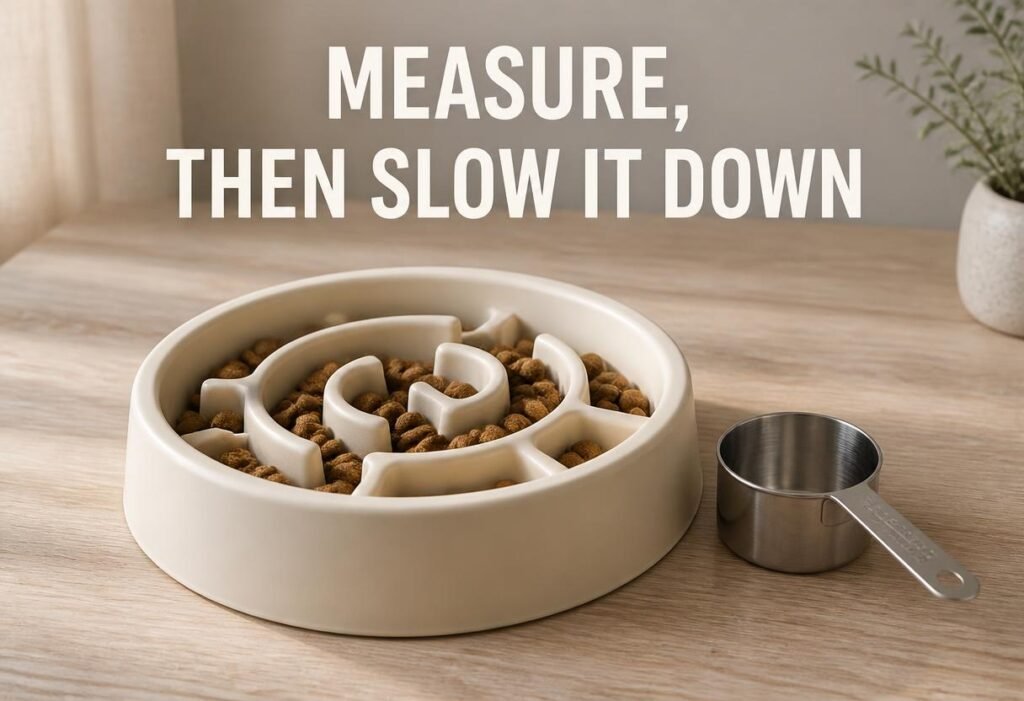
- Time a normal meal first, so you know what you’re improving on.
- For the first few meals, load the maze loosely rather than pressing food into the grooves.
- Stay nearby and calm. A dog that finds mealtime confusing takes cues from you.
- If your dog quits after a minute or two, the bowl is too hard. Go easier rather than waiting it out.
- Feed separately in multi-dog homes. Competition drives speed, and it’s an independent bloat risk factor.
- Wash it properly. Grooves that hold damp residue are the main hygiene complaint with every design here.
- Re-time the meal after a fortnight. If your dog has cracked it, step up the difficulty level.
If the maze alone isn’t enough, a lick mat is the natural companion — it stretches wet food and toppers out far longer than any bowl can, and works well for dogs that need calming as much as slowing.
Know the Emergency Signs
A slow feeder dog bowl removes the need to recognise GDV. It progresses within hours, and it does not resolve on its own. Get to an emergency vet immediately if you see:
- Retching or trying to vomit with nothing coming up
- A visibly swollen or hard, drum-tight belly
- Restlessness, pacing, or an inability to settle
- Heavy drooling
- A hunched or stiff posture with an arched back
- Rapid breathing, pale gums, or collapse
AAHA’s guide to canine bloat covers the risk factors in more depth. If you own a high-risk breed, it’s worth asking your vet about preventive gastropexy, which is often done at the same time as spaying or neutering.
Frequently Asked Questions
My dog beat the maze in a week. Did I waste my money?
No — that’s expected, and it’s documented in the research. Dogs get faster at these bowls with practice while still eating slower than from a flat dish. If the gain has shrunk too much, step up a difficulty level rather than giving up on the idea.
Can I just put a large rock or ball in a normal bowl?
It’s a recognised improvisation, and it does slow dogs down. The catch is choking and cracked teeth if the object is the wrong size or gets bitten. A purpose-made slow feeder dog bowl removes that risk for about the price of a bag of treats.
Will it help my dog lose weight?
Indirectly. It doesn’t reduce portions, but eating slowly gives satiety signals time to register, so dogs are often less frantic afterwards. Actual weight loss comes from measuring portions — the bowl just makes the same food last longer.
Are slow feeder dog bowls suitable for wet or raw food?
Yes, though cleaning matters more. Wet food packs into grooves and needs a proper wash rather than a rinse. For raw feeding, stainless steel or ceramic is the safer choice over scratched plastic.
Can puppies use a slow feeder dog bowl?
Yes, and starting early builds a good habit. Use a small, easy pattern so a puppy isn’t fighting for its dinner, and supervise the first few meals to be sure it isn’t chewing the bowl instead of eating from it.
The Bottom Line
For most dogs, the Outward Hound Fun Feeder is the slow feeder dog bowl to start with, purely because you can choose the difficulty instead of gambling on it. Flat-faced breeds should skip straight to the Leashboss tilted design. Easily frustrated dogs, chewers, and raw feeders do better with the Neater Pets stainless dome, LE TAUCI’s ceramic handles bowl-flippers, and the stainless Outward Hound is there for the dog that has already outsmarted something easier.
Match the difficulty to the dog, and the rest is detail. A slow feeder dog bowl that your dog actually uses beats a harder one it refuses.
If your dog is older or stiff and you’re weighing bowl height alongside eating speed, our guide to elevated dog bowls covers that decision, and puzzle toys are worth a look if the mental side is what your dog is short of.
This article is for general information only and is not veterinary advice. Bloat is a medical emergency — if you suspect it, contact an emergency veterinarian immediately.
As an Amazon Associate, we earn from qualifying purchases. Prices and availability are accurate as of the date of publication and are subject to change.