Most people buy a dog water bottle based on how much it holds. That’s the wrong number to shop on, and it’s why so many of these end up in a drawer after three walks — too heavy to carry, or too fiddly to use one-handed while you’re holding a leash and a poop bag.
The capacity you need is smaller than you think, and the features that decide whether you’ll actually keep using the thing have nothing to do with volume. Here’s how to work out the right size, what genuinely matters in the mechanism, and five bottles worth buying.
What’s In This Guide
- What Size Do You Actually Need?
- The Features That Actually Matter
- Our Top 5 Picks
- Water Alone Won’t Stop Heatstroke
- Frequently Asked Questions
What Size Do You Actually Need?
Start with the daily baseline. PetMD puts it at roughly one ounce of water per pound of body weight per day — so a 40-pound dog needs around 40 ounces across a full twenty-four hours, most of it at home from the bowl.
That’s the number people get wrong. A dog water bottle doesn’t need to carry a day’s worth of water. It needs to cover the gap between leaving the house and getting back, which for most people is a thirty-to-sixty-minute walk. On a mild day, a medium dog might take a few mouthfuls in that window and ignore the rest.
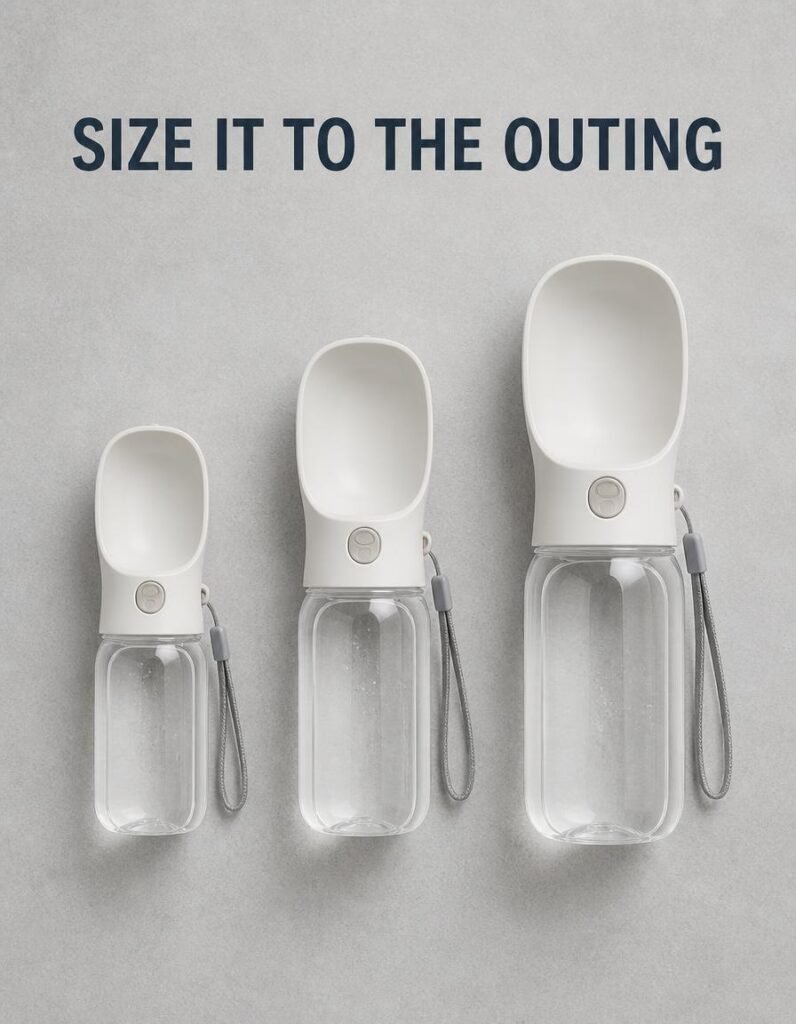
Rough guide for sizing a dog water bottle to the outing:
- Short city walks, small dogs: 10-14 oz is plenty. Anything bigger is dead weight in your hand.
- Normal daily walks, medium dogs: 15-20 oz covers almost every situation.
- Long hikes, large dogs, hot weather: 25-40 oz, and expect to carry it on a strap rather than in your hand.
Weight is the honest constraint here. Water is about two ounces per fluid ounce once you include the bottle, so a full 40 oz stainless bottle is genuinely heavy after a mile. Buy for the walk you actually take, not the hike you imagine taking.
The Features That Actually Matter
Four things separate a dog water bottle you keep using from one you abandon.
One-handed operation
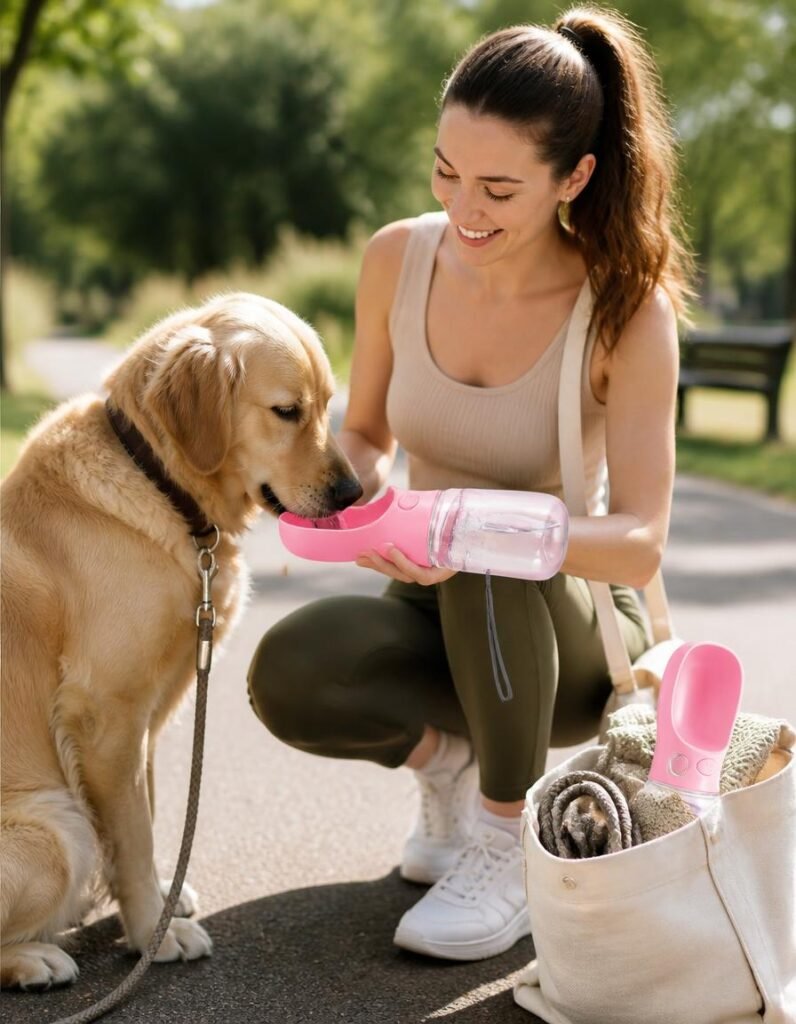
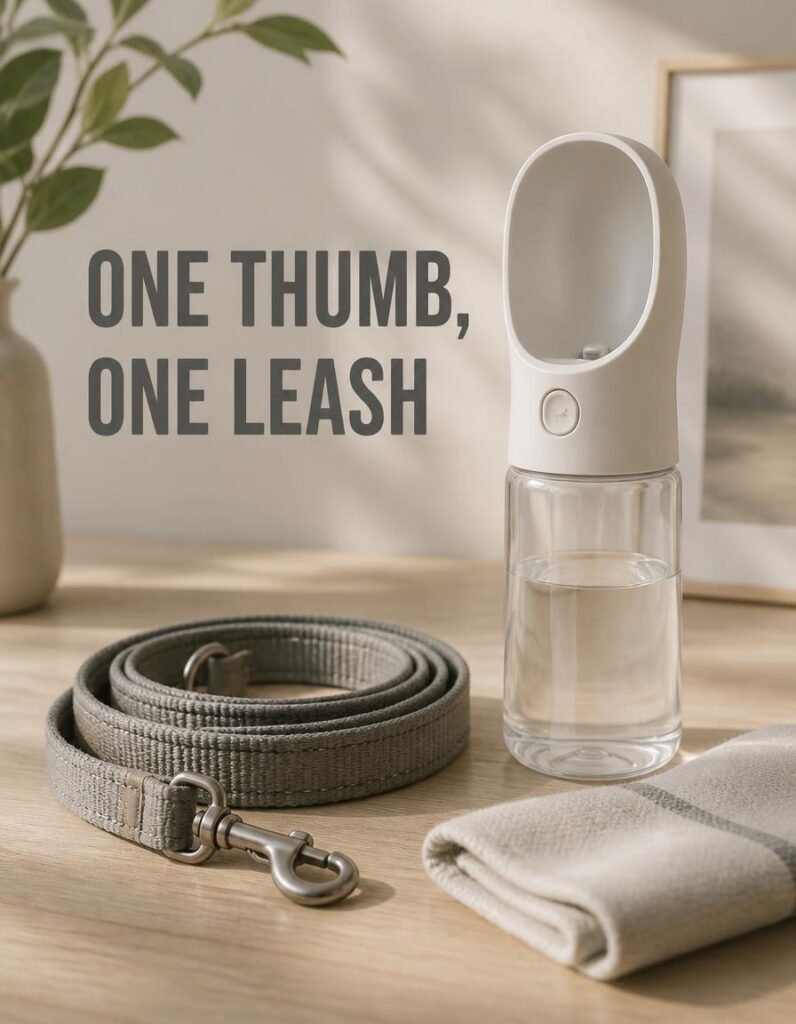
Your other hand has a leash in it. Every decent design here works with a single thumb — press a button, tilt, done. If a bottle needs two hands to open, unscrew, or assemble, you will stop bothering.
Water return
The best feature in this category is the one buyers overlook. Dogs rarely finish what you pour. Bottles that let you tilt back and send the leftover water into the reservoir mean you’re not tipping half a bottle onto the pavement at every stop.
Worth knowing the trade-off, since nobody mentions it: returned water has been in your dog’s mouth. It goes back into the bottle with whatever came off their tongue. That’s fine for a single walk, and it’s why you should empty and rinse rather than top up yesterday’s water. If sharing bothers you, a bottle with a detachable bowl suits you better than a return mechanism.
A genuine leak lock
Every product on the market says leak-proof. The ones that mean it have a physical lock switch plus a silicone gasket, not just a tight lid. This matters most if the bottle lives in a backpack.
Bowl width
A narrow trough is awkward for a big dog and nearly useless for a flat-faced one. Wide, shallow, and rounded beats deep and narrow every time.
Our Top 5 Dog Water Bottle Picks
1. MalsiPree Portable Dog Water Bottle — Best Overall
The one to buy if you just want a dog water bottle that works and you don’t want to think about it further. The 19 oz version hits the sweet spot for a medium dog on a normal walk, and it comes in 12 oz and 25 oz if your dog sits at either end of the scale.
It’s food-grade BPA-free plastic, weighs under six ounces empty, and the whole thing runs off one thumb — slide the lock, press, water flows into the built-in bowl, tilt back, and the leftovers return to the reservoir. No separate bowl to carry or lose.
One honest caveat: it’s plastic, and reviewers have reported cracking if it’s dropped hard on concrete. That’s the trade-off for the low weight and low price. If your gear takes a beating, skip to the stainless picks below.
Best for: everyday walks with a small or medium dog.
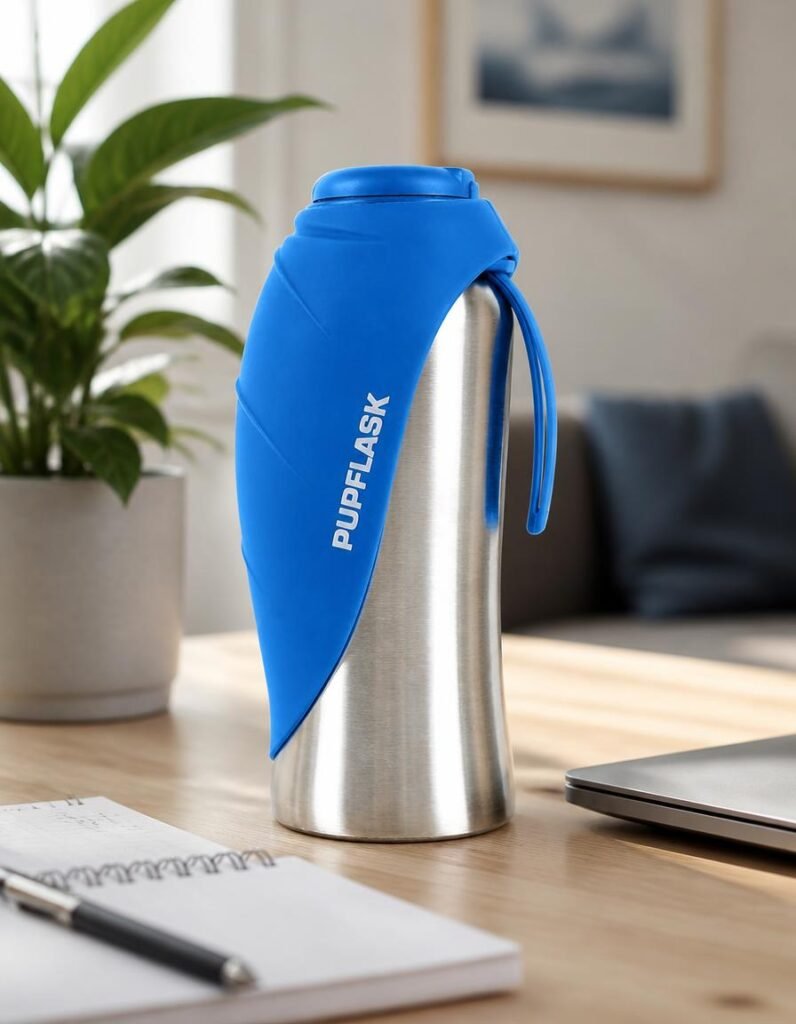
2. PupFlask Stainless Steel Dog Water Bottle — Best for Big Dogs and Long Hikes
When 19 ounces isn’t enough, this is the step up. It holds 27 or 40 ounces in surgical-grade 316 stainless steel — the good stuff, non-magnetic, and it doesn’t leach, so there’s no interior plastic liner and nothing to hold a smell after a summer in the car.
The clever part is the bowl. A thick food-grade silicone leaf flips up into a wide drinking cup and folds flat over the bottle when you’re done, so there’s no separate dish rattling around your pack. A one-button release runs the water, and the extra-wide cup means leftover water gets saved rather than spilled. It ships with a carry strap, which you’ll want at 40 ounces.
Best for: hiking, large breeds, and anyone who’s already broken a plastic bottle.
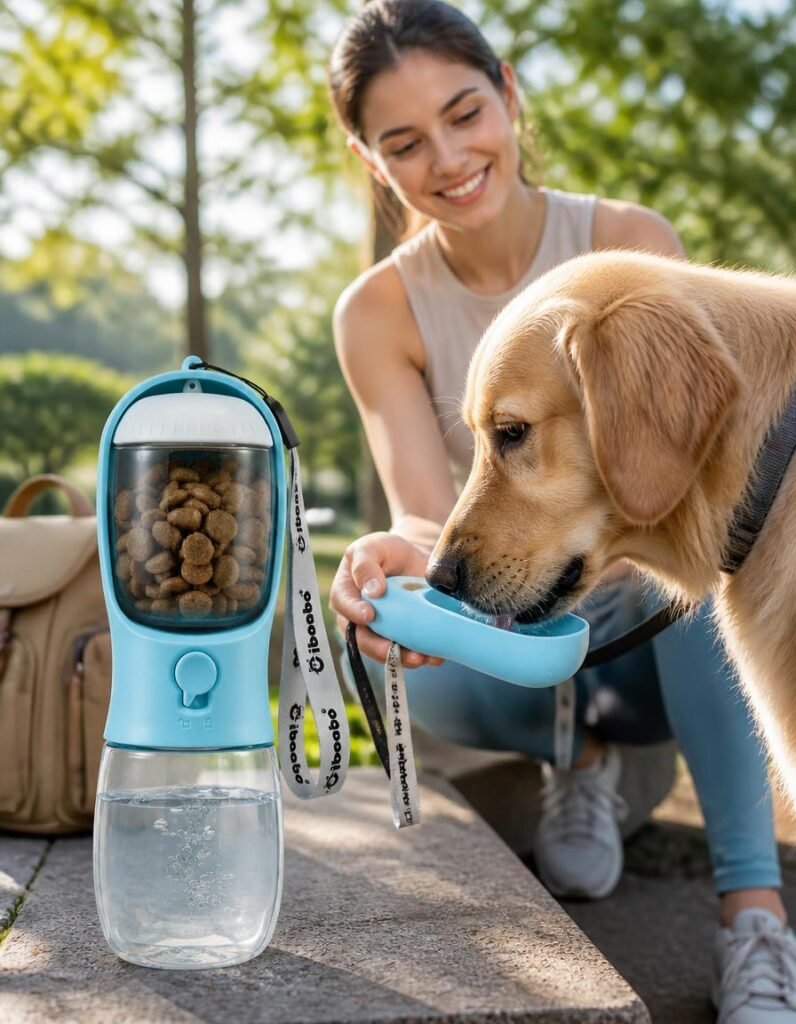
3. Cibaabo Dog Water Bottle with Filter and Treat Container — Best Filtered
The pick if you fill up from public taps, park fountains, or a hosepipe. There’s a carbon filter built into the bottle, which cleans up the taste that makes some dogs turn their nose up at tap water.
The genuinely useful extra is the treat container clipped to the bowl — around 100g of space, which is enough for a handful of training treats. On a long walk, that means water and rewards in one hand instead of two pockets. It’s a one-button operation, with a silicone loop and a twist lock, and water flows back into the bottle when you’re done rather than onto the pavement. Two sizes: 10 oz for small dogs and short walks, 19 oz for bigger dogs and hikes.
One thing to watch: the lock switch has to be turned back after every use, or it can seep into a bag. That’s true of most bottles in this category, but this one’s manufacturer says so outright rather than pretending otherwise.
Best for: refilling on the go, fussy drinkers, and anyone who carries treats too.
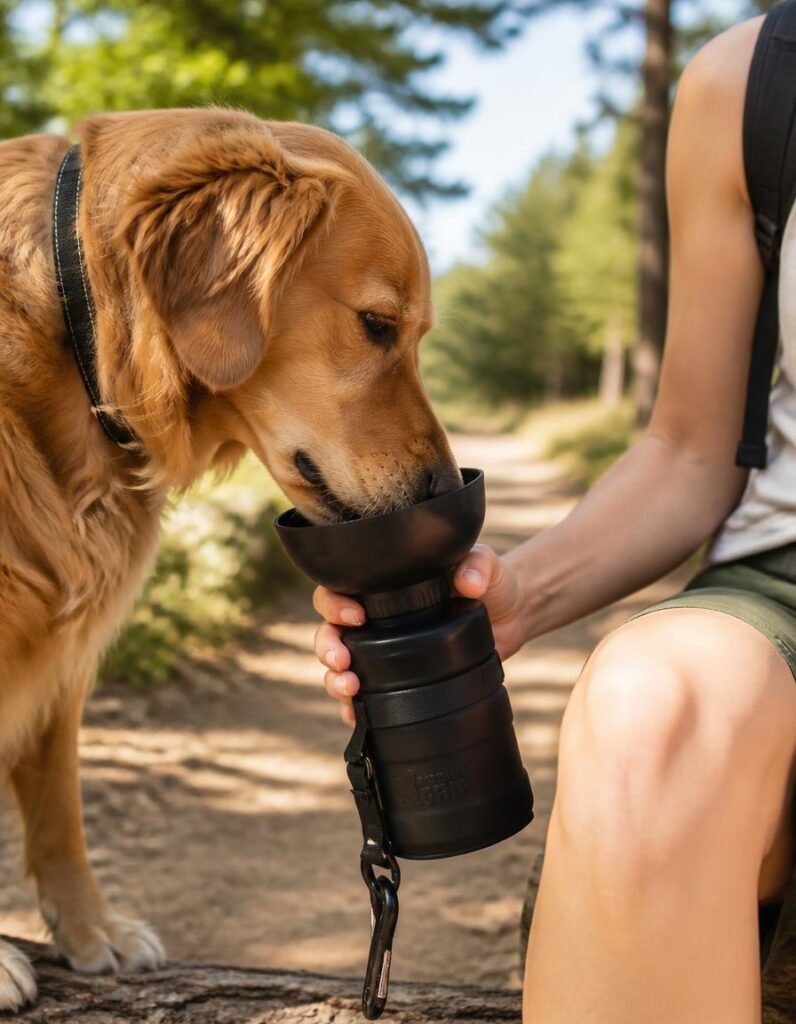
4. Gorilla Grip Dog Water Bottle — Best Lightweight Squeeze Bottle
A different mechanism from everything else here, and a good one. Rather than a button, you squeeze the soft silicone body to push water up into a flip-up bowl, then unlock and squeeze again to drain the leftovers back in. It’s the most intuitive design in this roundup — nobody needs instructions to squeeze a bottle.
It ships with a strap and a carabiner, which matters more than it sounds — a bottle clipped to your bag gets taken, a bottle you have to carry gets left behind. The whole thing is BPA-free, food-grade silicone, and dishwasher-safe, and a twist lock at the base of the bowl seals it for a backpack. Three sizes: 12 oz, 16 oz, and 20 oz.
Two honest drawbacks from owners: the 12 oz is small enough to be fiddly to grip and twist, and the silicone bowl can be stiff to unscrew if it’s been done up tight. Sizing up to 16 or 20 oz solves the first one.
Best for: clipping to a bag, and anyone who wants the simplest possible mechanism.
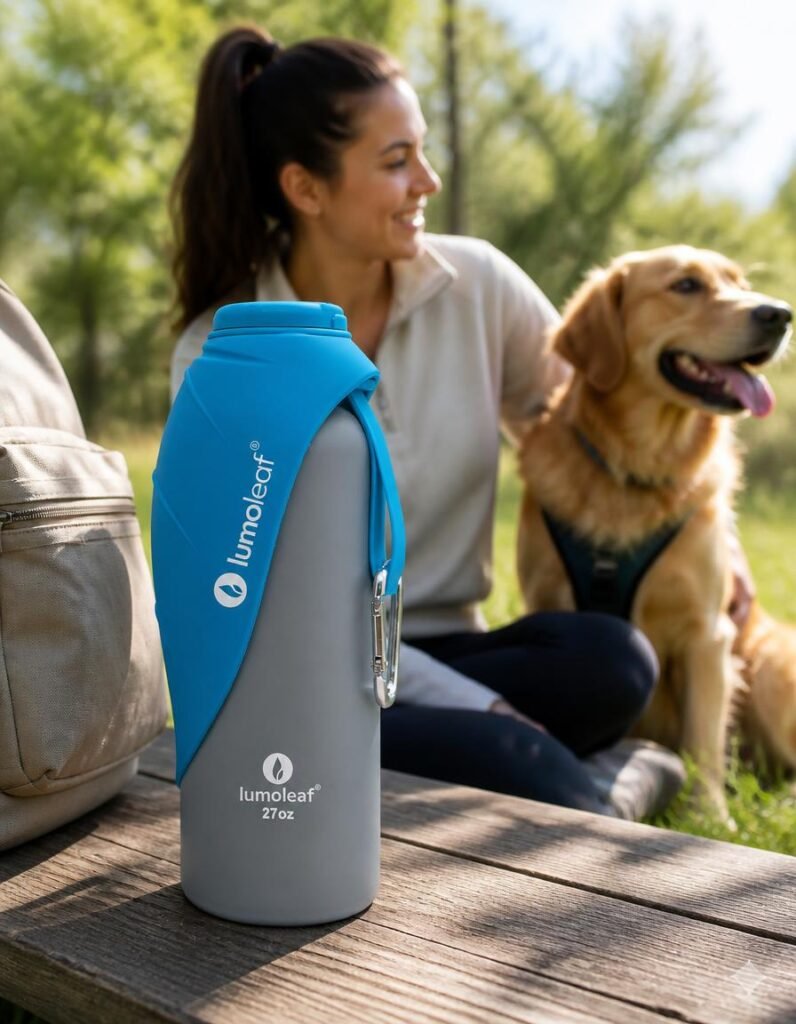
LumoLeaf Insulated Dog Water Bottle — Best for Hot Weather
An uninsulated bottle in a hot car becomes warm water within an hour, and warm water is exactly what a panting dog won’t drink. This one is double-walled stainless steel, so what you put in stays at roughly the temperature you put it in at — cold on a hot day, or unfrozen on a cold one.
The wide mouth is the detail that makes the insulation useful: it’s big enough to drop ice cubes in, which is the difference between cool water and genuinely cold water three hours into a hot afternoon. It’s also what makes it easy to clean properly, which narrow-necked bottles never are. A flip-up leaf bowl holds 27 oz, leftover water drains back into the bottle, and a D-ring clip lets you hang it off a backpack rather than carry it.
Two practical notes: the stainless body is dishwasher safe, but the silicone cap isn’t, and the button needs closing after you pour, or it will keep seeping. At over a pound empty, this is a car-and-daypack bottle rather than something to carry round the block.
Best for: summer, road trips, and dogs who won’t touch lukewarm water.
Water Alone Won’t Stop Heatstroke
Carrying water is good practice. It is not heat protection, and it’s worth being blunt about that in August.
Dogs shed heat mainly by panting, not sweating, and a dog can overheat badly while perfectly hydrated. The surface matters as much as the water: the AKC warns that once temperatures hit 85°F and stay there, even a short outing can be risky, because you’re wearing shoes and your dog isn’t. AAHA makes the related point that dogs often keep walking on damaged pads rather than showing pain, so you have to check rather than wait to be told.
Get to a vet immediately for heavy, frantic panting that doesn’t settle, bright red or very pale gums, thick drooling, staggering or weakness, vomiting or diarrhoea on a hot day, or collapse. Heatstroke is a genuine emergency, and it moves fast.
The real protections are timing and surface — walk early or late, take grass over asphalt, and shorten the route when it’s hot. A cooling mat at home handles the recovery side, and it’s worth reading our guide to how much exercise a dog actually needs if you’re adjusting routines for summer.
Using It Without the Hassle
- Practise the lock at home before you need it one-handed on a pavement.
- Fill with cold water, not lukewarm. Dogs drink more when it’s cold.
- Offer small amounts often rather than one big drink. A dog that gulps a large volume after hard exercise is more likely to bring it straight back up.
- Empty and rinse after every walk. Don’t top up yesterday’s water — that’s how these develop a film inside.
- Take the silicone gasket out weekly and wash underneath it. That’s where the smell starts.
- Clip it to a treat pouch or belt rather than carrying it. Bottles you have to hold get left at home.
Frequently Asked Questions
Can’t I just use a collapsible bowl and my own bottle?
You can, and plenty of people do. The catch is that it’s two items to carry, two hands to use, and the bowl gets damp and lives in your bag. A combined dog water bottle solves the one-handed problem, which is the one that actually decides whether you take it.
Is it safe for my dog to drink from puddles or streams instead?
Standing water can carry giardia, leptospirosis, and blue-green algae, the last of which can be fatal quickly. Carrying your own water is the whole point — a dog that isn’t thirsty is far less interested in the puddle.
Should I worry about backwash going into the bottle?
For a single outing, no. Empty it afterwards rather than letting it sit for days, and don’t share it with your own drinking bottle. If it genuinely bothers you, choose a detachable-bowl design over a water-return one.
Plastic, stainless, or silicone?
Plastic is the lightest and cheapest, but it cracks if dropped. Stainless lasts indefinitely, doesn’t hold smells, and is the only one that insulates — at a weight cost. Silicone packs down the smallest but is fiddlier to clean.
How much should my dog drink on a walk?
There’s no fixed figure — offer water every twenty minutes or so in warm weather and let your dog decide. A dog refusing water on a hot walk isn’t necessarily fine; it can be an early sign they’re overheating rather than that they aren’t thirsty.
The Bottom Line
For most people, the MalsiPree at 19 oz is the right dog water bottle: light, cheap, one-handed, and sized for the walk you actually do. Scale up to the stainless PupFlask for hikes and big dogs, or the insulated Pro if you’re dealing with real summer heat. Cibaabo’s filter earns its place if you refill from public taps, and the Gorilla Grip clips to your bag and needs no explaining.
Whichever you pick, size it to the outing rather than the day, and get one you can work with a single thumb. That’s the difference between a dog water bottle you use and one that lives in a drawer.
Getting kitted out for a new dog? Our new puppy checklist covers the rest of the gear worth buying first.
This article is for general information only and is not veterinary advice. Heatstroke is a medical emergency — if you suspect it, contact a veterinarian immediately.
As an Amazon Associate, we earn from qualifying purchases. Prices and availability are accurate as of the date of publication and are subject to change.