
DailyPetPicks is reader-supported. When you buy through links on our site, we may earn an affiliate commission at no extra cost to you.
You run a roller over the couch cushion, and it comes up loaded. You take the same roller to the back seat of the car, and it picks up almost nothing. Most people read that as a quality problem and go looking for a stickier tool.
It isn’t a quality problem. Hair lying on top of fabric and hair worked down into fabric are held there by two different forces, and stickiness only defeats one of them. Once you see that, the whole category makes sense: a dog hair remover that fails on your stairs is not a bad product; it is the wrong tool pointed at the wrong surface. This guide sorts the five picks below by the job each one actually does, tells you which surface each one fails on, and covers the free laundry step that does more than any dog hair remover you can buy.
Why is dog hair harder to shift than lint?
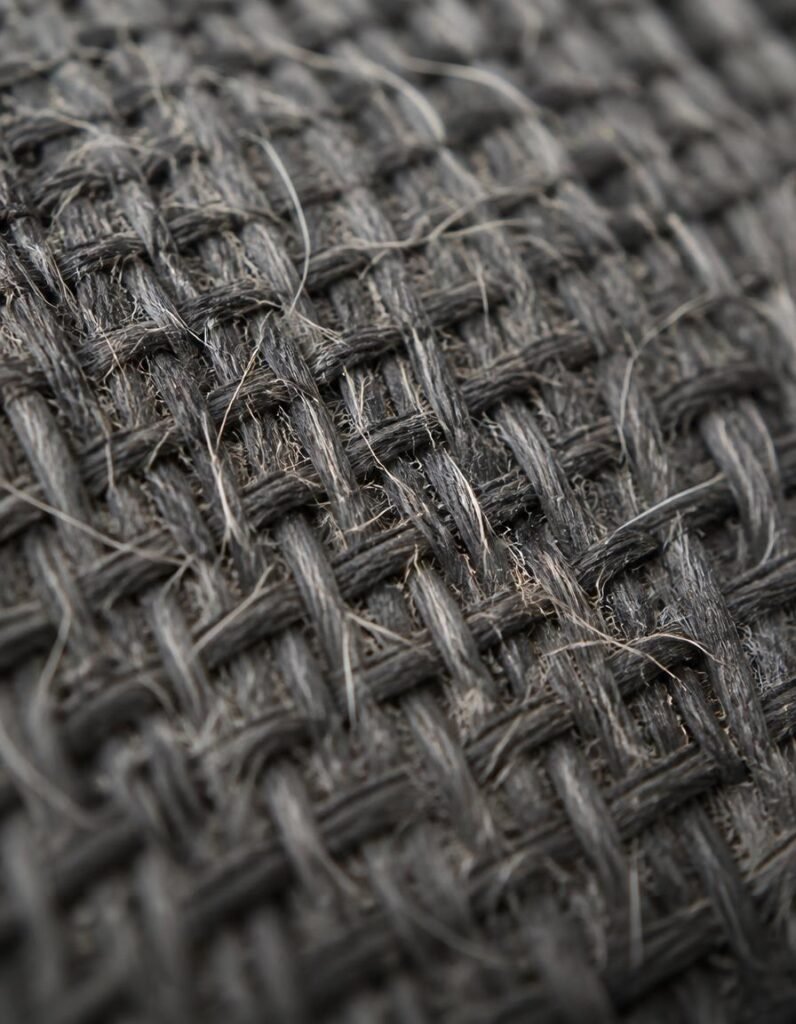
A strand of dog hair is not a smooth filament. Its outer layer is made of overlapping scales, like roof shingles laid along the shaft. When that strand lands on a woven fabric and gets pressed in — by a dog lying down, by you sitting on it — the scales catch on the threads. Pulling the strand back the way it came works against every one of those scales at once. It behaves like a barb.
Two other things pile on. Fabric and hair build a static charge against each other, especially synthetics in dry indoor air, and that charge holds the hair flat to the surface. And hair carries skin oil, which acts as a mild adhesive. So you are fighting mechanical hooking, an electrostatic bond, and a sticky film, all at once.
That matters for one practical reason. An adhesive sheet or a reusable roller only lifts what its surface can touch. If the hair is hooked below the surface of the weave, no amount of extra tack will reach it. This is the single most common reason a dog hair remover gets a one-star review: it was doing exactly what it was built to do, on hair it was never able to reach.
The two jobs a dog hair remover has to do are
Job one is surface hair. Loose strands sitting on a couch cushion, a fleece throw, a made bed, a jumper you just pulled on. This hair is barely attached. Anything tacky or anything that generates a little static will collect it, and the only real questions are how much the tool holds before it stops working and how annoying it is to empty.
Job two is embedded hair. Strands driven down into carpet pile, into the weave of car upholstery, into the seams and piping of a sofa. Here, collecting is the second step. The first step is dragging the hair back up out of the pile, and that takes friction, not tack — a rubber or silicone edge pulled against the nap in short strokes.
Almost everybody buys a dog hair remover for job one and then judges it on job two. You buy a roller because the couch looks bad, it fixes the couch, and then you drag it across the stair carpet and decide the thing is useless. It isn’t useless. It has no mechanism for lifting hair that has been pressed below the surface, and the listing never claimed one.
If your home has both problems — and if you have carpet and a car, it does — one dog hair remover will not cover you. Two cheap tools that each do one job beat one expensive tool doing half of each.
How to choose: match the tool to the surface
- Reusable roller (fur bin type). Needs a taut surface to work against. Brilliant on cushions, mattresses, dog beds, and car seats, you can press flat. Poor on anything slack — a shirt hanging loose has nothing to push back.
- Adhesive sheets. Work on slack fabric because you press down rather than drag. This is why the humble sticky roller still wins on clothing. The real spec is sheet width and sheets per dollar, not the word “extreme” on the packet.
- Rubber edge or rubber broom. The only category in this list with a mechanism for embedded hair. Carpet, rugs, stairs, car footwells, woven upholstery.
- Laundry aids. For anything that goes through the wash anyway: bedding, blankets, dog beds, your own clothes.
One more filter before you spend on any dog hair remover: the upstream fix is cheaper than all of it. Hair you catch on the dog never reaches the sofa, so a decent deshedding session does more than a drawer full of gadgets. Our roundup of dog grooming tools under $30 covers that side, and the guide to reducing dog shedding explains how much of it is actually controllable.
The 5 best dog hair remover picks
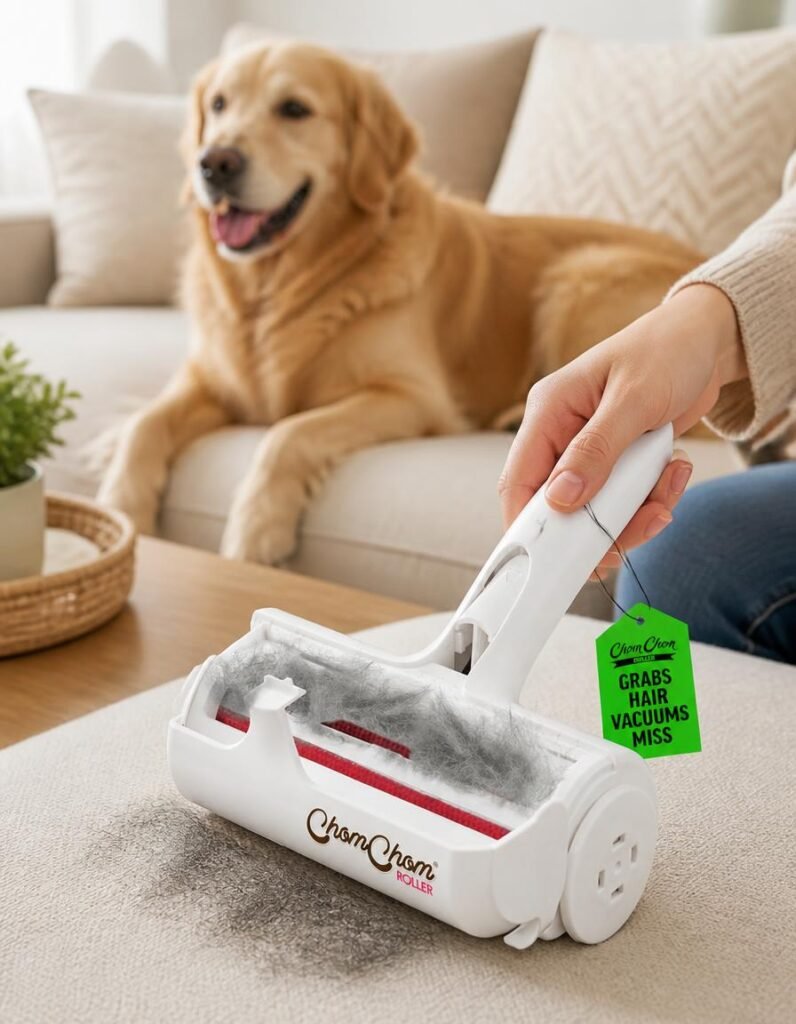
1. ChomChom Roller — best all-round dog hair remover for furniture
The one everybody has seen. It is a reusable roller with a two-direction head and a fur bin: you push and pull it across the fabric, the hair collects inside, and you press a release to empty it. No sheets, no refills, no running out at the worst moment.
It earns the top spot on Job One, and it is genuinely better at it than a sticky roller because it works by friction and static rather than adhesive, so a full bin doesn’t mean a dead tool. On a couch, a bed, a fabric car seat, or a dog bed, it will pull up more in three passes than a lint roller does in fifteen.
Watch out for: it is the most expensive thing on this list and sits close to our $30 line, so buy it for the surface you clean most, not as a general-purpose answer. And note where the maker points it — couches, pillows, bedding, rugs. Carpet is not the pitch, and the deeper your pile, the less it will do. Pair it with pick four rather than expecting it to cover both jobs.
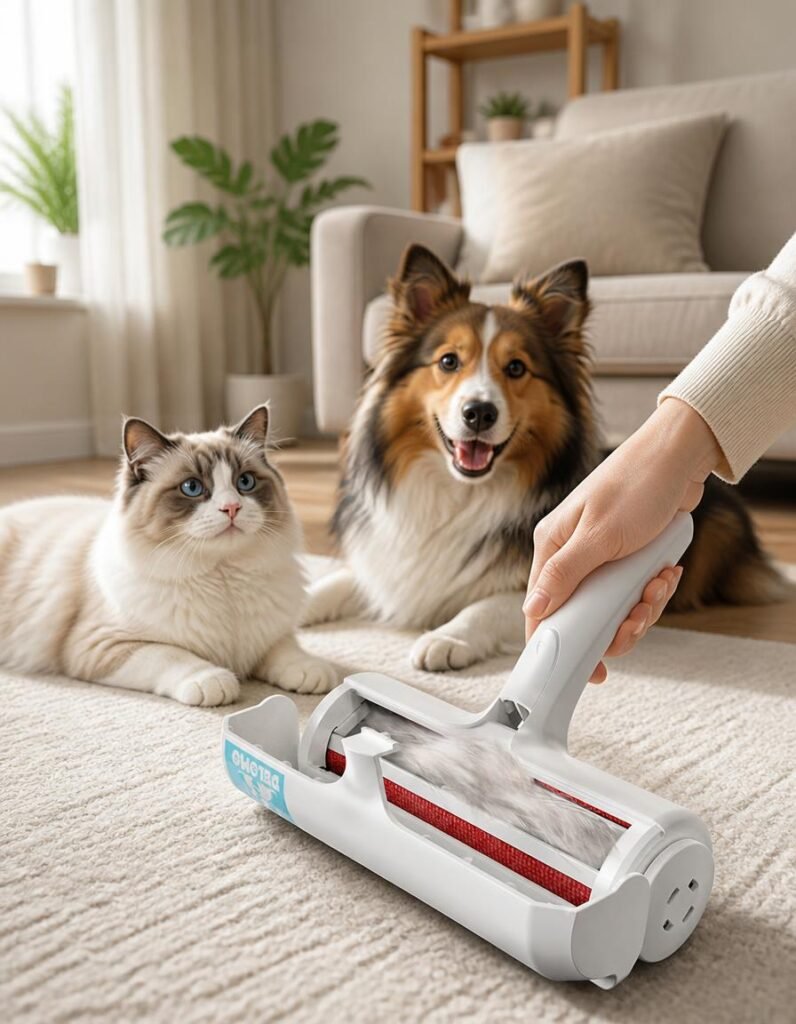
2. DELOMO Pet Hair Remover Roller — best value
Same idea as pick one at roughly half the money: a self-cleaning roller with a large fur bin, no batteries, and no consumables. If you have never owned a reusable dog hair remover and you are not sure it will earn its keep, start here rather than at the top of the range.
The large bin is the practical difference from the cheaper no-name versions of this design. A small bin on a heavy shedder means you are emptying it every couple of passes, which is exactly the friction that puts a tool in a cupboard forever.
Watch out for: the roller surface is not meant to be rinsed under the tap — the listing says to wipe it with a damp cloth instead. Soaking the brush face is the usual way these get ruined. Same limitation as pick one on deep carpet.
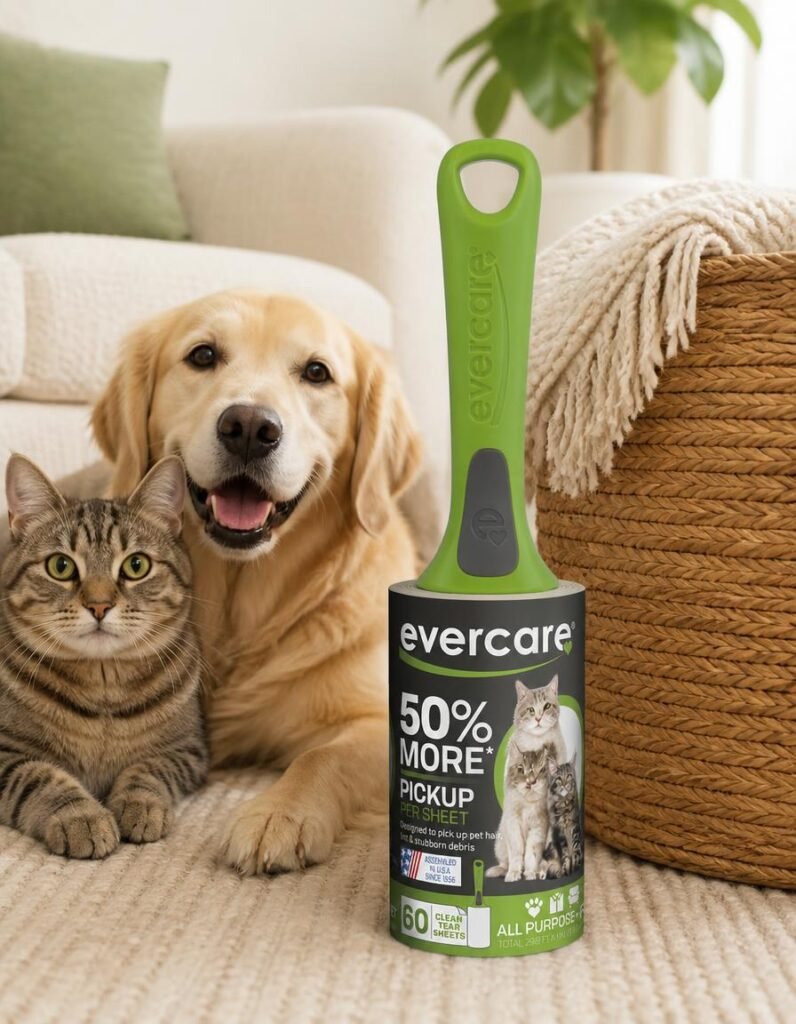
3. Evercare Extra Sticky Lint Roller — best for clothes
Yes, the boring sticky roller is still on the list, and it is the right dog hair remover for one specific job. A reusable roller needs something to push against. Held up in one hand, a shirt or a pair of trousers simply moves with the tool. An adhesive sheet works by contact pressure instead, so it doesn’t care whether the fabric is taut.
Buy the refillable body and refill it. The handle is a one-off cost, and the sheets are forever, so the number that decides value is sheets per dollar and the width of the roll, not how loudly the box says extra sticky. A wider roll means fewer passes down a trouser leg, which is the only thing that makes anyone actually use it on the way out the door.
Watch out for: adhesive is single-use by nature. Once a sheet is loaded, it cannot give the hair back, so you peel and bin it, and on a heavily furred coat, you can burn through a lot of sheets. Keep this one for clothing and let the reusable tools handle the furniture.
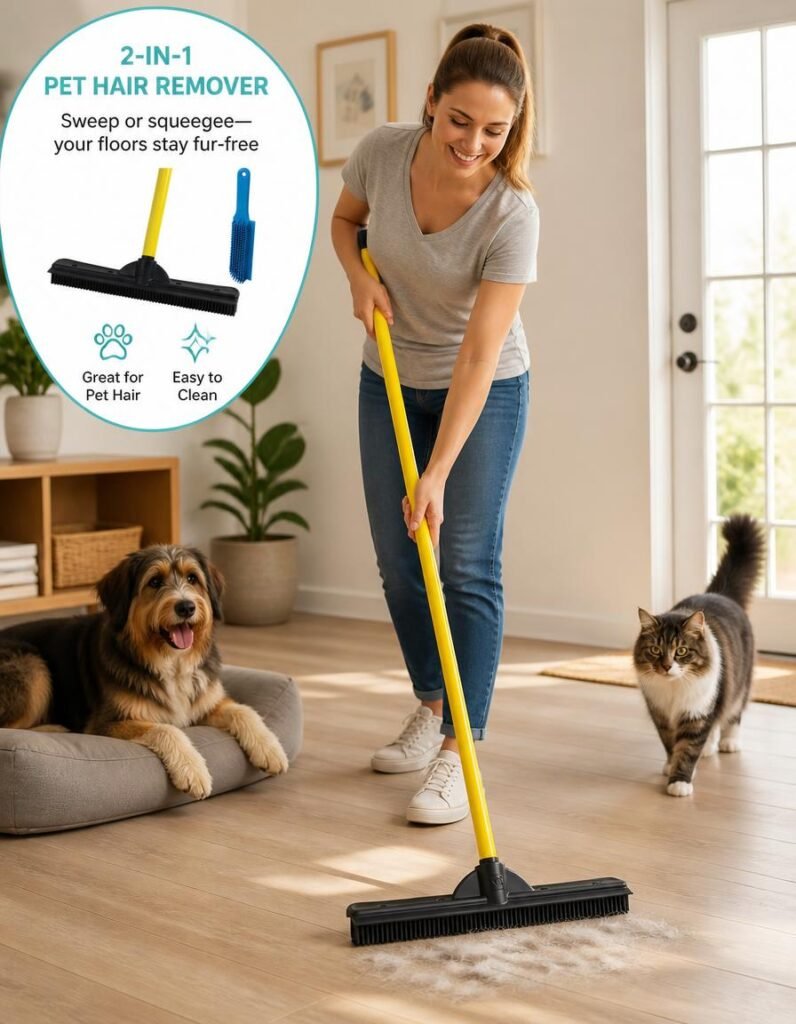
4. FURemover Rubber Broom with Squeegee — best for carpet, stairs, and the car
This is the job-two tool, and it is the dog hair remover most households are actually missing. A natural rubber head on a telescopic handle, with a squeegee edge on the reverse. You pull it toward you in short, sharp strokes, and it drags embedded hair up out of the pile into a ridge you can pick up or vacuum.
The brand makes the point itself: its own listing instructs short, sharp strokes specifically to bring embedded hair to the surface, and claims that even pet-specific vacuums cannot match it on that. Treat the vacuum comparison as marketing — but the instruction is the honest part, and it tells you this is a drag-and-lift tool, not a collector. The long handle also means that stairs and car footwells stop being a kneeling job.
Watch out for: it leaves you with a pile of hair to collect, so it is a step in a process rather than a finished answer. Rinse the rubber head under the tap when it clogs. And if your car is where the problem lives, a fabric barrier is the cheaper long game — see our picks for dog car seat covers.
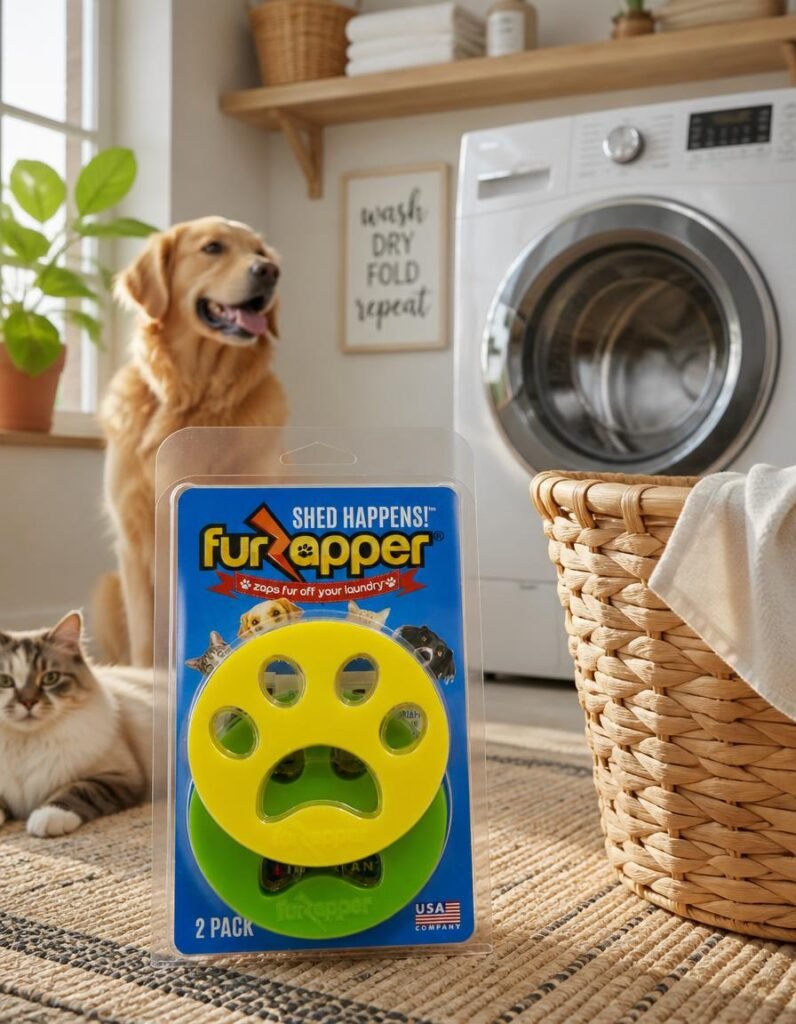
5. FurZapper 2-Pack — best for laundry
Two tacky silicone discs that go into the washer with the load and then into the dryer with it. They loosen hair as the load tumbles, so it ends up down the drain or in the lint trap instead of being redeposited on everything. It is the one dog hair remover here that works while you do something else. For dog blankets, bedding, and the covers off your dog’s bed, this is the one that saves real time.
What makes it worth including is how frank the current listing is. It states that results vary by fabric, hair type, load size, and machine; that heavily furred items should have the loose fur taken off first; and that it will not clear heavily embedded hair in a single cycle. That is a laundry aid describing itself as a laundry aid, which is more than most of this category manages.
Watch out for — and this one matters: the listing tells you not to use fabric softener or dryer sheets with it, because they coat the silicone and kill the tackiness. That directly conflicts with the standard laundry advice in the next section, which calls for a dryer sheet. You have to pick one method or the other. Do not run both and expect either to work.
The laundry step nobody sells you
Here is the part that costs nothing and outperforms every dog hair remover on this page for anything washable.
Do not put a hairy blanket straight into the washer. Consumer Reports explains what happens when you do: once water is added, pet hair clumps, and those wet clumps stick to fabric and to the drum and work their way into the drain pump. You have not removed the hair. You have moved it somewhere more expensive.
The sequence they recommend instead is a ten-minute no-heat tumble in the dryer first — the air-fluff setting — with a dryer sheet to break the static bond. The hair lifts off and lands in the lint trap. Shake the items out, then wash them. Clean the lint filter afterwards. They also suggest half a cup of white vinegar in the rinse cycle to help fibres release, with the sensible caveat that you should check your manual first, because repeated vinegar use does not suit every machine.
So the honest ordering is: shift the loose hair with a dog hair remover, run the no-heat tumble, then wash. If you are using the FurZapper discs from pick five, drop the dryer sheet from that sequence and let the discs do the destaticking instead — they cannot work through a softener film.
Why it matters beyond the couch looking tidy
The thing that makes people react to dogs is not the hair itself. It is a set of proteins in dander, saliva, and urine, and the hair is mostly a delivery vehicle carrying them around.
That vehicle travels farther than you would guess. A national survey of 831 US homes found the dog allergen Can f 1 essentially everywhere, including in homes that had no dog, and the researchers pointed at transport on clothing as the reason. A separate study of cars, homes, and classrooms found meaningful dog allergen levels in the cars of dog owners even when the dog was not being carried in them, and higher levels in schools than in homes without pets.
Read plainly, that means the pass you make over your coat before you leave the house is not vanity, and the car seats are not a cosmetic problem. Be realistic about the limits, though: taking hair off a surface reduces the carrier; it does not neutralise the protein, and anyone with a diagnosed dog allergy in the household needs a proper plan from their doctor rather than a better roller.
What to skip
- Stickiness claims with no numbers behind them. “Fifty percent stickier” is a comparison to the same brand’s own standard product, not to anything you might buy instead. Sheet count, sheet width, and price are the figures that decide it.
- Grooming gloves are sold as furniture tools. A silicone glove is a good thing to use on a dog. On upholstery, it mostly gathers hair into drifts that you then have to pick up by hand.
- “Magic” brooms with hard plastic bristles. The mechanism in Pick Four is the rubber. A stiff plastic imitation at the same price is a broom, and a broom skates over embedded hair.
- Buying a whole new adhesive roller each time. Refills exist and cost a fraction of a fresh handle.
- Waiting for a single dog hair remover to do everything. It is not coming. The tools that beat the couch are the wrong shape for the carpet, and that is physics rather than a gap in the market.
Related reading: dog drying towels that actually work.
Frequently asked questions
Does a dog hair remover work on car seats?
On flat, firm seat panels, a reusable roller does well because you can press against the padding. Where it struggles is the woven side bolsters, the seam channels, and the carpet in the footwell, and that is where the rubber broom earns its place. Cars are the hardest surface in the house, which is why so many people conclude their dog hair remover is faulty after trying it there first.
Can I wash a reusable roller?
Usually not the way you would think. Most fur-bin rollers are meant to be wiped with a damp cloth, not rinsed or soaked, because water in the brush face wrecks it. Rubber tools are the opposite — the rubber broom is designed to be rinsed clean and will keep working for years.
Do I still need a vacuum?
Yes. These tools are better than a vacuum at lifting hair out of a weave, but they are not collectors. The realistic routine is to use a rubber tool first to raise the hair, and vacuum second to take it away. Doing it in the other order is why the vacuum seems to leave hair behind.
Won’t brushing the dog solve this instead?
It solves a large part of it, and it is the cheapest lever you have — hair caught in a brush never reaches the sofa. It will not solve all of it, because dogs shed continuously rather than only during a brushing session. Regular at-home grooming plus one good dog hair remover for surfaces is a far better setup than three gadgets and no brush.
Which one should I buy if I can only buy one?
If your problem is the sofa and the bed, take the reusable roller. If your problem is carpet, stairs or the car, take the rubber broom. If the hair that bothers you is mostly on clothes and bedding, the sticky roller plus the free dryer step above will beat either of them.