DailyPetPicks is reader-supported. As an Amazon Associate, we earn from qualifying purchases, at no extra cost to you.
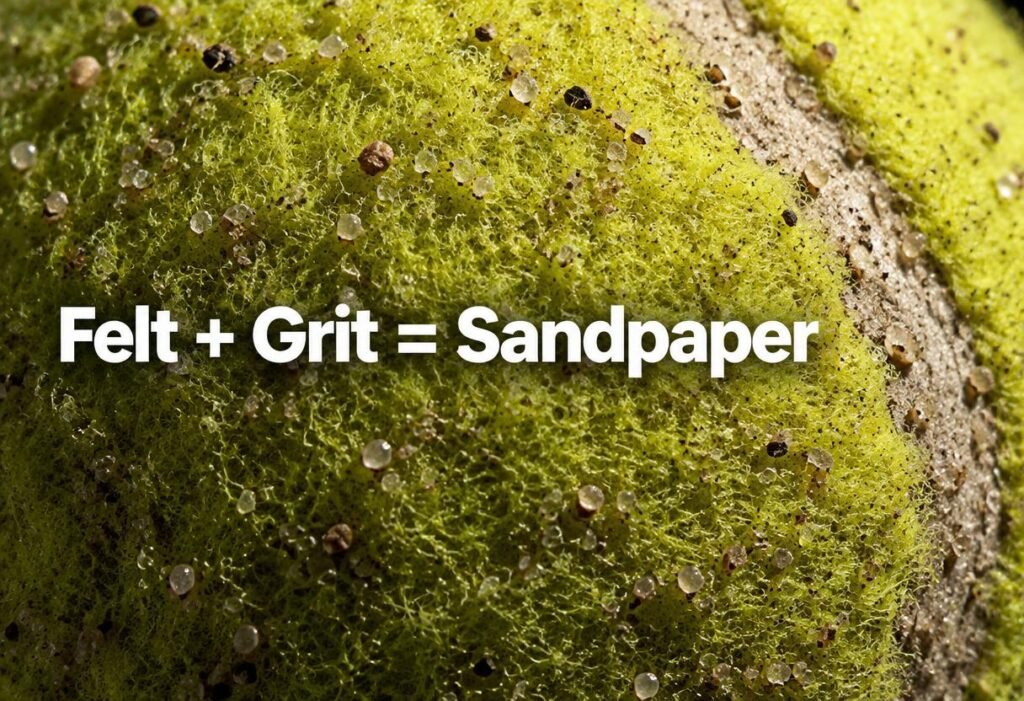
The fuzzy yellow ball is the most dog-loved toy on earth, and a board-certified veterinary dentist compares its felt to sandpaper. The fuzz on an ordinary tennis ball picks up dirt and sand, and every chomp grinds it against your dog’s teeth. Over years of fetch, that can file teeth down, a problem dentists call blunting.
You don’t have to ban fetch. You need dog tennis balls made for the job, sized correctly for your dog, and a couple of simple habits. Below we explain the two real risks, abrasion and choking, then give three picks for the best dog tennis balls, from fuzz-free rubber to a dog-specific felt ball for the dogs who simply won’t accept anything else.
Risk 1: the felt wears teeth down
In the AKC’s guide to tennis ball safety, veterinary dental specialist Dr. Thomas Chamberlain explains that the fuzz is abrasive on its own and that dirt and sand make it worse. Repeated chewing wears teeth down through blunting and can, in bad cases, expose the tooth’s pulp. New York’s Animal Medical Center says the same: its board-certified dentists note that the nap on tennis balls can wear down enamel over time and recommend fuzz-less balls instead.
The dogs most at risk are the obsessive chewers, the ones who carry a ball everywhere and gnaw it while lying down. A dog that chases, grabs and drops a ball a few times a week is in a different category from a dog that chews one for hours a day. If your dog is the second kind, fuzz-free dog tennis balls are the single best change you can make.
Risk 2: the wrong size can choke
The second danger is more sudden. The AKC warns that strong-jawed dogs can break tennis balls, and half a ball can lodge in the throat and block the airway. The Animal Medical Center shows x-rays of tennis balls and pieces in dogs’ stomachs and intestines, including one case where part of a ball lodged in the intestine and needed surgery, and it warns specifically that small balls meant for small dogs can be swallowed by larger dogs.
- Size up, not down. A ball should be too big to fit fully into your dog’s mouth behind the teeth. If in doubt, choose the next size up.
- One ball at a time. Veterinarian Dr. Marty Becker, quoted by the AKC, advises against giving a dog more than one ball at once, since a dog trying to carry two can end up with one in its throat.
- Retire damaged balls. Split, torn, or chewed-through dog tennis balls go in the bin, not back in the toy box.
- Fetch toy, not chew toy. Balls are for supervised play, then they go away.
What to skip: bulk sports tennis balls
Search Amazon for dog tennis balls and many of the top results are bulk packs of practice tennis balls, often 24 or even 80 at a time, sold as “playing balls for dogs.” They’re cheap, which is the appeal. But they’re ordinary felt tennis balls, built for rackets, with exactly the abrasive nap the dentists warn about, and many are a single standard size regardless of your dog. We don’t recommend them for daily fetch. If you already have a bucket, keep them for occasional supervised games and throw away any that get split or soggy.
The 3 best dog tennis balls
1. Chuckit! Ultra Ball, Medium (2 Pack) – best overall
The Ultra Ball is the fuzz-less ball the dentists are effectively describing: tennis-ball size and bounce, with a smooth natural-rubber surface and no felt to trap grit. It’s one of Amazon’s two best-selling dog toy balls; it floats, and its bright colour is easy to spot in long grass. The Medium is 2.5 inches across, the same as a standard tennis ball, and fits standard-size Chuckit! launchers.
We cover it in depth in our Chuckit! Ultra Ball review. The short version: it’s tough, bouncy, and the best everyday replacement for felt dog tennis balls. Pair it with a launcher, as in our Chuckit! launcher review, and you never have to pick up a slobbery ball again.
- Best for: medium dogs, daily fetch, dogs that chew balls
- Size: 2.5″ (standard tennis-ball size)
- Watch out for: too small for large and giant breeds; size up to the Large
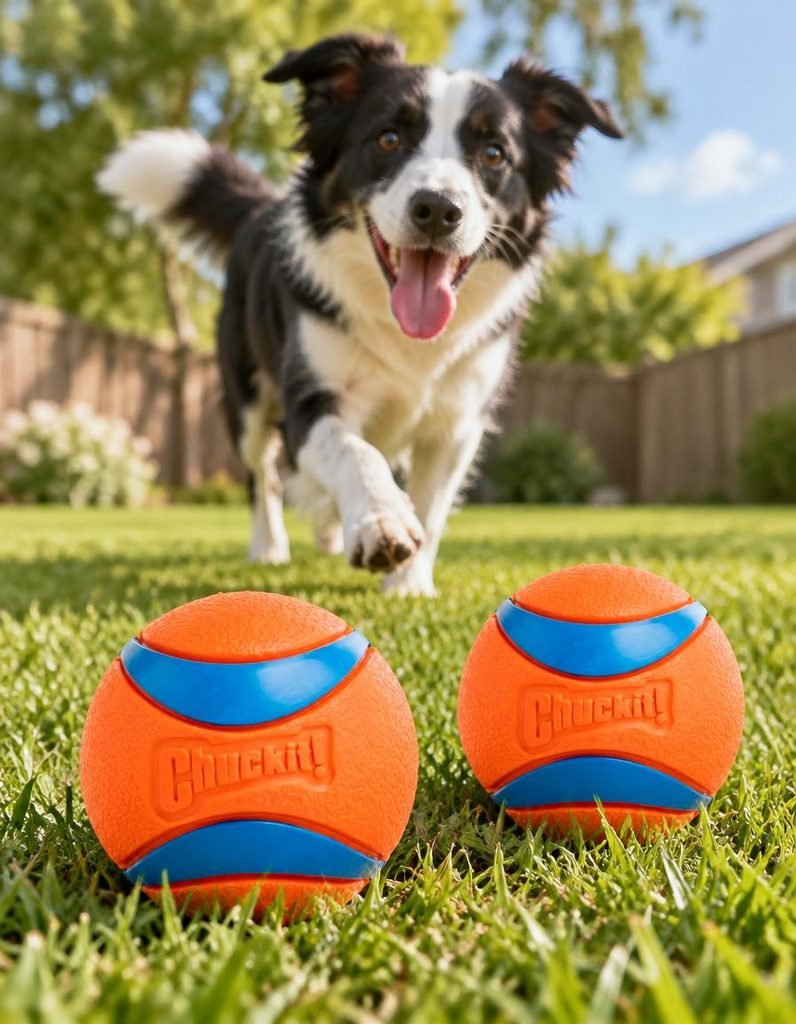
2. Chuckit! Ultra Ball, Large – best for big dogs
This is the choking advice turned into a product. Big dogs are routinely given standard 2.5-inch dog tennis balls, which sit far too comfortably at the back of a Labrador’s or a shepherd’s throat. The Large Ultra Ball is 3 inches across, listed for dogs of roughly 60 to 100 pounds, with the same fuzz-free rubber, bounce, and floating as pick 1. It’s one of Amazon’s top three dog toy balls.
For giant breeds, even this may be on the small side; if your dog can close its mouth fully around it, look at the XL size. And check that your launcher takes the larger ball, since many standard launchers are sized for the Medium.
- Best for: large breeds, roughly 60 to 100 lb
- Size: 3″
- Watch out for: needs a Large-size launcher; giant breeds may need XL
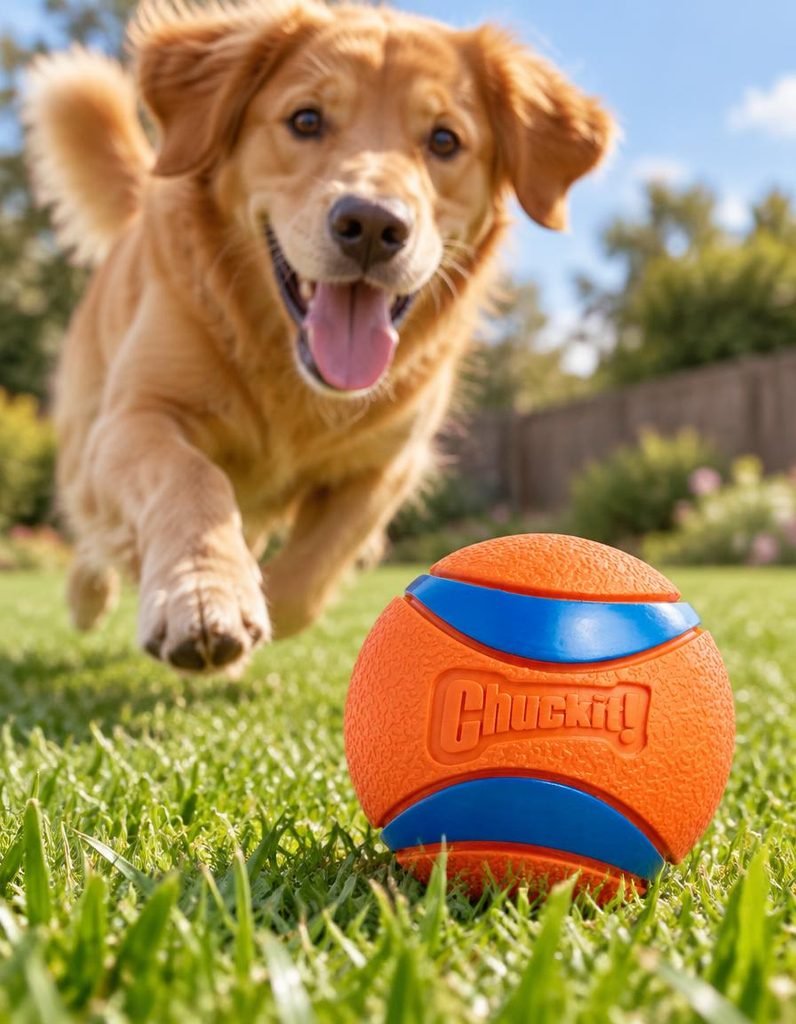
3. KONG SqueakAir Balls (3 Pack) – best for felt-ball fanatics
Some dogs flatly reject rubber. They want the fuzz. For them, KONG’s SqueakAir is the compromise: a felt-covered ball with a squeaker, made specifically for dogs. KONG states that it uses a special non-abrasive felt that won’t wear down your dog’s teeth, which is a direct answer to the blunting problem.
That’s the manufacturer’s claim, and we haven’t seen independent testing of it, so we’d still treat these differently from rubber: use them for supervised games, rinse off grit and sand after beach or sandpit play, and retire them once they’re worn bald or split. KONG itself says to supervise play and stop using the toy if it’s damaged. Pick the size that matches your dog’s weight on the listing.
- Best for: dogs that refuse rubber balls, squeaker lovers
- Material: rubber core with dog-specific felt, squeaker
- Watch out for: felt still collects dirt; not for unsupervised chewing
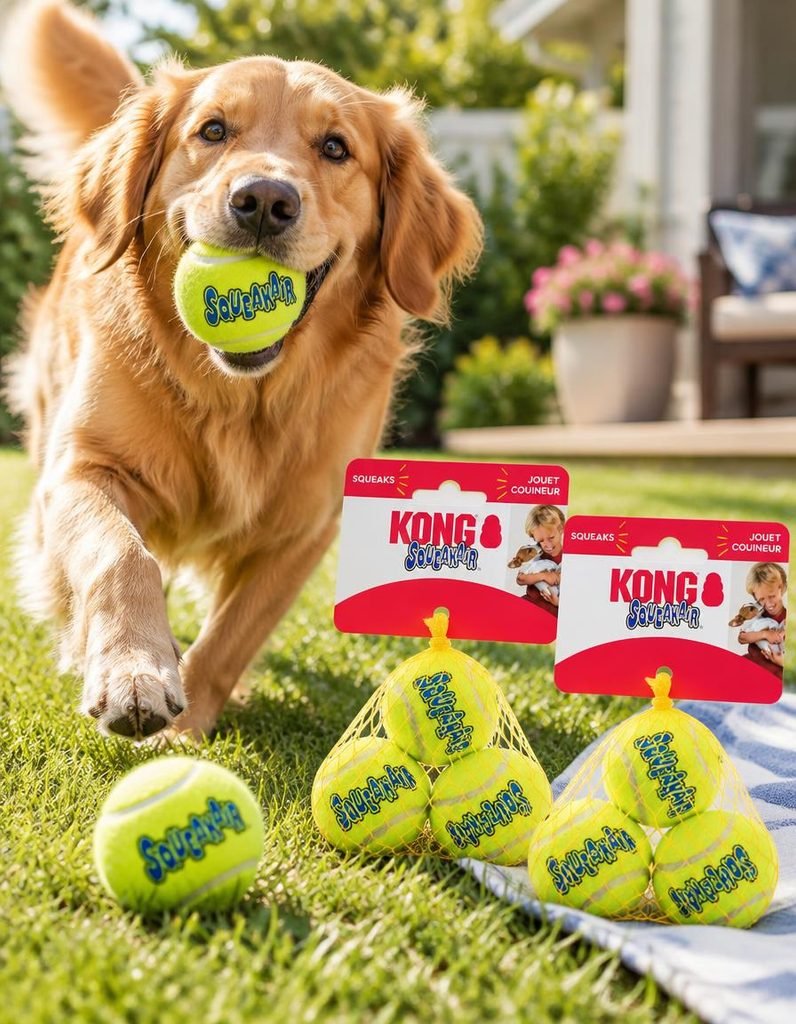
Fetch habits that protect teeth and throats

- Teach “drop it”. The AKC recommends it, and it ends the endless chewing between throws. A small training treat makes it easy to teach.
- Skip keep-away. The AKC also advises avoiding keep-away games, which encourage a dog to clamp down and chew.
- Put the ball away after the game. Give a proper chew toy for chewing time instead; our dog toys under $30 include tough options.
- Rinse after sand and beach play. Grit is what turns any ball into sandpaper.
- Check teeth now and then. Flattened, shiny or yellow-brown worn tips on the front teeth and canines are worth mentioning to your vet.
- Don’t overdo it. Repetitive high-speed fetch is tiring on joints; mix it up, and see our guide to how much exercise a dog needs.
How much hard play does your dog actually need? Answer five quick questions below for a daily exercise and play plan.
FAQ
Are tennis balls bad for dogs’ teeth?
Regular tennis balls can be. Veterinary dentists say the abrasive felt, especially when dirty or sandy, can wear teeth down over time. Fuzz-less rubber dog tennis balls avoid the problem.
What size ball is safe for my dog?
One that’s too big to fit fully into the back of your dog’s mouth. Standard 2.5-inch balls suit medium dogs; large breeds need a 3-inch ball or bigger. If you’re unsure, size up.
Can my dog chew a tennis ball unsupervised?
It’s best not to. Balls can be broken and swallowed, and pieces have caused intestinal blockages that needed surgery. Keep balls for supervised play and give a proper chew toy for chewing.
Are dog tennis balls different from regular ones?
Good ones are. Dog-specific balls use rubber with no felt, or a felt the maker says is non-abrasive, and they come in sizes for different dogs. Bulk sports tennis balls are made for rackets, not mouths.
The bottom line
The fuzz is the problem and the size is the danger. Swap felt for fuzz-less rubber dog tennis balls for everyday fetch, size up for big dogs, keep one ball at a time, and put it away after the game. The Chuckit! Ultra Ball is the best everyday pick in Medium, the Large is the safe choice for big dogs, and KONG’s SqueakAir is the compromise for dogs that insist on felt. Your dog’s teeth have to last a lifetime; the ball only has to last a season.
Still looking for something?
Find the Right Gear for Your Dog
Tell us what's going on, and we'll point you to the picks and guides that fit your dog.
Describe what you needTry: pulls on the leash sheds everywhere peeing inside crate size