
The moment you actually need a dog first aid kit, you will not be in a position to shop for one. You will be on a trail with a torn paw pad, or in a kitchen at 11 pm with a nail bleeding onto the tiles, or in a car park with a dog who has just been stung. The whole point of the thing is that it already exists, already packed, already in the boot.
Which is why the buying decision is easier than most roundups make it sound — and also why almost every pre-made kit on the market shares the same three gaps. We looked at what’s actually inside the popular kits, what independent field testers found when they opened them, and what veterinary bodies say belongs in one. Below are four kits worth buying, plus the small handful of items you should add to whichever one you pick.
What is a dog first aid kit actually for
A dog first-aid kit does not treat your dog. It buys you time. The American Veterinary Medical Association is blunt about this: first aid care is not a substitute for veterinary care, but it may keep your pet alive until you can get them to a vet. Everything in the bag exists to stop bleeding, protect a wound from dirt and licking, keep a frightened animal from biting, and get you to the clinic with the situation no worse than when it started.
That reframing matters, because it changes what you should look for. A kit with 136 pieces is not automatically better than one with 35. What you want is a small number of items that address the injuries dogs actually turn up with — cuts, torn pads, broken nails, ticks, stings, limps — packed somewhere you can find them one-handed while holding a squirming dog. The AVMA’s own first aid checklist runs to about twenty items, and most of them are unglamorous: gauze, non-stick bandages, blunt-ended scissors, tweezers, a digital thermometer, a muzzle, a spare leash, saline, gloves, a flashlight, and your vet’s phone number on paper.
The gap in almost every pre-made kit
Here’s the thing nobody selling these mentions. Pre-made kits are built around bandaging because bandaging supplies are cheap, and they make the piece count look impressive. The dog-specific items — the ones you cannot improvise from a human first aid box — are the ones most likely to be missing.
When one outdoor gear publication opened six popular kits and inventoried every item, the pattern was consistent: several had no styptic powder at all, one listed aspirin on the packaging that wasn’t inside (and shouldn’t be given to a dog without veterinary direction anyway), and more than one included 3% hydrogen peroxide as a vomit inducer, which is no longer something you should reach for on your own judgement. Their overall conclusion was that none of the kits were complete as sold.
So the honest way to buy a dog first aid kit is this: buy the bag and the bulk consumables, then spend a little more on the three items that make it genuinely dog-ready. Total cost stays modest, and you end up with something better than any single boxed product. The picks below are ordered by who they suit, not by piece count.
The best dog first aid kits to buy
1. ARCA PET Ready-Go Pouch — best dog first aid kit for most owners
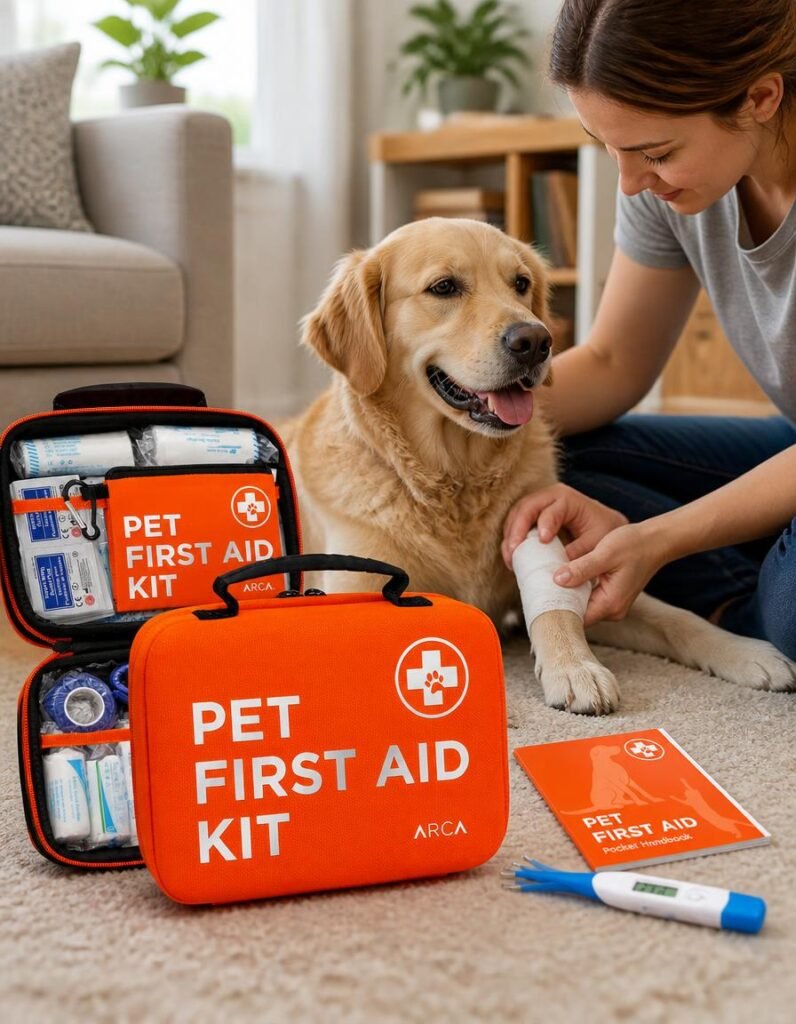
A 35-piece pouch in a reflective, water-resistant bag that fits in a daypack or a glove box. It carries gauze, antiseptic towelettes, a bandage roll, a roll of vet wrap, tweezers, a tick remover, an emergency blanket, EMT shears, tape, a whistle, iodine prep pads, sting relief pads, gloves, eyewash pods, and a first aid manual.
Two details lift it above the identical-looking competition. The reflective panel on the front means you can find it in a dark car boot with a phone torch, which sounds trivial until it isn’t. And the EMT shears are the real thing — they’ll cut through a collar or a harness, which is the single most useful non-medical function a kit can have if your dog is caught on something.
The trade-off is capacity. There’s enough here for one or two incidents before you need to restock, and the plastic tools are functional rather than lovely. For a dog who walks, hikes, and rides in the car, that’s the right compromise — this is the kit that actually gets carried rather than left in a cupboard.
2. Adventure Medical Kits Trail Dog — best for hikes and long walks
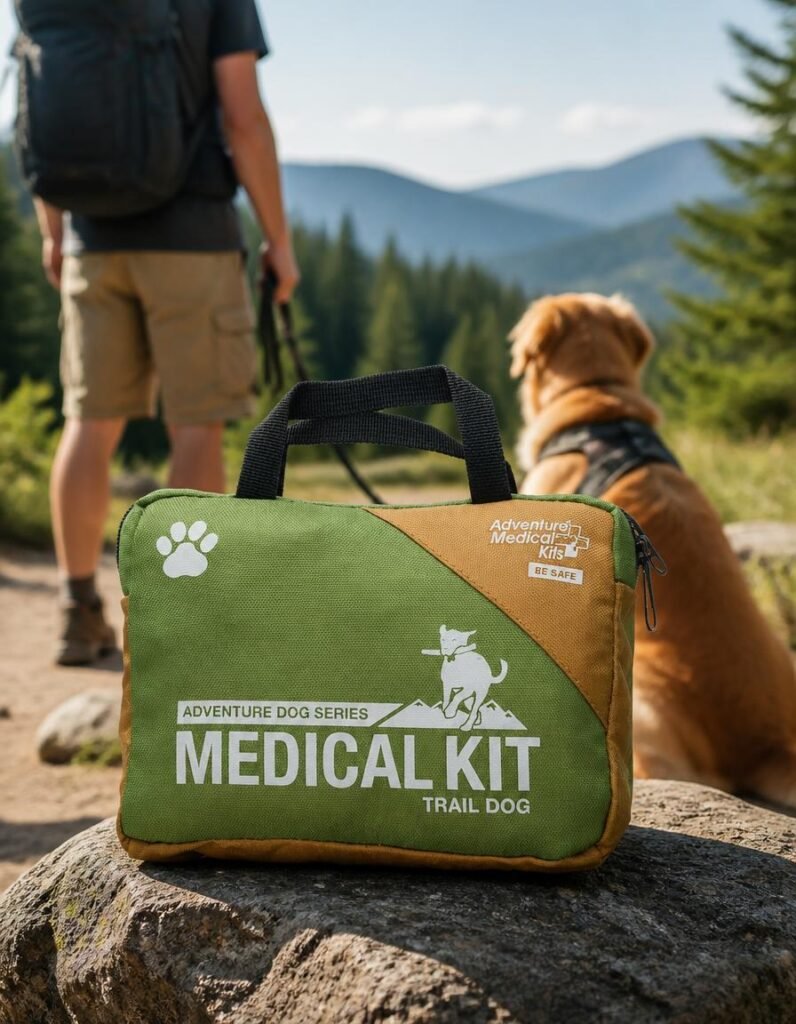
Adventure Medical Kits has been making this dog first aid kit for over a decade, and it shows in the choices. Contents run to sterile gauze dressings, non-adherent dressings, a conforming gauze bandage, a 10cc irrigation syringe with an 18-gauge tip, saline wound and eye wash, a large roll of self-adhering elastic bandage, triple antibiotic ointment, antiseptic wipes, alcohol swabs, a triangular bandage that doubles as an emergency muzzle, splinter picker and tick remover forceps, and a proper printed pet first aid manual — all inside a waterproof DryFlex bag.
The irrigation syringe is the standout. Most paw injuries on a trail are contaminated rather than catastrophic, and flushing grit out of a wound properly is more useful than covering it. The printed manual matters too: several rival kits have moved to a QR code, which is worth nothing in a valley with no signal.
One caveat, and it’s the reason this isn’t the top pick. This kit includes a bottle of 3% hydrogen peroxide labelled for inducing vomiting. Leave it sealed unless a vet or a poison line tells you to use it — more on that below. Field testers also found the printed contents list on the outer bag didn’t perfectly match what was inside, so check yours when it arrives and write the real list on the bag.
3. RHINO RESCUE Pet First Aid Kit — best home and car dog first aid kit
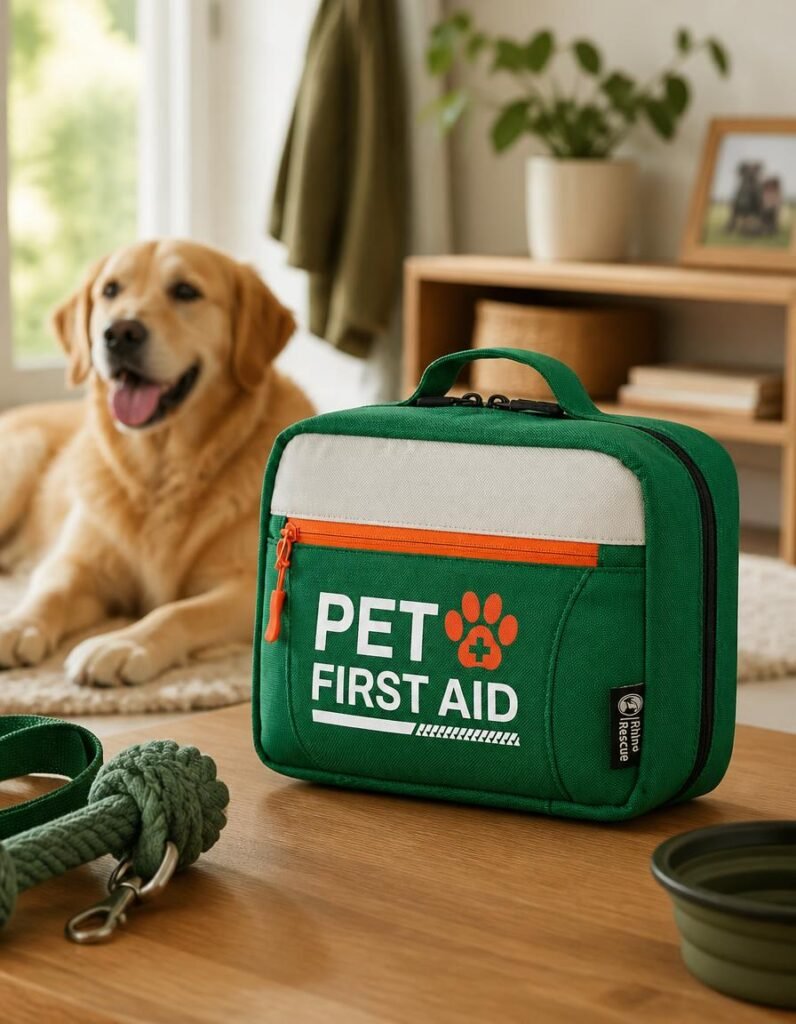
Rhino Rescue came out of the human trauma-kit world before it started making pet versions, and the build quality reflects that: abrasion-resistant fabric, two-way zips, transparent internal dividers so you can see what you’re grabbing.
What earns it a place is the non-bandage contents. It includes a digital thermometer, a muzzle, a feeding syringe kit, a pill pouch, a collapsible water bowl, and disposable foot booties, alongside the usual gauze, self-adhesive bandage, instant ice pack, and emergency blanket. The booties are the underrated item — a cut pad that’s been cleaned and wrapped will stay clean on the walk back to the car if there’s something over the top of it, and nothing else in a standard kit does that job.
It’s bulkier than the pouches above, which makes it a house-and-car kit rather than a hiking one. If you only own one dog and it lives at home, this is the one to own. The included manual covers heatstroke, trauma, and bites, which pairs sensibly with keeping a cooling mat around in summer.
4. Adventure Medical Kits Heeler — best minimalist option
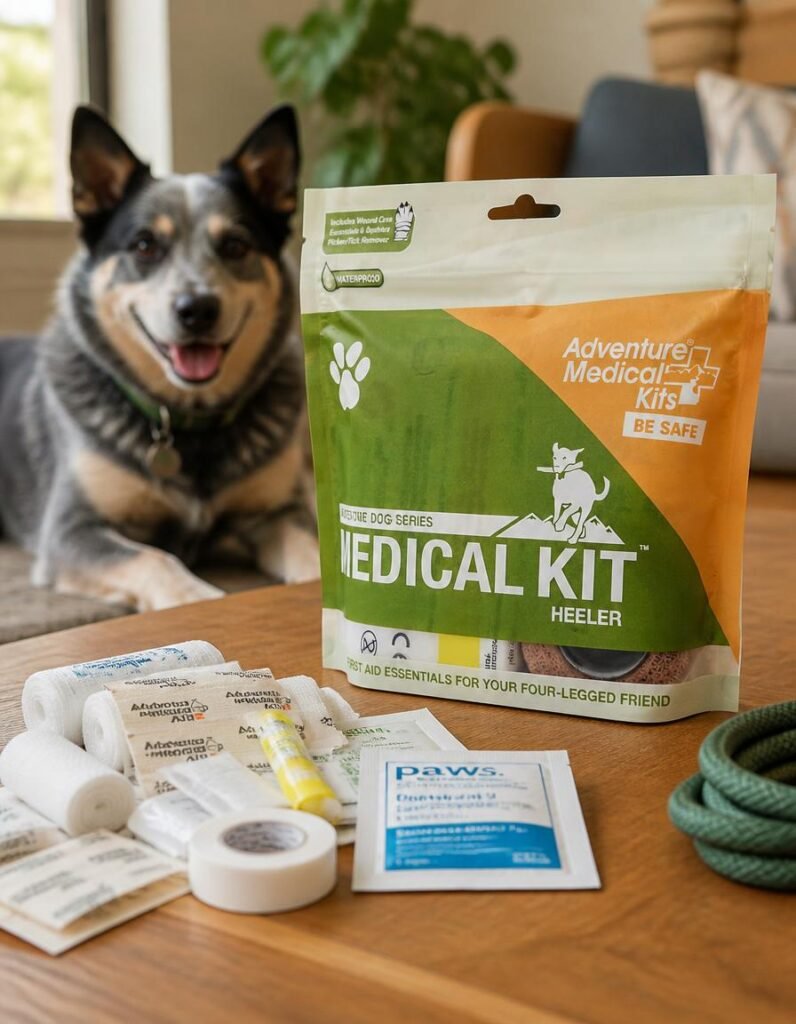
The Heeler is the Trail Dog’s smaller sibling: sterile bandage materials, bleeding and wound care, blister and burn care, fracture and sprain supplies, common medications, a triangular bandage for muzzling, a self-adhering bandage that won’t stick to fur, and the same pet first aid manual, all in waterproof DryFlex bags. It weighs almost nothing.
Buy this dog first aid kit as a second kit rather than a first. The realistic setup for most households is a full kit at home and a light one that lives permanently in the car or the walking bag — because the kit you didn’t bring is worth exactly as much as no kit. At this size and price, having a duplicate stops being an indulgence.
Three things to add to your dog’s first aid kit
Whichever kit you buy, these three are the difference between a box of gauze and a genuinely useful dog first aid kit. Together, they cost less than the kit itself.
Styptic powder, for the injury you’ll actually have
A nail cut too short bleeds dramatically, refuses to clot, and gets walked through every room in the house. It is far and away the most common at-home dog injury, and most dog first-aid kits have nothing for it. Kwik Stop has been made to the same formula since 1961 — ferric subsulfate to clot, benzocaine for the sting — and it stops a quickened nail in seconds when you press it on with a moistened cotton bud.
It’s for superficial bleeding only: nails, minor grooming nicks, small surface cuts. Never pack it into a deep wound or a body cavity. If you trim at home, keep it beside the clippers as well as in the kit — our guide to trimming dog nails safely covers how to avoid needing it in the first place.
A proper roll of vet wrap
Adhesive bandages do not work on dogs. Fur defeats them, and anything that does stick has to come off a dog who did not consent to that. Cohesive wrap solves it by sticking only to itself — 3M’s Vetrap is the version vets and horse trainers have used for forty years; it tears by hand without scissors, and it holds a dressing on a paw or a leg through movement.
Most dog first aid kits include a token roll; a full 4-inch roll costs very little and gives you enough for several dressing changes. One rule: apply it at roughly half stretch and finish the last wrap with no tension at all. Pulled tight, it acts as a tourniquet, and a bandage that cuts off circulation to a paw does more damage than the original cut.
A tick remover you can use under pressure
The plastic tick hooks bundled into cheap dog first aid kits tend to flex at exactly the wrong moment. A stainless steel set that includes fine-tipped tweezers is a lifetime purchase, and the TickCheck kit is the category bestseller on Amazon for good reason: two steel removers, a leather case, and a tick identification card.
Technique matters more than the tool. The CDC’s guidance is to grasp the tick as close to the skin as possible and pull straight up with steady, even pressure — no twisting, no jerking, and none of the folk remedies involving petroleum jelly, nail polish, or heat, which don’t make ticks detach and may make things worse. Veterinary references note that fine-tipped tweezers used properly are as effective as any dedicated device, so the tweezers in that kit are doing as much work as the hooks.
What not to use out of your kit
Two items turn up in these dog first aid kits that most owners misuse, and one category should never be in there at all.
- Hydrogen peroxide on a wound — no. The AVMA states it plainly in its kit checklist: do not use hydrogen peroxide on wounds. It damages the healthy tissue you need for healing. Saline or a pet-safe wound cleaner is what the flush is for.
- Hydrogen peroxide to induce vomiting — only on instruction. The ASPCA is clear that it’s the only method that can be used at home, and equally clear that it should only be done under the guidance of a veterinary professional, because too much causes real damage. It is never given to cats. Call your vet, or the Animal Poison Control Center on 888-426-4435, or the Pet Poison Helpline on 855-764-7661 before you do anything — a consultation fee may apply, and it’s still the right call. Some substances are more dangerous coming back up than going down.
- Human painkillers — never. Ibuprofen, paracetamol, and aspirin are not dog medicines. Adverse reactions are common, and some are fatal. Nothing goes in your dog’s mouth from the medicine cabinet without a vet saying so first.
- A muzzle on a vomiting dog — never. Muzzling an injured dog protects you both, and a triangular bandage will do it in a pinch. But the AVMA’s warning is specific: don’t muzzle a pet that is vomiting.
Where to keep it, and what else goes in
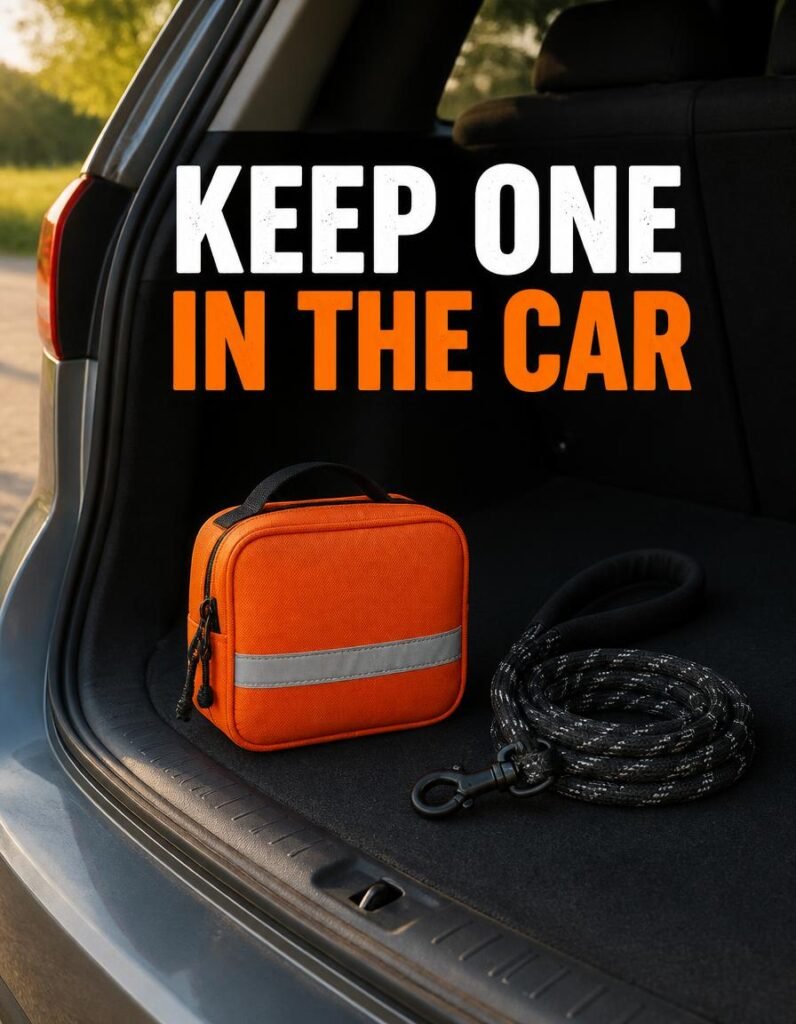
Keep one dog first-aid kit at home and one in the car. Emergencies happen on walks, at the park, and on the way somewhere, and the home cupboard is the one place you’re least likely to need it. Both should be somewhere anyone in the household can find them without asking.
Then add the free items, which are the ones people skip. Write your vet’s number, your nearest 24-hour emergency clinic, and the poison control line on a card and put it in the bag — phones die, and signal fails exactly where dogs get hurt. Add a copy of your dog’s vaccination record and current medications, and a recent photo. Check the kit every six months and replace anything used or expired; a dog first aid kit that hasn’t been opened since 2023 is a bag of out-of-date ointment.
If you’re assembling this for a new dog, it belongs on the same shopping trip as the crate and the bowls — see our new puppy checklist for the rest of the day-one list. And if paw pad damage is your particular worry, a pot of paw balm lives happily in the same bag for the aftercare end of things.
Related reading: dog cones and recovery collars.
Frequently asked questions
Can I just use a human first aid kit for my dog?
Partly. Gauze, tape, scissors, gloves, and saline work on anyone. What a human kit gets wrong is everything else: adhesive plasters won’t stick to fur, several common human medications are toxic to dogs, and there’s no muzzle, no slip lead, no styptic powder, and no tick tool. If you’d rather not think about which items cross over during an emergency, buy a dog first aid kit and keep them separate.
Is a bigger kit better?
No. Piece counts are a marketing number — most of the difference between a 35-piece kit and a 136-piece kit is extra gauze pads and cotton swabs. Judge a dog first aid kit on whether it has dog-specific items, whether you can find things inside it quickly, and whether it’s small enough that you’ll actually take it with you.
Do I need a thermometer in there?
It’s on the AVMA’s list, and it’s genuinely useful — dogs run warmer than people, so guessing by feel tells you nothing. It’s taken rectally with a little lubricating jelly, which is why plenty of owners quietly skip it. If you want one without buying it separately, the Rhino Rescue kit above includes it.
What should I do first if my dog is bleeding badly?
Press a clean cloth or gauze firmly over the site and hold it. The AVMA advises not lifting it to check for at least three minutes, and if blood soaks through, adding more layers on top rather than removing the first — pulling it off takes the clot with it. Severe bleeding means the nearest veterinary hospital, immediately, with pressure maintained on the way.
How often should I restock it?
Every six months, and immediately after any use. Ointments and saline have expiry dates, adhesive tape dries out, and the one thing worse than no kit is a kit you’re relying on that turns out to be empty where it matters.
The verdict
For most owners, the ARCA PET Ready-Go Pouch is the right dog first aid kit: compact enough to carry, reflective enough to find, and it includes shears that cut a collar. Hikers should take the Adventure Medical Kits Trail Dog for its irrigation syringe and printed manual; households that want one comprehensive kit on a shelf should choose the RHINO RESCUE for its thermometer, muzzle, and booties; and the AMK Heeler is the cheap second kit that lives in the car.
Then add styptic powder, a full roll of vet wrap, and a steel tick remover, and write your vet’s number on the bag. That combination costs a little more than the boxed kit alone and covers the injuries dogs genuinely arrive home with. It also does the only thing a first aid kit can honestly promise: it keeps the situation stable long enough to get to someone qualified.
Note: Pet product pricing and pack sizes change frequently on e-commerce marketplaces. Always check current contents and specifications before completing your order.
Disclosure: dailypetpicks.com is a participant in the Amazon Services LLC Associates Program, an affiliate advertising program designed to provide a means for sites to earn advertising fees by advertising and linking to Amazon.com. This means we may earn a small commission if you purchase through our links, at no extra cost to you.