
Disclosure: dailypetpicks.com is a participant in the Amazon Services LLC Associates Program, an affiliate advertising program designed to provide a means for sites to earn advertising fees by advertising and linking to Amazon.com.
Sometime in the next few weeks, your evening walk moves into the dark. Nothing about the walk changes — same route, same time, same dog — except that the drivers on it can no longer see either of you. That is the whole reason a dog safety light exists, and it is also why most people buy the wrong one: they shop for brightness, when the thing that decides whether a driver reacts in time is where the light sits and what it does as you move.
This guide works through what the road-safety research actually says about being seen after dark, applies it to the gear that exists on Amazon, and lands on five picks. Every one of them costs less than a takeaway. One warning up front: a dog safety light does not make a driver stop. It buys you distance, and distance is the only thing you can buy here.
The risk isn’t the dark. It’s when the dark arrives.
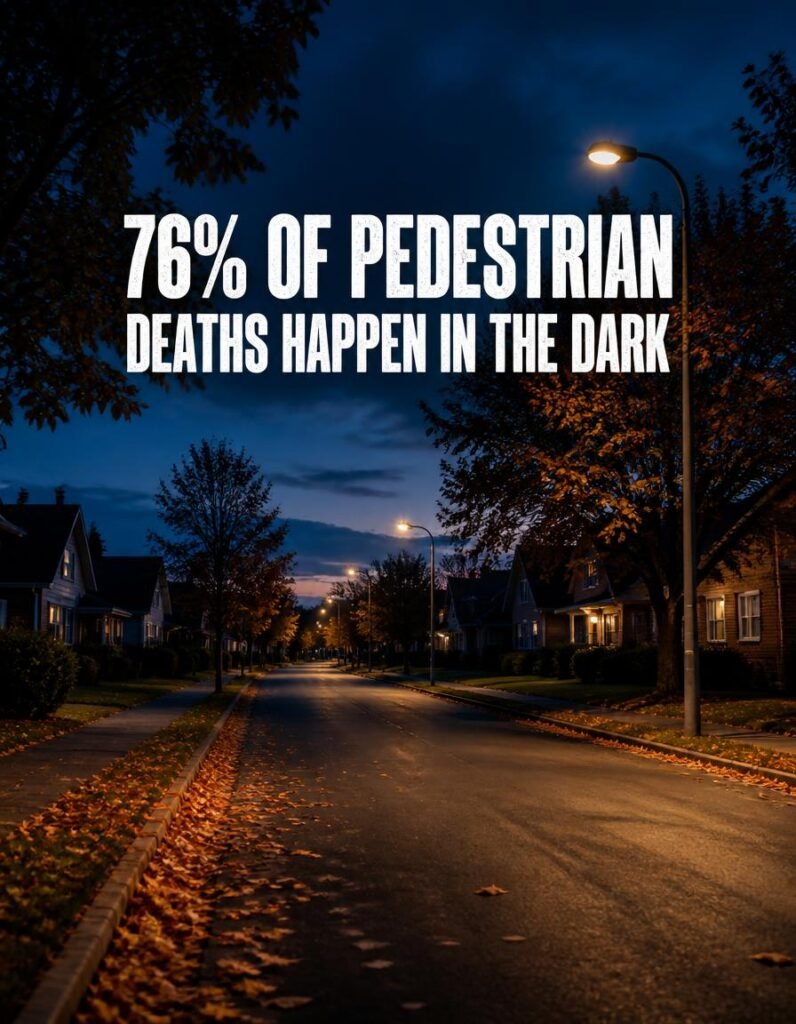
Walking after dark is not a rare edge case. According to NHTSA figures published through its pedestrian safety program, 76% of pedestrian deaths in 2024 happened in the dark, against 20% in daylight. Dusk and dawn accounted for 2% each. The overwhelming majority of the danger sits in one lighting condition.
What makes autumn specifically awkward is that the clocks move, but your routine does not. The walk that happened in daylight all summer is suddenly the walk that happens in the worst hour of the day, and NHTSA’s crash data shows the early evening — roughly 6pm to 9pm — carrying the heaviest share of pedestrian fatalities during the September-to-November stretch. Your dog still needs the same amount of exercise in November as in July. The walk is not optional. The visibility is the part you get to change, and a dog safety light is the cheapest way to change it.
Reflective and lit are not the same purchase
Almost every listing in this category blurs two completely different technologies, so it is worth separating them before you spend anything.
Retroreflective material — the grey strip on a harness, the silver print on a leash — does not produce light. It returns light to its source. That is a genuinely clever property: it means a car’s own headlights bounce back at the driver rather than scattering. But it also means the reflective strip is completely invisible until something aims a beam at it. A cyclist with a head torch pointed at the ground, a driver on parking lights, a car turning across your path with its beams swept away from you — none of those switch your reflective strip on.
An LED dog safety light does not wait for anyone. It emits, so it is visible to a driver, a cyclist, and a jogger equally, and it is visible before headlights find you. That is the case for buying an active light rather than relying on the reflective trim already sewn into your harness.
The honest version, though, is that you want both, and for a specific reason. Reflective material has no battery to go flat, and it keeps working on a walk that ran twenty minutes longer than you planned. A dog safety light covers the moment before the headlights arrive. They fail in opposite conditions, which is exactly why the sensible setup uses one of each rather than two of either.
Drivers recognise movement, not shapes
Here is the finding that should reorganise how you think about all of this, and that no product listing will ever tell you.
Road-safety researchers have spent decades measuring how far away drivers actually recognise a person at night. The consistent result is that the human visual system is exceptionally good at spotting biological motion — the specific rhythm of a walking gait — and much worse at picking a static bright patch out of a cluttered roadside. In one closed-road study summarised in this review of nighttime pedestrian conspicuity, drivers on low beams recognised a walker wearing reflective markers on the moving joints at roughly 3.4 times the distance of the same walker wearing a reflective vest carrying an equal amount of material. Same amount of reflection. Same night. Triple the warning.
Two things follow for anyone buying a dog safety light. First, position beats brightness by a margin that no lumen figure can close — a light on a wrist or an ankle, which swings, does more work than a brighter one clipped to a torso, which does not. Second, and less comfortable: your dog’s neck is not a moving joint. A collar light rides on the least mobile part of a moving animal, roughly eighteen inches off the ground and usually on the far side of you from the traffic. It is also only as secure as the collar it clips to.
Which is why the single most useful sentence in this guide is: light both ends of the leash. One dog safety light on the dog is half a solution. You are the tall shape at bumper height. Your dog is the small, fast one near the kerb. A driver who sees only the dog has not seen a person and will not slow down for what looks like a bike reflector at ground level. Clip one light to the dog and one to your own hand or to the leash handle.
The battery is a safety spec, not a convenience one
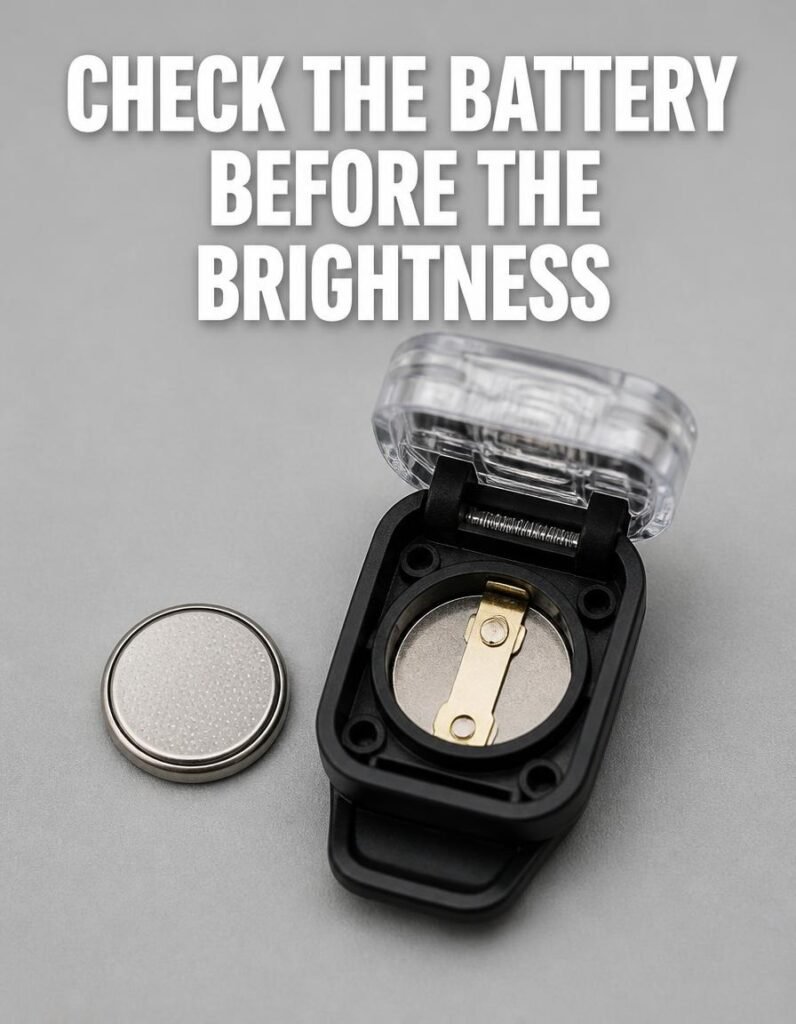
This is the part of the category nobody writes about. A large share of cheap clip-on lights and light-up bands — including plenty sold specifically as a dog safety light — run on lithium coin cells — CR2032, CR2016, 1154 — held behind a twist cap or a small screw. That cap is on a product you are attaching to a dog, at chewing height, on a strap that other dogs at the park can reach.
Swallowed coin cells are not an ordinary “call the vet in the morning” problem. Pet Poison Helpline describes lithium button batteries as the most dangerous household type because a lodged 3-volt cell drives a current through tissue and can cause severe damage to the oesophagus or gut within 15 to 30 minutes of contact — and unlike a leaking alkaline battery, it does not need to be punctured to do it.
The manufacturers know. Nite Ize’s own Amazon listings for these products carry the line “Supervised use only. Ingestion of this product can result in serious injury” alongside a battery warning, and Amazon’s own pet-safety flag on the necklace version reads “Choking hazard, not a chew toy.” That is the seller telling you the thing the review roundups leave out.
None of that makes coin cells unusable — a sealed, well-made unit is fine, and the coin-cell versions genuinely run far longer per battery. It makes the battery the first spec to check on any dog safety light rather than the last. Four of the five picks below are USB rechargeable with sealed housings, which is not a convenience preference. It is the reason they were chosen.
What actually matters when you buy
Strip out the marketing and a dog safety light comes down to five questions, roughly in order of how much they decide the outcome.
- Attachment, first and last. The failure mode in this category is not dimness; it is loss. A steel carabiner or a captive clip survives a fence scramble; a split ring on a plastic tab does not.
- Which way does it throw light? A single-sided lens facing sideways does nothing for the car behind you. A ring, or two lights placed front and back, solves this.
- Steady or flashing. Flashing catches attention; steady lets a driver judge your distance and speed. On roads, a steady glow on one and a slow flash on the other cover both.
- Battery type and cable. Rechargeable and sealed for anything at chew height — and check whether the cable is included, because it frequently is not.
- Water rating. Anything under IPX4 is a fair-weather product, and the dark season is also the wet season.
The 5 best dog safety lights for night walks
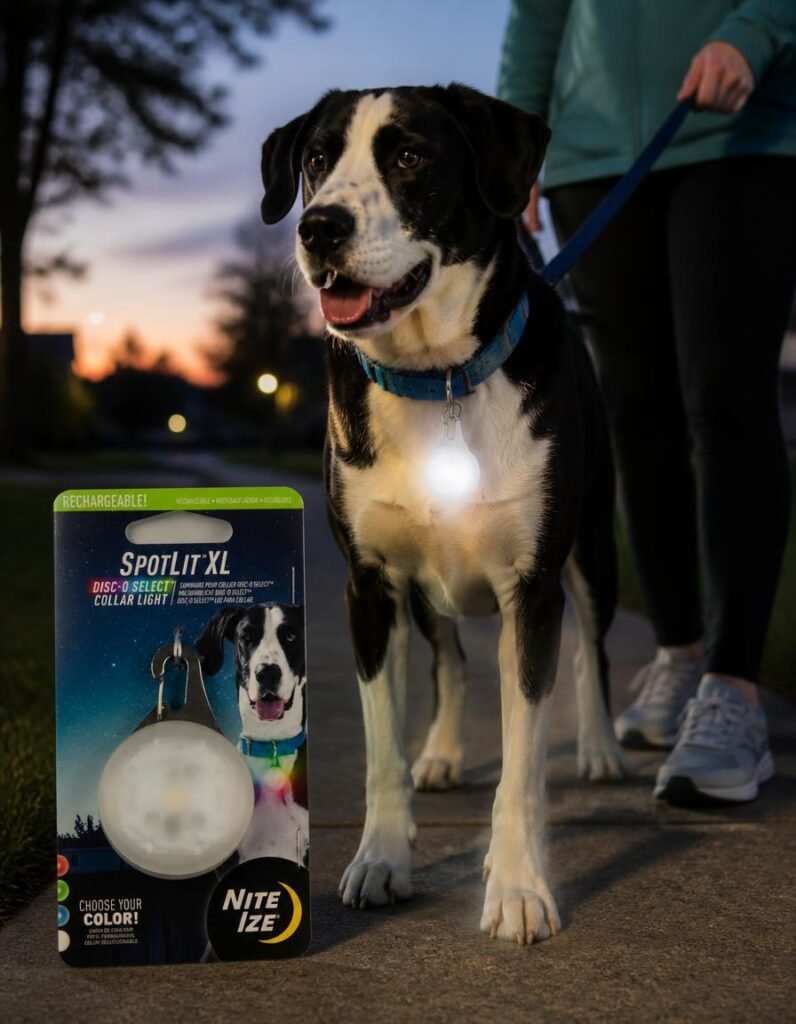
1. Nite Ize SpotLit XL Rechargeable Collar Light — best overall
The SpotLit XL is the pick because of the part nobody photographs: the clip. It is a stainless steel carabiner with a wire gate, not a keyring loop, so it stays on a collar through undergrowth and greeting other dogs. The body is sealed and recharges over USB, so there is no coin-cell cap for a dog to work loose, and Nite Ize rates it at up to 10 hours — enough for a fortnight of evening walks between charges.
The XL is the larger of the two SpotLit sizes and the dog safety light to get for a medium or large dog; the standard SpotLit is dimmer at a distance. Colour selection is genuinely useful if you walk two dogs, because you can tell them apart at fifty yards. The one real annoyance is that the micro-USB cable is not in the box.
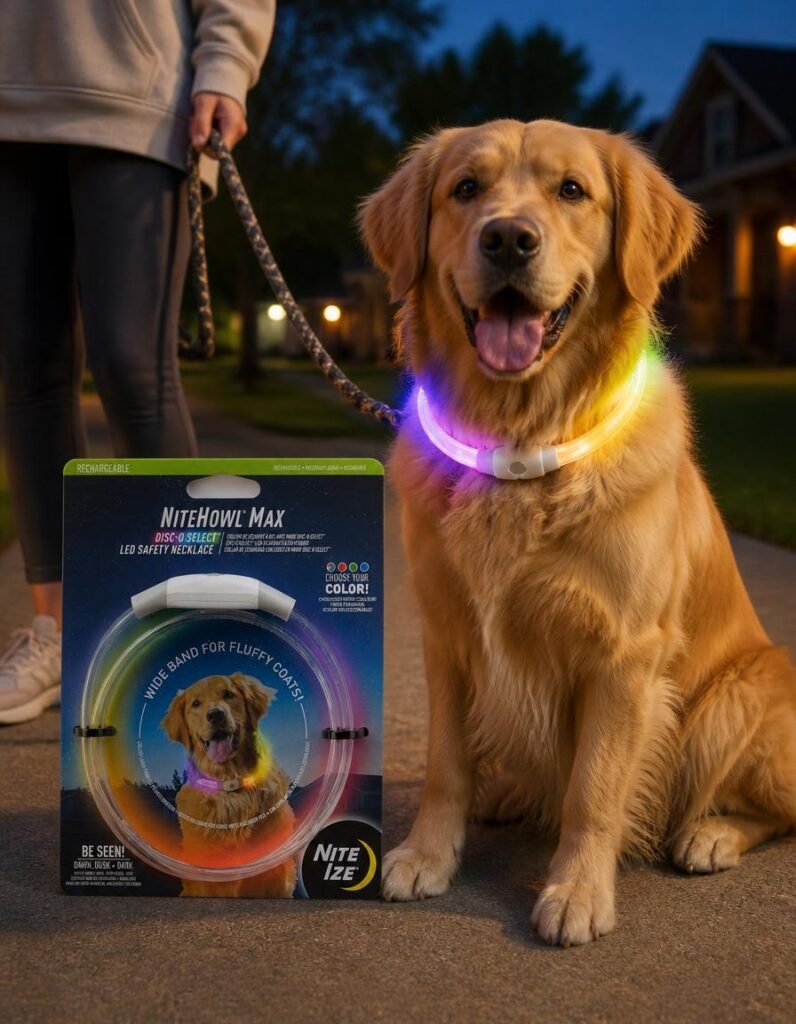
2. Nite Ize NiteHowl Max Rechargeable LED Safety Necklace — best for fluffy coats
Clip-on lights have one specific failure: on a husky, a golden or a chow, the light sinks into the coat, and the fur masks it from the side — the exact angle a car approaches from. The NiteHowl Max solves that with a wide, flat light-transmitting band that lies on top of the fur and glows around the full circumference, so there is no dead angle.
As a dog safety light, it cuts to fit anything from a 12-inch to a 27-inch neck, recharges in about two hours, and runs up to ten hours. It is a necklace worn alongside the everyday collar rather than a replacement for it, so the ID tag stays where it belongs. Note Amazon’s own listing flag on this one: it is not a chew toy, and it should come off indoors.
3. Clip-On Dog Collar Light, 4 Modes, IP68 (2-pack) — best value
Two lights for less than the price of one branded dog safety light, and the two-pack is the point rather than a bonus. It lets you do the thing the previous section argued for: one light on the front of the collar, one on the back or on the harness handle, so a car approaching from either direction sees something. A single sideways-facing lens cannot do that at any price.
Four modes, an IP68 rating that comfortably covers rain, and a rechargeable sealed body. It is currently one of the best-selling clip-on lights in its Amazon category, which, for a generic product, is the most useful signal available. Read the next section before you assume that it is unique.
4. Novkin Rechargeable Dog Light (2-pack) — for your end of the leash
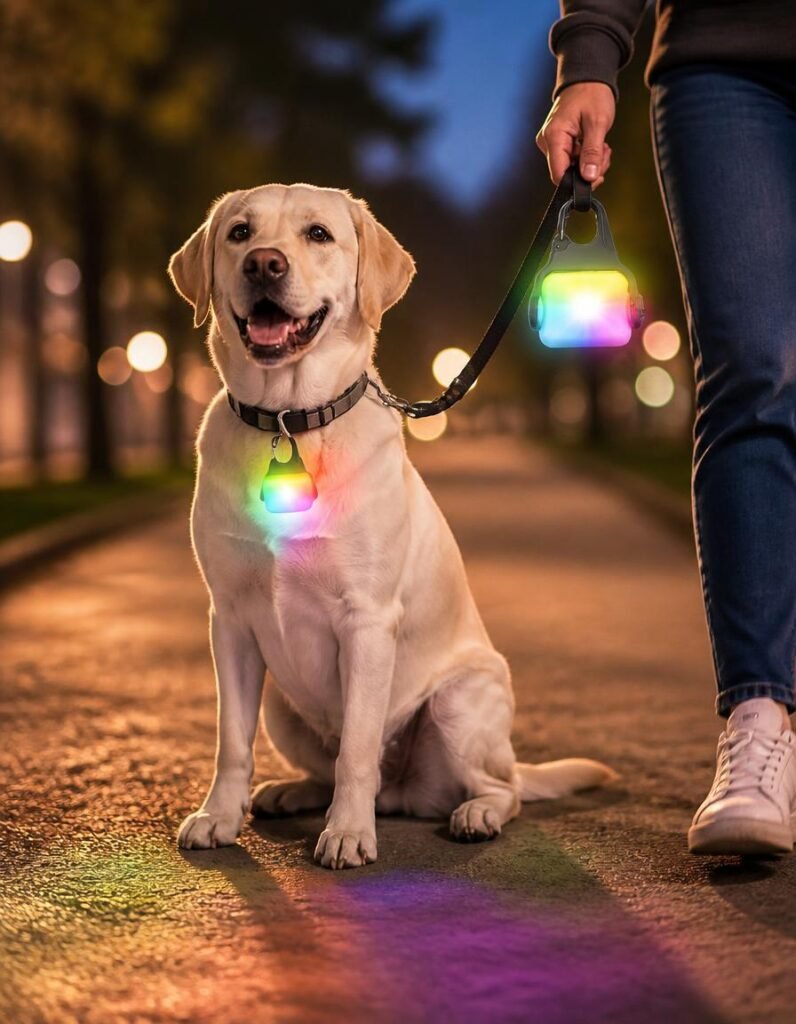
This is the pair to buy if you took the “light both ends” argument seriously. The stainless carabiner clips this dog safety light to a jacket zip, a coat pocket, a waistband, or the leash handle as easily as to a collar, so one goes on the dog, and one goes on you — and if you can clip yours to a wrist strap or a cuff rather than your chest, you get some of that biological-motion advantage for free.
It has been on Amazon since 2021, which in a category full of six-month-old brands counts for something, and it recharges in about half an hour for roughly six hours of light. One caveat on the copy: the listing claims visibility up to 500 metres. Treat that as marketing — it is an unfalsifiable number measured in ideal conditions, and it says nothing about a driver picking you out against a lit high street. The product is good; the number is noise.
5. Myddomi Dog Collar Light, 4 Modes, IP68 (2-pack) — the one that includes the cables
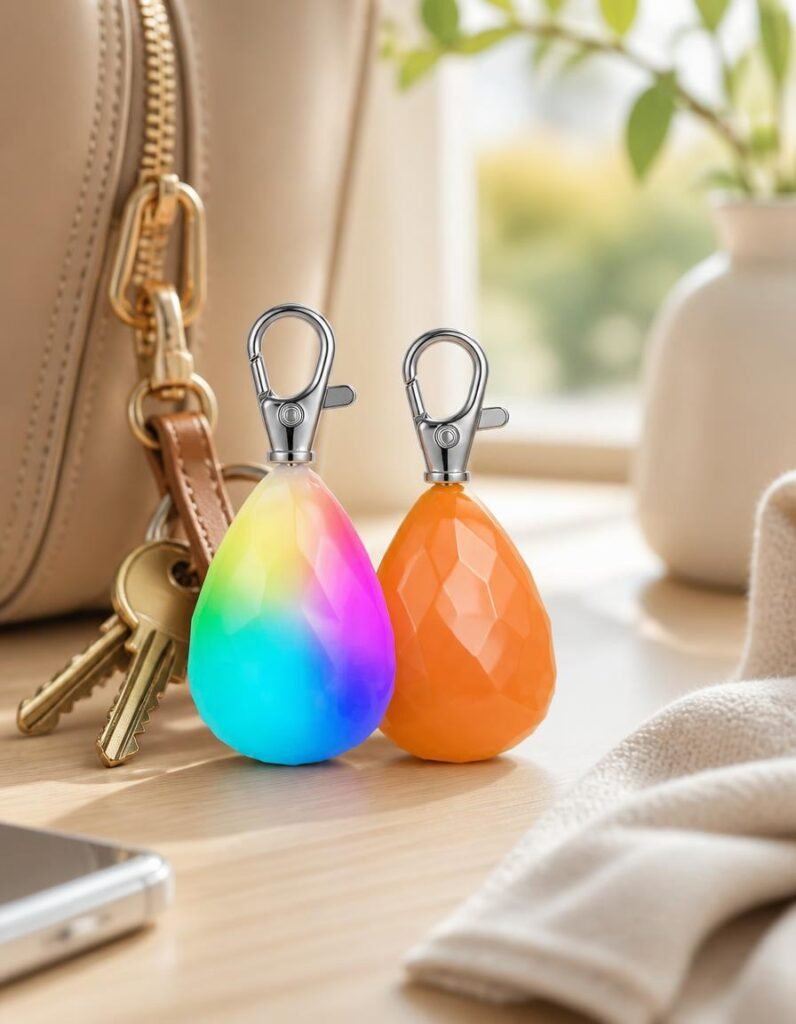
A small thing that turns out to matter: both Nite Ize picks above ship without a charging cable, and a dog safety light you cannot charge on the night you unbox it is a light you leave in a drawer. This set includes two USB-C cables and two lights, so both can charge at once on different nights of your rotation.
USB-C rather than micro-USB is the other quiet advantage, because it is the cable already living beside your bed. Same IP68 body and four-mode switching as pick three. If you are buying your first set and do not want to think about any of this, this is the least fussy option on the list.
Why do three of these look almost identical
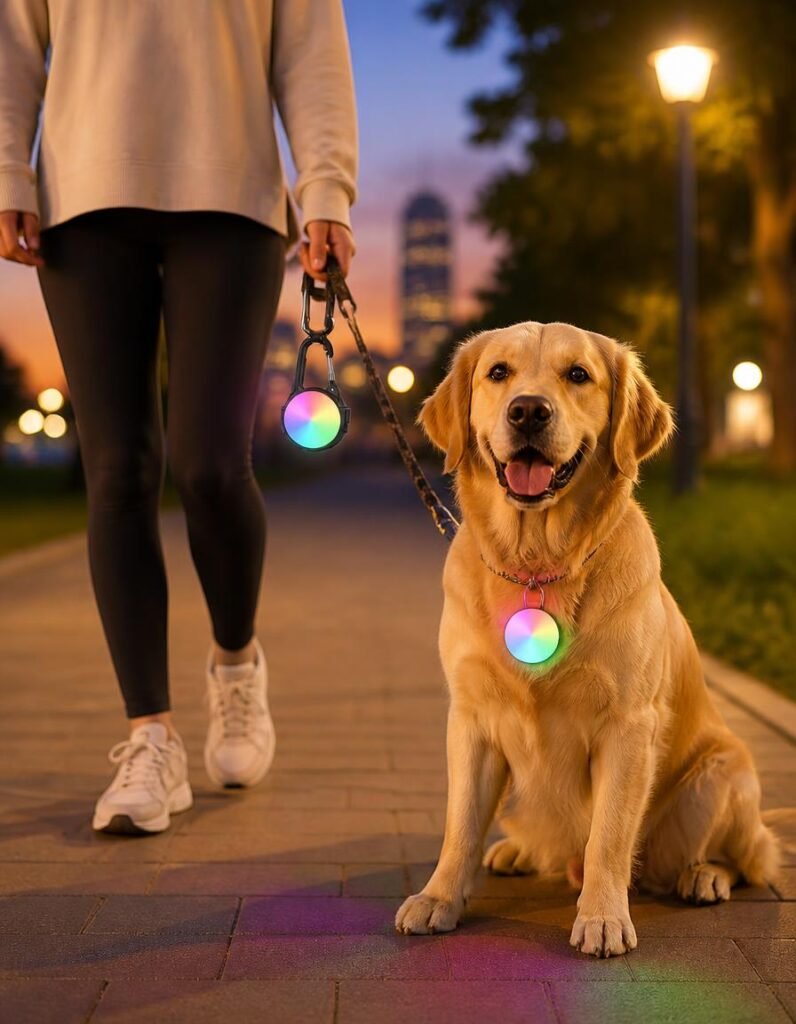
Spend ten minutes in this category, and you will notice the same small rounded rectangle with a silicone strap sold under dozens of brand names that look like keyboard mashing. That is not a coincidence, and it is not a scam: it is one or two moulded designs, produced at volume and relabelled by whoever is buying that week. Picks three, four, and five come from that world.
What actually varies between one generic dog safety light and the next is worth knowing, because it is not the shape. It is the ingress rating, the battery capacity, whether the clip is steel or plastic, whether the cable is included, and how long that exact listing has existed. Those four things are the entire basis on which picks three to five were separated, and they are the four things to compare if you go looking on your own. A brand name in this corner of the market tells you nothing at all.
The cheapest upgrade isn’t in this list
Honesty requires saying this plainly: the strongest evidence in the research points to reflective material on moving joints, and not one of the five products above puts anything on a moving joint. They all sit on the dog’s neck or your torso, because that is what the market sells and what a dog will tolerate wearing.
So add the free half yourself. A reflective or LED slap band around your own ankle or wrist costs a few dollars, weighs nothing, and reproduces the configuration the studies measured — the one that drivers recognised roughly three times sooner. Nite Ize’s SlapLit and a dozen generic equivalents do this. Buy the dog safety light for the dog, then spend five more dollars on the part of the pair that the evidence actually favours. If you also carry treats for road-crossing practice, a treat pouch with a reflective panel does double duty.
What to skip
- Sealed lights with non-replaceable, non-rechargeable batteries. When it dies, you buy another one. Common at the very bottom of the price range.
- Anything whose lighting element is the collar itself. A light-up collar sounds tidier than a clip-on, but it makes your dog’s ID collar dependent on a charge, and the collar’s real job is identification. Keep the two separate.
- Brightness claims in metres. “Visible up to 500m” is untestable and appears on almost every listing, including ones recommended above.
- Laser and projector novelties. They point light at the ground, not at drivers, and some are genuinely bad news near a dog’s eyes.
Frequently asked questions
Do dogs need a light to see, or is it just for drivers?
Just for drivers and for you. Dogs see considerably better than we do in low light, so a dog safety light is not helping your dog navigate — it is making your dog and, by extension, the person attached to the other end of the leash, visible to traffic. That reframing matters when you choose where to mount it: aim for what a driver can see, not what looks bright from where you are standing.
Steady or flashing — which is better?
Flashing wins attention; steady wins judgement. A driver can estimate how far away a steady light is and how fast it is moving, which is harder with a strobe. Running one steady and one flashing across two lights covers both, which is another argument for the two-packs.
What colour should I choose?
Any colour of dog safety light is visible; the question is what it gets confused with. Red reads as a bike tail light and white as a headlight, which can be genuinely misleading on a road. Green, blue, and amber are less ambiguous. If you walk more than one dog, giving each a different colour makes them individually trackable in the dark.
Will a light stop my dog from pulling into the road?
No, and it is worth being blunt about that. Visibility is not control. If your dog surges toward the kerb, the fix is training and equipment, not lumens — start with loose-leash work, which is harder in the dark because your dog can read your body language less easily than you think.
Is one light enough for a puppy?
One is enough for a small dog on a lead, but weight matters more than it does on an adult — a heavy clip on a puppy collar rotates and ends up under the chin, pointing at the pavement. Choose the lightest sealed unit you can and add it to the puppy gear list rather than treating it as an afterthought.
The short version
Buy an active light rather than trusting reflective trim, because reflective material does nothing until a headlight finds it. Put one light on the dog and one on yourself, because you are the shape at bumper height. Choose sealed and rechargeable over coin cells at chewing height. And if you want the single highest-value addition, put something reflective around your own ankle, where the research says drivers notice it soonest.
The Nite Ize SpotLit XL is the dog safety light to buy if you buy one thing, on the strength of the clip and the sealed battery. The two-packs are the better answer if you would rather cover both ends of the leash for the same money — which, on the evidence, you should.