DailyPetPicks is reader-supported. When you buy through links on our site, we may earn an affiliate commission at no extra cost to you.
Almost every dog crate cover listing sells the same idea: dogs are den animals, a crate is a den, and a cover finishes the job. It is a tidy story. It is also the weakest part of the pitch, and believing it pushes people toward the one mistake in this category that actually matters — pulling a heavy cover down over all four sides and walking away.
A dog crate cover is not a den. It is a visual barrier. Once you look at it that way, the buying decision changes shape: you stop asking which one feels cosiest and start asking which sightline you are trying to block, how much air the fabric lets through, and whether the thing will physically fit the crate you already own. This guide covers those three questions, then four picks under $30 that answer them, and it is honest about the cases where a cover will not help you at all.
The den story does not hold up
You will find the den framing in serious places. The American Kennel Club’s crate training material tells you to drape a lightweight blanket over the crate to mimic a den environment, and several of its training pages describe dogs as naturally den-dwelling animals.
The behaviour side disagrees. PetMD’s veterinary blog puts it flatly: dogs are not the den animals we have long supposed, and they spend the overwhelming majority of their lives out in the open rather than tucked into enclosed spaces. Denning in wild canids is seasonal maternal behaviour — a female uses a den to whelp and raise pups for a few weeks, then abandons it. Unless your dog is a nursing mother, there is no denning instinct sitting there waiting to be satisfied.
This is not a pedantic argument, because the two stories give you opposite instructions for a dog crate cover. If a cover works by satisfying an instinct for enclosure, more coverage is better, and four sides beat three. If it works by removing something the dog can see, then coverage is targeted, and the side you leave open matters more than the number of sides you close.
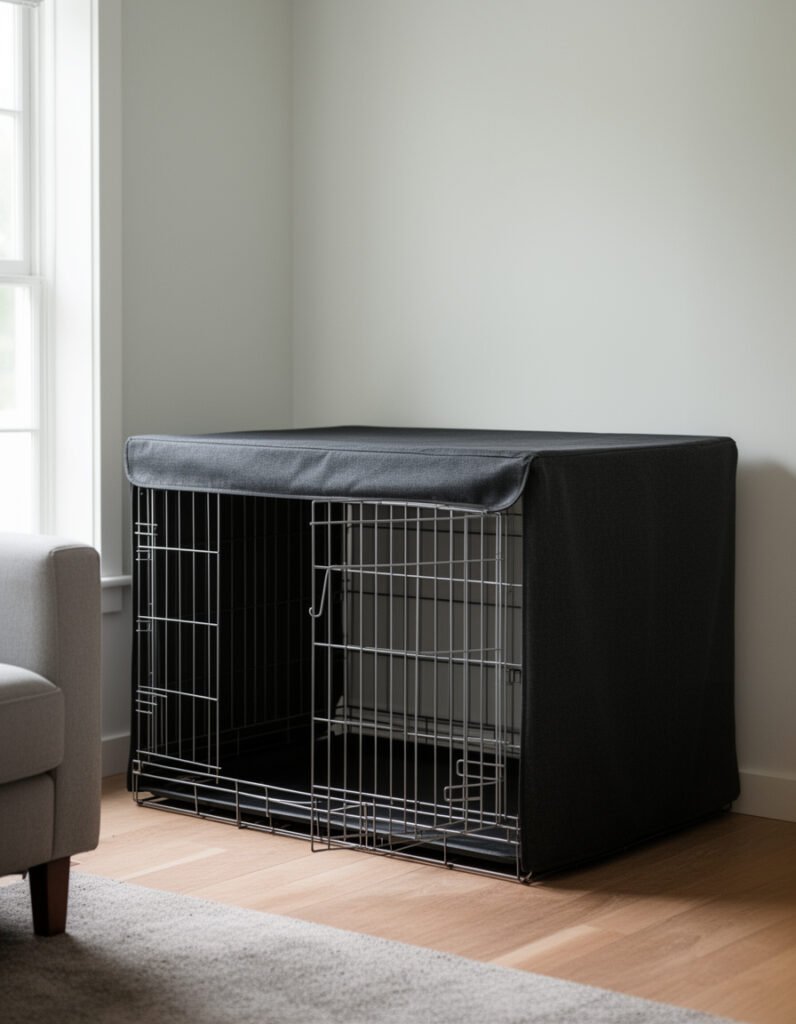
Tellingly, the AKC’s own puppy guidance lands on the second version. Its beginning crate training advice is to cover a wire crate except for most of the front. That is not a den. That is a screen with a window left in it.
What is a dog crate cover actually for
The mechanism behind a dog crate cover that has real support is dull and specific: dogs bark at things they can see, and if they cannot see them, they bark less. Shelters have known this for years. The ASPCA’s professional guidance on reducing barking in kennels recommends cheap barriers on the working side of a run and half-height doors so dogs cannot watch people and other dogs go past. Nobody in that setting is thinking about dens. They are cutting off a trigger.
Worth knowing the limit, though, because it cuts against the product. A study of 17 shelter-housed dogs partially removed a visual barrier so the dogs could see each other and the room, expecting more noise. Vocalisations went down, not up, and stress behaviours did not shift either way. Blocking the specific thing that sets your dog off is well supported. Blocking everything, on the general theory that dark equals calm, is not.
So before you buy a dog crate cover, work out what the trigger is. If your dog erupts when the postman crosses the window or the front door opens, a cover on that side is a genuinely good five-minute fix. If the problem is thunder, fireworks, or a Hoover, understand that a sheet of polyester does close to nothing for sound, and you are buying the wrong tool. And if the problem is that your dog panics when left alone, that is separation anxiety, which no cover treats.
The two measurements that determine fit
Measure the crate, not the dog. A dog crate cover is sold in 24, 30, 36, 42, or 48 inches, and it is easy to assume that the number is a standard. It is a nominal size, and the makers know it. MidWest — which builds the iCrate, the most common wire crate in American homes — states on its own crate cover listings that if you are buying for another manufacturer’s crate, you should measure the outside dimensions first to be sure of the size. When the biggest name in the category tells you not to trust the label, take the tape measure out. The gaps are small but real: the published dimensions on a 42-inch MidWest cover are 42 by 27.25 by 30 inches, while several competing 42-inch covers are cut for a 28-inch width.
Count the doors and note where they are. A single-door crate opens at one end. A double-door crate adds a side door, and a three-door crate adds another. A cover that only rolls up at the front turns a side door into an ornament, because you will not unclip the fabric twice a day to use it. Pet Dreams sells its cover in separate single-door and double-door versions rather than pretending one shape suits both, which is the clearest admission in this category that “universal fit” is doing some work.
There is a third check that is not a measurement but decides more than either: how much air the dog crate cover lets through. Air permeability is a measurable property with a test standard behind it, ASTM D-737, and Pet Dreams is the only brand here that says it has run the test. Treat any brand’s claim about its own product with the usual scepticism, but the underlying point survives: a great many covers are heavy coated polyester built for outdoor kennels, where waterproofing is the goal and airflow is the thing being deliberately given up. Indoors, on a crate your dog sleeps in, that trade is backwards.
The 4 best dog crate cover picks
1. MidWest Quiet Time Privacy Crate Cover — best overall
The default dog crate cover, and the reason is boring: MidWest makes the crate most people own, so its covers are cut to its own crates rather than to an average of everyone’s. The cover slips over the top, hook-and-loop tabs hold it at the bottom, and the panels open for access to end and side doors on one-, two-, and three-door crates.
It is poly-cotton rather than coated polyester, machine washable and dryer safe, and it comes in the full size run so you can match the crate you have. If you own an iCrate or a Life Stages crate, start here and stop thinking about it.
Watch out for: wash it separately, because the hook-and-loop tabs will find every knitted thing in the load. And if your crate is not a MidWest, follow the maker’s own instructions and measure before ordering rather than matching the number on the box.
2. Pet Dreams Breathable Crate Cover — best for warm rooms and flat-faced breeds
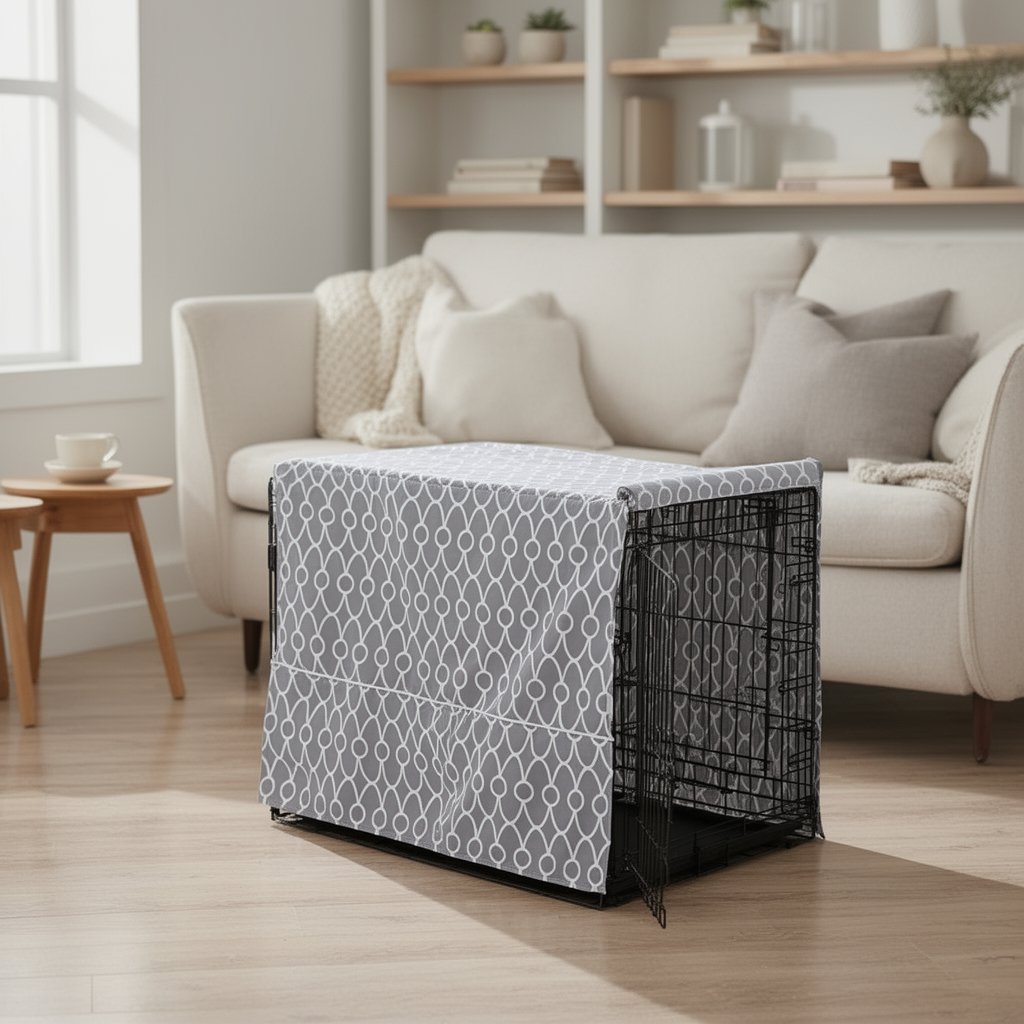
This is the airflow pick and the only one making a testable claim about it. Pet Dreams says its fabric was air-permeability tested to ASTM D-737 by an accredited lab and is left uncoated on purpose, and it is openly rude about the rest of the category while it does so. The cover comes in single-door and double-door versions across the 18- to 48-inch range, so you are choosing a shape as well as a size.
Two details in its own fitting instructions are worth stealing whatever dog crate cover you end up with: put the seams at the back rather than on top, and tie the cover to the bar below the crate pan so the ties end up outside the crate instead of inside it, where a bored dog can reach them.
Watch out for: a breathable fabric is a light fabric, so this is the weakest choice if what you actually want is blackout for a night-shift sleeper. It is also the priciest thing on this list and the one most likely to drift over the $30 line, so check before you commit.
3. Explore Land Heavy Duty Polyester Cover — best for a crate that lives outside the house
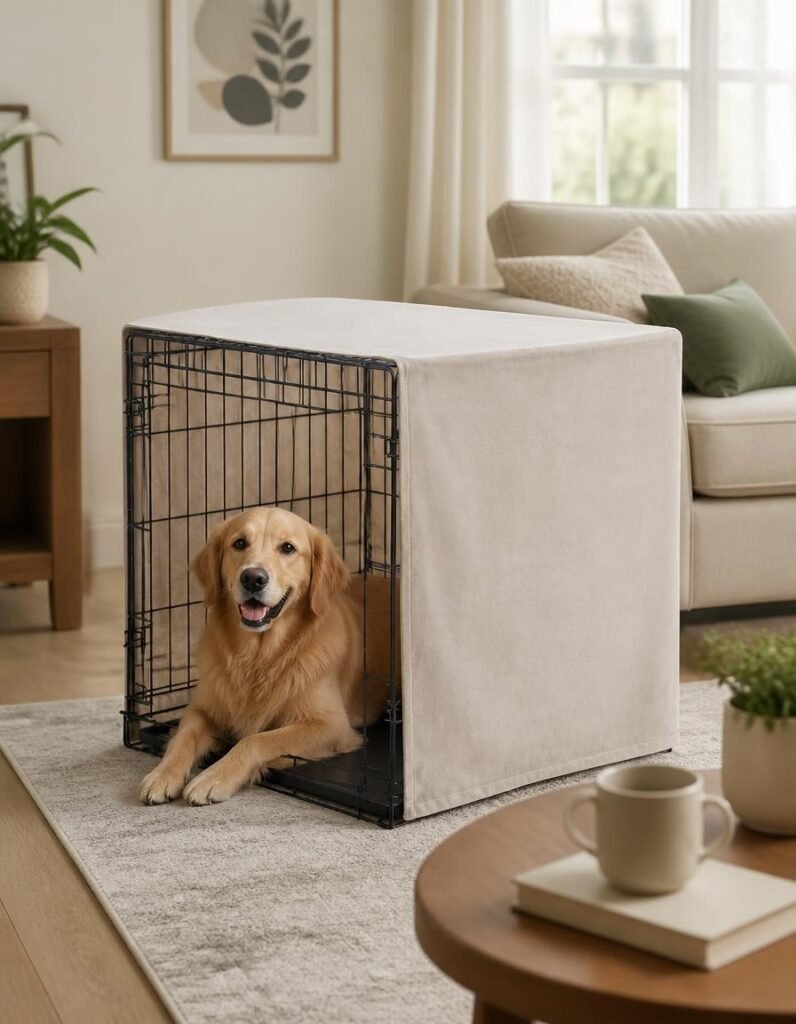
Not every crate sits in a living room. Plenty live in a garage, on a covered porch, in the back of a van, or beside a ring at a training day, and out there the job changes completely — wind, sun, and dust rather than airflow through a bedroom. This is the dog crate cover for that crate, and it is also the cheapest thing on this list.
Heavy polyester, roll-up panels on every side so one-, two-, and three-door crates all work, and toggles along the bottom that clip to the cage so a gust cannot lift it off. It has been tracked on Amazon since early 2020, which, in a category full of listings younger than the average puppy, counts for something.
Watch out for: do not bring this one indoors and drop it over the crate in your bedroom. The property that makes it good outside — heavy fabric that keeps weather out — is the same property that makes a coated dog crate cover a poor choice in a warm room. Right answer in one place, wrong answer in the other. And note that it shades a crate; it does not cool one.
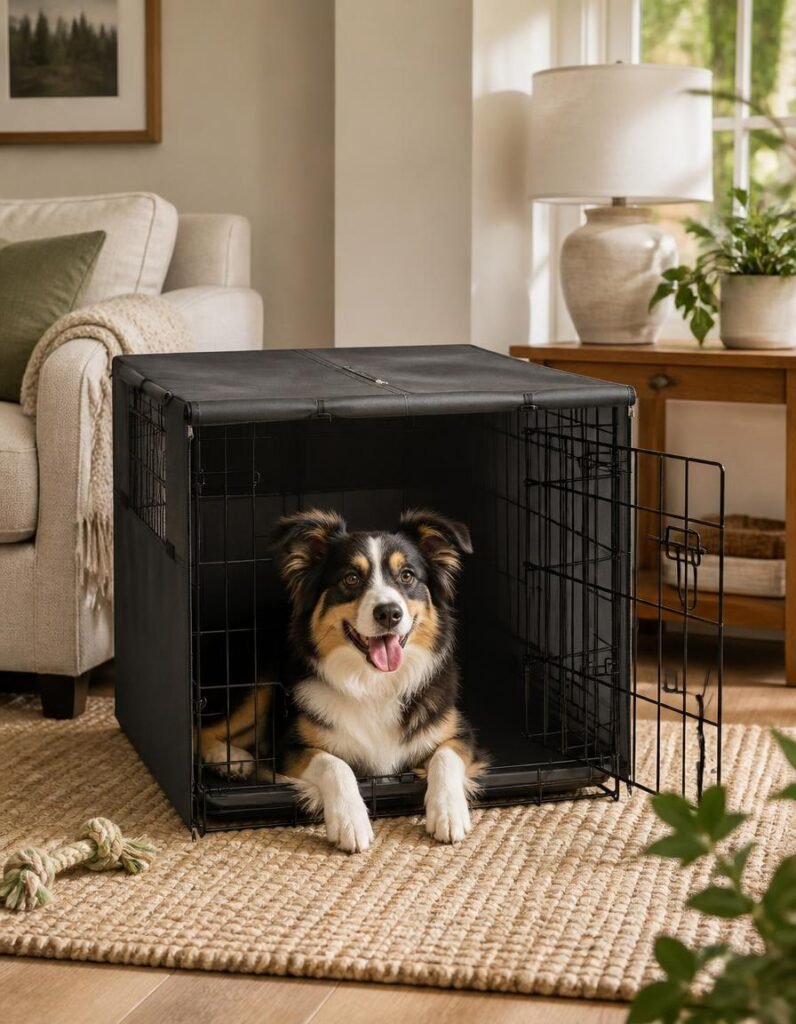
4. MidWest Polyester Privacy Cover, 42-inch — best for large crates
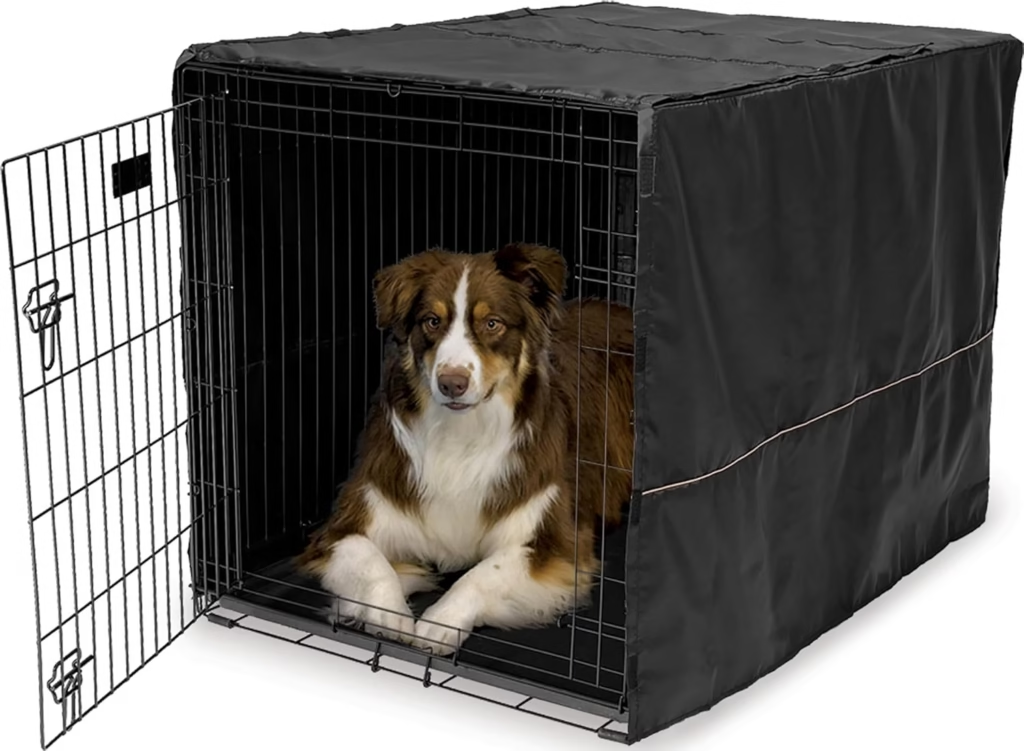
Large crates are where fit goes wrong most often, partly because the covers are bigger and drape further, and partly because a 42 or 48-inch crate is usually the only one in the house that sits somewhere awkward. This is the plain black polyester dog crate cover version of pick one, cut for 42-inch crates, and it has been listed since 2010 — a long time for a product that is essentially a rectangle of fabric to stay near the top of its category.
Same fitting method as pick one: over the top, Velcro tabs at the bottom, panels open for the doors. If you want it in poly-cotton with a pattern instead, the same size exists in the Teflon-treated designer print line.
Watch out for: a big crate under a big cover holds a lot of still air. This is the size where leaving a side genuinely open stops being advice and starts being the rule.
Why are there only two brands here
Four picks, two makers, and that is deliberate. Scroll the dog crate cover bestseller lists, and you will see the same rectangle of polyester sold under a dozen brand names nobody has heard of, at the same sizes, with the same roll-up panels. There is very little product here to differentiate — the decision is size, door layout, and fabric weight, not badge. So the sensible move is to buy from the two names with a long enough listing history that the size you order is the size that has been shipping for years.
One design does deserve a mention even though it is not a pick: Gorilla Grip’s crate covers have openable mesh windows at the front and back. That solves the exact problem this article keeps circling — how to check on your dog without unrolling the whole thing — and it is the feature we would most like to see on the picks above. We have not linked it because we could not confirm the listing details to the standard we hold ourselves to, but it is worth a look while you shop.
Using a cover without cooking the crate
Dogs shed heat by panting, which means they need moving air, and they need somewhere for the warm air to go. A crate with a dog crate cover over all four sides has neither. The rules are short:
- Leave at least one side fully open, and make it the front unless the front is what you are blocking.
- Check by hand. Twenty minutes after you cover it, put your hand inside. If it feels warmer or closer than the room, take a panel off.
- Watch the dog, not the cover. Panting, restlessness, or repeatedly moving to the open side all mean the same thing.
- Secure the fabric low and outside. Loose fabric hanging within reach gets pulled through the bars and chewed, which is a swallowed-fabric problem, not a laundry problem. If your dog is at that stage, our guide to chewing is more useful than any cover.
- Never cover a crate as a punishment. The crate has to stay in a place the dog chooses to go into, which is the whole basis of crate training.
In a genuinely warm room, the honest answer is that the cover is not the tool. Move the crate off the sunny wall, and if heat is the recurring problem, a cooling mat inside the crate does more than any fabric over the outside of it.
What to skip
- Waterproof 600D outdoor kennel covers, used indoors. They are built for a kennel run in the rain, and coating a fabric to stop water is also how you stop air. That is Pick Three’s territory and only Pick Three’s.
- Buying by your dog’s size. The cover fits the crate. Your dog’s weight has nothing to do with which one to order.
- Blackout as a headline feature. Useful if you sleep days; irrelevant to the barking problem most people are actually trying to solve, which is about a specific sightline rather than about darkness.
- A dog crate cover was bought to fix crate anxiety. If your dog is not comfortable in an uncovered crate, adding fabric changes nothing about why. Go back a step and rebuild the association with food and short sessions.
- Assuming a bare crate is the problem. Often what is missing is something to do in there — a stuffed toy or a lick mat — and a decent bed in the right size.
Frequently asked questions
Should I cover my dog’s crate at night?
If your dog wakes and reacts to headlights across the ceiling or movement in the hall, yes, covering the side facing the trigger is usually enough. If your dog already sleeps through, a dog crate cover is solving a problem you do not have. Watch the first few nights rather than assuming it helped.
Will a cover stop my dog from barking?
It can stop the barking that starts with something seen. It will not touch the barking that starts with something heard, and it does nothing for barking that is about being left alone. Shelters use visual barriers precisely because sight-triggered barking is the kind you can design out of a room.
Can I just use a blanket?
For a night or two, yes, and it is the sensible way to find out whether covering helps at all before spending anything. What a purpose-made dog crate cover buys you is that it stays where you put it, opens where the doors are, and does not hang in loose folds a dog can drag through the bars. A blanket that gets pulled inside and shredded is the failure mode.
How do I know if it is too hot in there?
Your hand is the instrument. Reach inside after twenty minutes and compare it to the room. Add the dog’s own signals — panting with the mouth wide, shifting to the open side, refusing to settle — and if any of those show up, take a panel off rather than adjusting anything else.
Which size do I order?
Measure your crate’s outside length, width, and height and buy the cover that matches those numbers, not the one that matches your dog. If the crate is nominally a 36 but measures something else, believe the tape. And if you are still choosing the crate itself, our guide to crate sizing comes first — get that right and the dog crate cover is the easy part.